
by YouTime Coaching | Sep 26, 2017 | Advice, Anxiety, Attitudes, boundaries, Children, Communication, Compromise, Consistency, Decisions, Emotions, Expectations, Failure, Fear, Fighting, Focus, Life Coaching, Listening, parenting, parents, positive reinforcement, Trust
As a parent, ever wonder what is going on inside your kid’s mind?
Through the positive work we have completed with adolescence, young adults, and families we’ve heard and seen almost everything. Kids want their freedom (sometimes without responsibility) and respect, while parents struggle with communication, setting boundaries, and timing.
Here are ten real thoughts direct from clients about their parents.
#1 I can’t talk to them because they will just get angry at me.
#2 All they care about are grades.
#3 They tell me to stop doing things that they do all the time and it’s bullshit.
#4 They won’t understand if I told them or will make me feel like it isn’t important.
#5 They choose when it’s convenient to say no and get upset.
#6 I don’t want to be like them.
#7 I tell them what they want to hear.
#8 When I actually try to talk to them about something that happened, I just get in trouble.
#9 When you start lecturing, I stop listening.
#10 When you trash my friends, I start disliking you, not them.
Remember, parenting is an imperfect process and so is being a kid. We are not sharing this list so you can take on all of the items one by one, instead, use it as a guide to see where more attention could be placed. When it comes to your kid’s motivation things can drastically change as they get older but if you’re able to adapt with the times, stay hip, and simultaneously hold true to healthy principles then this process could be easier on you.
Here’s just one easier way to think about motivation. Remember, in parenting, effort counts.
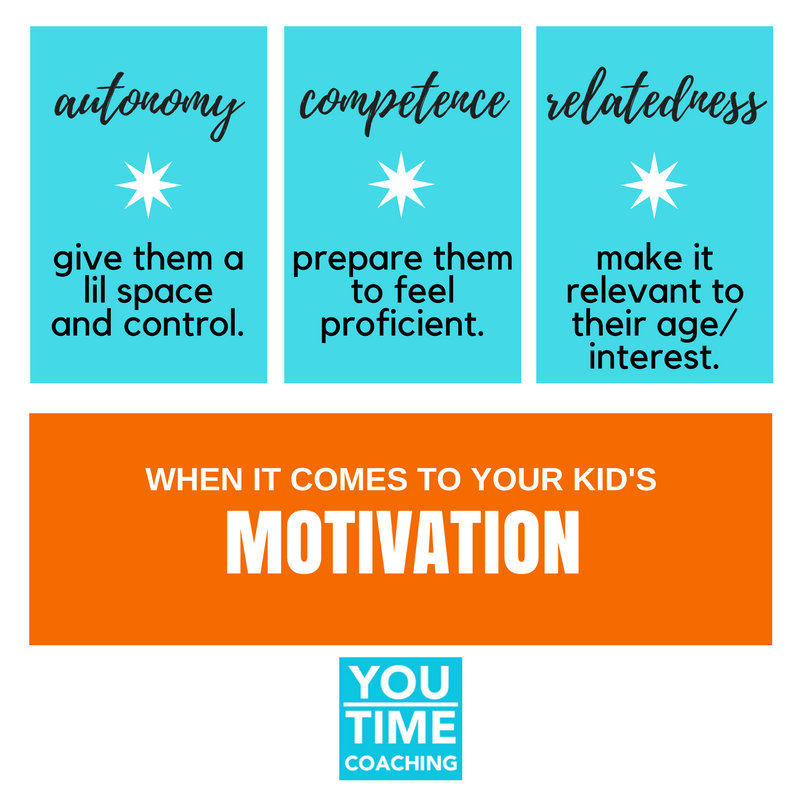
What goes into your kid’s motivation?
Just like when a kid doesn’t get their way, the thoughts kids have about their parents are changing by the minute. The importance behind these thoughts is where the focus should lay. Communication is typically always an underlying relationship issue between parents and kids. Check out these other blogs for helpful tips on communication with your teens, How to Love Your Kids When They Are Tough to Love and Do NOT Try to be Your Child’s Best Friend.
Feel free to leave comments below or on any of our social media pages to get a conversation going!

by YouTime Coaching | Sep 1, 2017 | Uncategorized
Oh boy, nothing makes me happier to hear somebody say, “I can’t do it”.
Sure, there’s a percentage of people who actually won’t be able to do “it” because of their skill level or how difficult the task is, but another big percentage of those people actually mean I won’t stick with it. These groups don’t need to be mutually exclusive and in fact, we have all been in both boats.
When you say that you “can’t” do something but actually have the skills and abilities to perform the task you are sending a mixed message to your brain. Typically the message is either fear or instant gratification based. When the message is fear-based but there is no threat of real danger then this will trigger a real fight or flight response (on false pretenses) and begin the pattern of convincing your brain that perceived fear is the same as actual danger.
Saying “I can’t do it” is quite a nice way of convincing yourself that whatever it is you’re trying to do you can’t actually do because of something outside of your control. It is also a nice way to completely screw up your rational way of thinking and can drastically limit you.
When people say they can’t do it, they really mean they won’t make time for it and don’t like the outcome when they try it. Let me introduce you to an important word:
RESILIENCE: The capacity to recover quickly from difficulties; toughness.
Those who master resilience tend to feel more in control of their lives, have healthier social support, maintain a healthy self-image/confidence, and can identify a greater sense of purpose. If you do not like the outcome, try again. If it doesn’t fill your expectations, try again. Quickly cutting yourself off because of some level of discomfort, pain, Vulnerability, boredom, or frustration severely cutting you off from opportunity and growth.
In this field, there is not a shortage of hearing excuses and fear-based rationales for why things don’t get done. Obviously, cultivating an environment of acceptance is important but at the same time, clear and “to-the-point” communication is sometimes most helpful.
Whoever is reading this, just know that you should stay away from accepting “I can’t do it” as a completely honest answer. Our minds, especially when driven by fear or instant gratification can convince us of pretty much anything.