
by YouTime Coaching | Mar 14, 2019 | Academics, Children, college, determination, Emotions, Focus, Motivation, parenting, parents, Support
Will your kid struggle as a freshman in college? Absolutely. Does the experience always need to be negative and feel like nothing good comes from it? Absolutely not.
When a kid is sent to college the exodus from being a child and living within their parent’s home to being a young adult truly begins. One major problem… teenagers being forced into an adult world, without being mentally equipped and prepared like an adult can lead to a lot of… [parents, fill in the blank]
Now Mom and Dad, please sit down and take three deep breathes because things are going to be alright.
Download our free parent assessment to see if your kid is truly
struggling and needs some additional support:
The Skinny On Your Freshman’s Struggle
Sure, your freshman kid could sustain some physical and emotional wounds during their college experience, but you kind of signed them up for it. Listen, all those nights you got on them for watching tv and making sure they started studying, the nights you made them their favorite dinner, those times you washed/dried their clothes (and probably folded), and the genuine efforts to hold to an 11pm curfew has all finally paid off.
They will have to do most or all of these things on their own now! [cue horror film music]
The question isn’t, “will my kid struggle?” it is, “how will they struggle and how will we respond?”.
To help you out a bit, here are some of the top re-occurring struggles for college students. I’ll include some pointers and a few “heads-up”.
[bctt tweet=”Kid struggling at school? Tweet us about it with the hashtag #thestruggleisreal” username=”@YouTimeCoaching”]
A FEW TOP COLLEGE STRUGGLES:
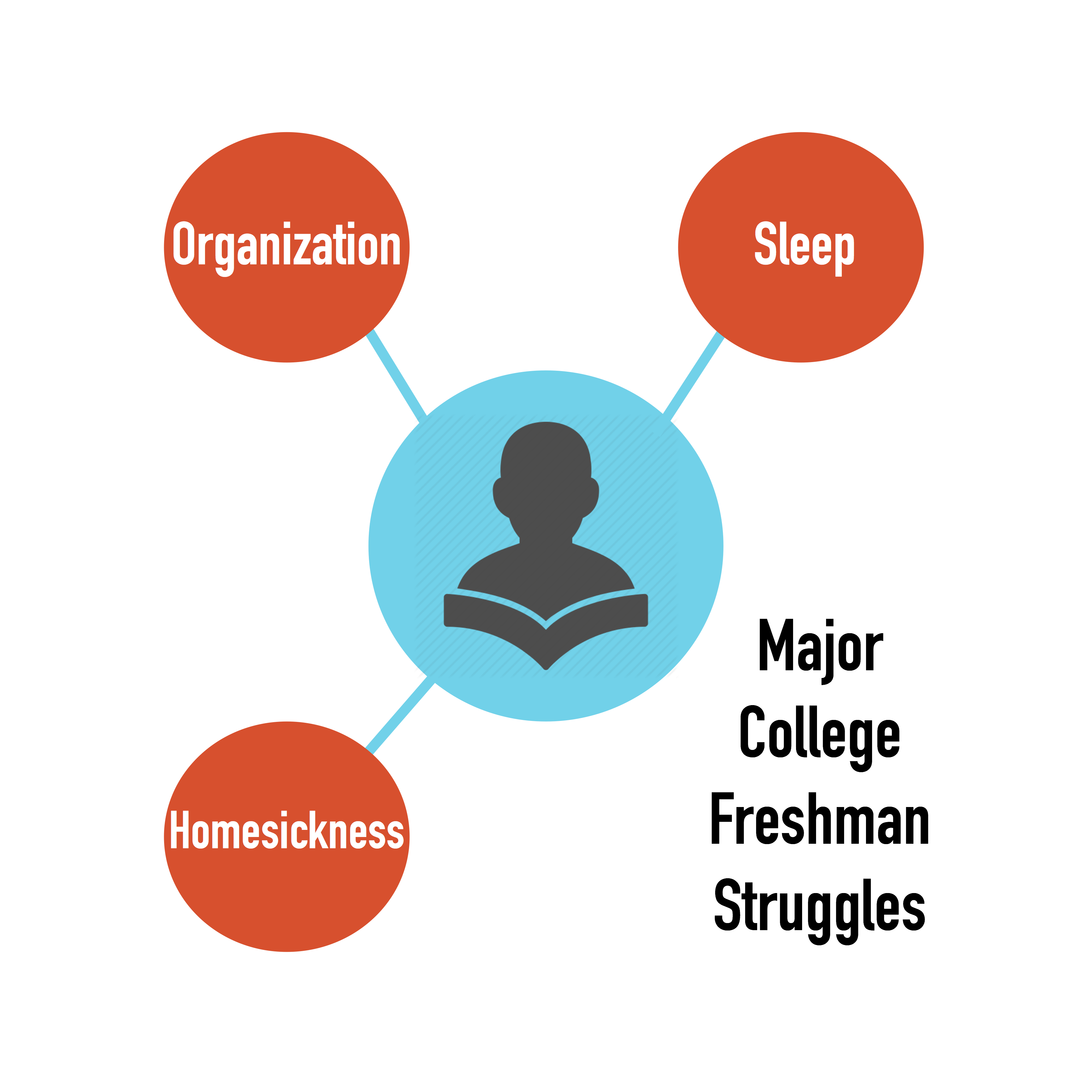 1. Homesickness
Some parents love the fact that their kid misses home, while also sympathizing with them. Keep in mind that homesickness is just as much about needs that are not being met at school as it is missing what they used to have. When you do get the coveted phone call from your freshman kid at school, listen to them closely and just maybe you will be able to see if their homesickness is a result of having challenging classes, finding it hard to connect with others, or if they simply want a care package mailed to them (always a winner).
2. Organization
College is typically more demanding than high-school in terms of work and very frequently much less structured in terms of homework/study time. This transition can be challenging for freshman and It is common to see a slip in grades because of this in addition to managing all their new freedoms. From frequently losing their cell phone or homework to their train of thought, organization can impact both physical and mental arenas. If your freshman kid shows signs of struggle with their organization skills, don’t panic. Together, look into a coaching program like www.YouTimeCoach.com and/or looking into the schools learning center services.
3. Sleep
When we are the ones lacking sleep, it is easy to notice the difference. Freshmen in college have this notion that they must perform at least 4 all-nighters the first semester, set a world record for cups of coffee or red bulls in a night, and put their ZZZ’s on the back burner. The reason behind this could be school work, a noisy environment, health issues, or higher priorities (pretty much everything). The college experience has so much to offer a freshman student, but this can create some priority confusion and FOMO (fear of missing out). A little trick, as your kid comes back for the holiday, take note of their sleep patterns. Typically the kids pulling late night study (or party) sessions will sleep in pretty late the first few nights home.
Keep these pieces of information handy for when your kid shows signs and symptoms of struggle. The best thing you can do for your kid is to be supportive, actively listen to them, empathize, and practice the skill of being non-judgmental. The pay off will be far greater than reacting through fear and anxiety.
Any questions regarding your kid, college, and their struggles?
Please email [email protected] or go to www.YouTimeCoach.com and click on the “Hire Us” page.

by YouTime Coaching | May 19, 2017 | Advice, Appreciation, Behavior, Benefit, boundaries, Children, Communication, Direction, Dreams, Growth, Human Needs, Insight, Kids, parenting, parents, Positive Psychology, positive reinforcement, Support, Teenagers, Understanding
Kids can be a pain in the ass sometimes.
Harsh words? Maybe. One thing is for sure though, those words are definitely filled to the brim with truth… harsh truth. This isn’t taking away from your unconditional love for them, it’s simply acknowledging that kids can sometimes do things that are very tough to love.
This is why parents turn to advice from others, seek out simple solutions, and time hacks. Sometimes it isn’t all that easy and you give into your frustrations, irritations, and anger. As parents, you are teachers, EVEN WHEN IT SEEMS YOUR KID DOES NOT WANT TO LEARN FROM YOU. Because the eyes are always on you, the advice you get absolutely needs to be solid.
YouTime Coaching’s extensive work with high-school and college students along with all of the hours worth of support for parents has allowed us to understand some keys elements in how to be a great teacher for your child even during those tough times. When it comes down to it, a child wants to understand, perceive they have some control, and feel supported in a non-judgmental way.
The hardest times to be a “good teacher” with your kids? (never thought you’d ask!)
Just to mention a few:
- when setting boundaries
- when you are angry, frustrated, or irritated (and sometimes hungry)
- when parents are on different pages
- when you feel as though your child is not listening
- when “nothing else seems to work”
- when your kid is an adolescent
- anytime
We don’t want you to be good teachers… we want you to be in many cases the kind of teacher “you wish you had growing up”, the kind of teacher that is more emotionally available than some families had in previous generations, and most importantly we want you to be the type of teacher that not only shows but explains the benefits in learning from failures, how to be compassionate to yourself and others, and have enough awareness/knowledge about what they are doing and why they are doing it.
For these reasons and with an entire year of putting together some of the most effective researched methods of teaching, motivation, and human behavior we have creating the “R.I.S.E. Method of Parent Teaching”.
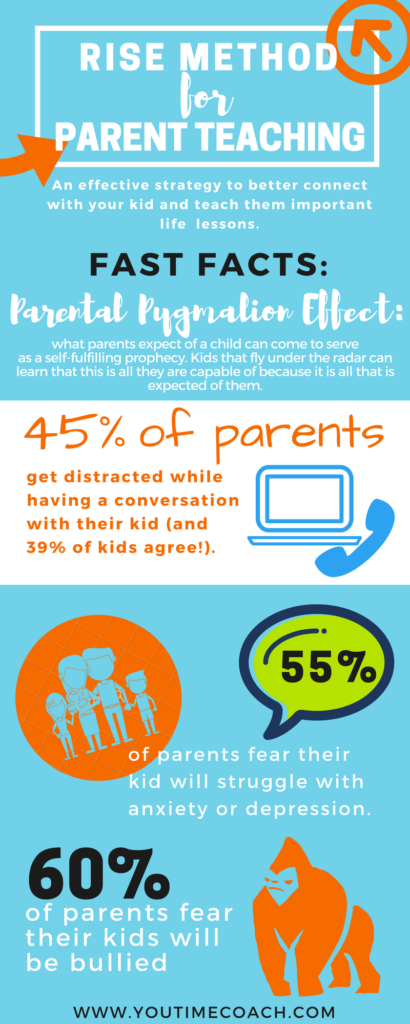
The premise behind the acronym “R.I.S.E.” is for parents to use the powers of awareness, communication, non-judgmental support, and compassion as a way to elevate their parenting and ultimately their relationship with their child.
Use can use this method while trying to set boundaries with your children, teach them important lessons, disciplining (btw before disciplining your kid read this amazing article, https://www.verywell.com/what-is-child-discipline-620113), and even just trying to improve your communication with them.
Remember, punishment is easy, discipline is hard. Implementing this method may be challenging and outside your comfort zone, if you need some guidance please drop us a line!
DOWNLOAD THE R.I.S.E. METHOD HERE.
by YouTime Coaching | May 21, 2014 | Change, happiness, Positive, Self-Change, Stages of Change, Support, Tracking Progress
The “Self-Help” field is a multi-billion dollar a year industry. By the figures alone, most people are consistently trying to improve themselves, experience change, and accomplish goals.
There is potential for significant harm when simply picking up a self-help book in the local bookstore. Here is a great clip of
Dr. John Norcross (one of the leading researchers in personal and professional change), sharing how there are actually only a couple, literally, a couple resources out there proven to work and how others can cause serious harm to you.
If you skipped down to this before watching the clip, don’t try taking a short-cut (that may say something about how you also approach your own personal and professional change). Go back and watch it.
Okay, so you have watched the clip and I want to now provide you with what I believe are 3 of the most important researched and proven to work strategies that will be vital to any self-change.
Strategy 1:
“Nobody wants to achieve the negative”
Imagine setting a goal, such as,
“I want to stop procrastinating”
“I want to not overeat”
“I want to stop being attracted to jerks”
“I don’t want to work a miserable job”
Does this sound all too familiar?
A huge number of individuals fall short in a fundamental piece to goal setting, which is, DO NOT SET NEGATIVE GOALS. Nobody wants to achieve a negative goal or move forward with it.
Almost sounds conflicting…”I am going to achieve and make progress with the negative”
When setting your goal, make sure to set it in a “positive-frame” rather than a “negative frame”. I will list some examples.
“I will stop procrastinating” (negative frame)
“i will be more pro-active and assertive” (positive frame)
“I don’t want to overeat” (negative frame)
“I will be more mindful and conscious regarding my meals” (positive frame)
Moving towards something positive and something “gained” has a far more positive impact then trying to “avoid the negative” or “delete” something out of your life. The “positive frame” will help with your mental and physical endurance while pursuing the goal!
![]()
Strategy 2:
“Nobody wants to be alone”
Sure we all want to think that we can make changes, reach goals, and live amazing lives all by ourselves. As much as this sounds nice and empowering, research shows that it is absolutely necessary to have a support team along the way.
Your social support team will not only help you progress with your goals, but is actually a huge factor in an individuals happiness!
This is what you need to do.
- Make a list of specific ways you need support in achieving your change.
- Number the specific ways so you know exactly how many people you need on your “team”.
- Start fielding a team by contacting people you know and specifically asking for their help in the way that you need it. (remember that some may not be comfortable, knowledgeable, or willing to help out for many reasons. It is important you are clear with them about what you are trying to accomplish and ask them if they can support you in that way)
- Keep your team updated throughout the process and stay connected! (communicate with them if you need check ins, help with accountability…etc)
Things to think about regarding support:
- There are different types of support, so different people should be included as each person offers something new.
- Some people aren’t able to provide the support you need, so be clear with them about your needs and respect if they aren’t able to help out.
- You are not looking for friends and family to coach you. Many people would like to add their “5 cents” to the conversation. This is not the support you are looking for. That support comes from a trained and experienced Life Coach.
Strategy 3:
“If you take steps backwards, you will want to stop walking”
So you establish a specific, attainable, realistic, and timely goal that is in line with your values, now what?
One of the pieces I purposely left out of the above equation is making your goal “measurable”.
You MUST find ways to measure your progress.
Research shows that measuring progress can increase your self-confidence, motivation to continue, and happiness. On a simple level, take a second and think about why anybody would desire to continue pursuing something that you are not showing improvement or making progress on.
Truth is, they don’t want to continue!
In this day and age, technology can be your friend and help you track progress. Here is a link that will provide apps that help you track progress on numerous types of goals.
![]()
YouTime Coaching provides Life Coaching and Therapeutic Mentoring to individuals and families. YouTime Coaching works side by side with individuals to help create direction, passion, and produce lasting personal and professional change. Together we create an environment for clients that truly delivers the necessary “YOU” time needed to regain focus, motivation, and the desire to grow. Together, we will discover what truly motivates and drives your most successful decisions and behaviors.
YouTime Coaching will help define your goals, support systems, purpose and value to change, help find multiple ways of achieving it, and make the necessary shifts in body, language, and focus to get you there. Through working with a diverse population of clients, YouTime Coaching has successfully helped many adolescents, adults, parents, athletes, and those in the performing arts with building resiliency, motivation, confidence, and lasting personal and professional change.
by YouTime Coaching | May 9, 2013 | Beliefs, Boston Marathon, Boston Strong, Confidence, Connections, Distress, Fear, Growth, Post Traumatic Growth, Post Traumatic Stress, Stress, Success, Support, The One Fund
In light of the recent bombings at the Boston Marathon and the massive numbers of individuals returning from war, our culture has become all too familiar with the term “post traumatic stress”. What most people are not as familiar with is the concept of
“Post Traumatic Growth”
Research involving individuals and their relationship to stress, pain, fear, and trauma have been around for thousands of years but the interest in Post Traumatic Growth began to steal some of the limelight in the 1990’s.
Post Traumatic Growth involves an individual’s path in adapting to sets of negative experiences that would normally cause psychological distress or harm. These events could include experiences with death, abuse, serious injury, natural disasters, relationships, accidents, and other potentially traumatic events.
Simply looking at this list you can understand why some individuals experience post traumatic stress.
BUT
What if there were a way to experience growth following traumatic events like those mentioned above?
Post Traumatic Growth Characteristics:
- Greater appreciation for life
- Shift in sense of priorities
- More genuine connections and relationships
- Increase sense of personal strength
- Recognition of new life paths and possibilities
Are you sold yet?
How can I get some Post Traumatic Growth?
1. First, you must have a belief system that supports growth.
Spirituality is a characteristic that has been closely linked to experiencing post traumatic growth, but the core concept behind this connection are the empowering beliefs a spiritual individual may possess.
Keep these in mind:
BELIEVE that you can grow from this
and
You are capable of this change.
2. You must have support
Support systems have been linked in post traumatic growth on many levels. Therapists, counselors, and life coaches (with proper training) can have great impacts on your ability to experience this growth, post traumatic event.
Surround yourself with genuine, insightful, and caring individuals that you feel comfortable sharing your life with. This could be the difference between growth and stress.
Conclusion:
- Be confident and open to being able to grow
- Develop a belief system that empowers and supports you in experiencing growth.
- Seek out opportunity to develop new genuine relationships and connections.
- Sniff out your most precious support systems and use them.
Lastly,
During the Boston Marathon I was watching the race in Kenmore Square (15 minute walk to the finish line), when I had heard what happened followed by a massive number of text messages, phone calls, and emails making sure I was okay. I want to thank those individuals and extend my heart and support to the families that were affected by these horrible events.
There is hope and there is strength within you to grow from this. Never loose sight of that.
All the best,
Jonathan B. Wolf, Ed.M.
Vitality, Performance, and Parent Coach
YouTime Coaching
Boston, MA
Contact:
[email protected]
(856)905-5410
If you would like to donate to The One Fund click the ribbon above: