
by YouTime Coaching | May 19, 2017 | Advice, Appreciation, Behavior, Benefit, boundaries, Children, Communication, Direction, Dreams, Growth, Human Needs, Insight, Kids, parenting, parents, Positive Psychology, positive reinforcement, Support, Teenagers, Understanding
Kids can be a pain in the ass sometimes.
Harsh words? Maybe. One thing is for sure though, those words are definitely filled to the brim with truth… harsh truth. This isn’t taking away from your unconditional love for them, it’s simply acknowledging that kids can sometimes do things that are very tough to love.
This is why parents turn to advice from others, seek out simple solutions, and time hacks. Sometimes it isn’t all that easy and you give into your frustrations, irritations, and anger. As parents, you are teachers, EVEN WHEN IT SEEMS YOUR KID DOES NOT WANT TO LEARN FROM YOU. Because the eyes are always on you, the advice you get absolutely needs to be solid.
YouTime Coaching’s extensive work with high-school and college students along with all of the hours worth of support for parents has allowed us to understand some keys elements in how to be a great teacher for your child even during those tough times. When it comes down to it, a child wants to understand, perceive they have some control, and feel supported in a non-judgmental way.
The hardest times to be a “good teacher” with your kids? (never thought you’d ask!)
Just to mention a few:
- when setting boundaries
- when you are angry, frustrated, or irritated (and sometimes hungry)
- when parents are on different pages
- when you feel as though your child is not listening
- when “nothing else seems to work”
- when your kid is an adolescent
- anytime
We don’t want you to be good teachers… we want you to be in many cases the kind of teacher “you wish you had growing up”, the kind of teacher that is more emotionally available than some families had in previous generations, and most importantly we want you to be the type of teacher that not only shows but explains the benefits in learning from failures, how to be compassionate to yourself and others, and have enough awareness/knowledge about what they are doing and why they are doing it.
For these reasons and with an entire year of putting together some of the most effective researched methods of teaching, motivation, and human behavior we have creating the “R.I.S.E. Method of Parent Teaching”.
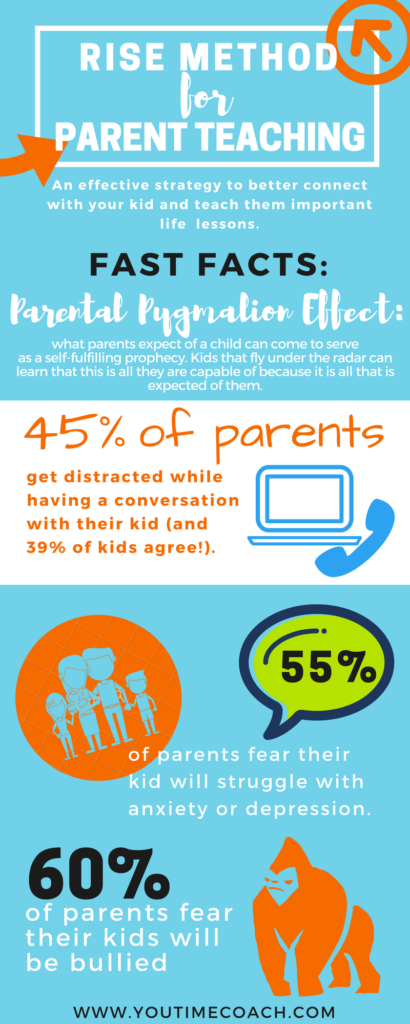
The premise behind the acronym “R.I.S.E.” is for parents to use the powers of awareness, communication, non-judgmental support, and compassion as a way to elevate their parenting and ultimately their relationship with their child.
Use can use this method while trying to set boundaries with your children, teach them important lessons, disciplining (btw before disciplining your kid read this amazing article, https://www.verywell.com/what-is-child-discipline-620113), and even just trying to improve your communication with them.
Remember, punishment is easy, discipline is hard. Implementing this method may be challenging and outside your comfort zone, if you need some guidance please drop us a line!
DOWNLOAD THE R.I.S.E. METHOD HERE.

by YouTime Coaching | Mar 2, 2017 | Academics, Advice, Beliefs, Benefit, college, Decisions, high school, Preparation, steps, Success
A gap year is a year that students take between high school and college, usually doing some sort of structured, non-academic activity.
Sounds nuts. Why would anyone do this?
The reasons are many, but here are a few of the more common ones:
- A student is academically burnt out and needs a break from academics to recharge
- A student doesn’t yet have the maturity to succeed in college (did you know that the male brain and executive functioning capacity doesn’t fully mature until the late 20’s?!)
- A student has a passion that they want to pursue prior to college
- A student’s not that into the idea of college, (or parents aren’t that into the idea of dropping $200K on a “meh, I guess I’ll go” response)
- A student wants to gain more experience to then be able to make the best of college
- A student feels like they need another go at the college admissions process
Thinking the gap year might be right for your student? Here are some pros and cons to consider.
GAP YEAR: Pros
- According to an Australian study published in August in the Journal of Educational Psychology, taking a gap year is linked to higher motivation in college.
- Taking a structured Gap Year invariably serves to develop the individual into a more focused student with a better sense of purpose and engagement in the world.
- According to American Gap Association statistics, taking a gap year helped focus student academic and career paths: 84% say it helped them acquire skills to be successful in future careers, and 73% say the experience increased their college readiness.
GAP YEAR: Cons
- Some students may view the gap year as a vacation. Without a clear plan, the gap year can pass by without doing much positive good for your student. If your student isn’t willing to put in the work to plan a productive gap year, then they shouldn’t take one.
- Financial concerns can impact a student’s gap year. Not every parent can support their children completely during the gap year. Your student may need to work, or they may be able to secure a scholarship or grant from a gap year program or college.
Common Concerns
Even after discussing the pros and cons of a gap year, I typically hear three major concerns from parents:
- “Next year, my student will be ‘too old’ for college.” College isn’t high school: a college classroom often includes both lower- and upperclassmen, sometimes with graduate students or non-traditional students mixed in. Age is rarely an issue, especially a single year.
- “How do I know my student will go back to school?” This is one of my favorite excuses, because the best counter-argument is simply to wait until they work a full-time job. After 40-hour work weeks, most teenagers will beg to go back to school! In fact, according to a study, 90% of students who took a gap year ended up going back to school within a year. If you’re still concerned that your student may “drop out”, it may be wise to gain admission to a college that will allow a deferral enrollment for the following year.
- “Why should my student wait if s/he is ready now?” Adapting to a new set of academic and social responsibilities is not easy for everyone; the first semester of college is often a difficult transition. It can be fun and fulfilling to tackle these responsibilities on your own schedule, without the added burden of a strict class schedule, the stress of dorm living, or tuition. Your student may be ready intellectually now, but a gap year will likely leave them extremely prepared, not just ready.
If your student is considering a gap year, I always stress a well-rounded and structured approach, with an emphasis on personal growth. For example:
Summer: Apply for summer employment and begin planning for your upcoming fall.
September–January: You may want to participate in academic, social, and career enrichment opportunities specifically designed for gap years; some great places to find these opportunities are:
February–June:
- Apply for a job with the skills you learned from the fall, intern at a potential future workplace, or take a course at your local community college.
- You can also travel, especially if you needed the fall to help you save up for your trip.
July–September: Continue any of the opportunities you’ve started over the past year. Don’t forget to take time to relax and connect with friends!
The above plan is designed to help your student begin college after a gap year with a set of advantages: a rested mind, additional education (potentially in both the academic and career arenas), increased confidence from spending time in “the real world,” and an extra year of overall maturity. Too often, we allow personal growth to happen while we’re busy with other things. But especially during key transition times, the self should be the priority. Imagine how much more a student with a clear sense of passion and purpose can get out of the college experience!
Remember: college is ultimately about your student becoming their own person. Deferring enrollment until after a gap year can be a very rewarding stage on this personal journey, but only if it’s the right fit for your student!

Jay Bacrania CEO & Co-Founder of Signet Education
This blog was written by Signet Education’s CEO & Co-Founder, Jay Bacrania with assistance from Signet tutor, Matt Grzecki. Jay has worked extensively with both special needs and high achieving students. He has taken a broad academic path that spans the sciences and humanities. Jay holds an BA in Comparative Study of Religion from Harvard University and attended Berklee College of Music for two years for Jazz Trumpet Performance. Beyond tutoring, Jay is interested in managing and refining Signet Education. You can almost always bet on finding him there at all hours, teaching or finding ways to make Signet even better!
Signet Education provides exceptional individualized tutoring, test prep, admissions consulting, and organizational coaching for students.
by YouTime Coaching | Feb 7, 2014 | Abuse, Benefit, Fear, Healthy, Positive, Reaction, steps, Tolerate
On Pinterest you can find nearly anything. From wedding ideas, workout routines, recipes, cute animal pictures, to quotes. If I had a specialty on Pinterest it would be finding unique, meaningful, and stimulating quotes to sit down and really think about (maybe even do something about). I know half of the population on social media believes, they are the quote gurus! I say, there can be many gurus.
I came across a quote a while back,
After reading this I thought for a moment about myself and some of the things that I allow to “slide by” throughout my day and week. What really grabbed me though, as seen through the work I do with clients, is that people tolerate very toxic things in their lives.
“Examine what you tolerate”. In other words, take a deeper look at what things you allow to exist, occur, and be done within your own life that you have convinced yourself are for your best interest. i
Individuals choose to tolerate a wide range of things in their lives that are believed to be for your benefit but are actually toxic to your life.
Major “tolerated” toxic events;
- Having friends that put you down
- Being lied to frequently
- Being in a relationship that is abusive (verbal, physical, sexually, and neglectful)
- Negative treatment because “you are not good enough”
- Bullying because “you deserve it”
- Consistently giving up on going to the gym or your diet because it “won’t make a difference”
- Bad habits (tolerated by the individual with the habit and others in their environment)
People tolerate all types of things as result of low self-worth and image, fear of others reactions, fear of “not being good enough”, fear of “the unknown and uncertainty”, the perceived consequences of not tolerating the event, and conditioning to tolerate these events from prior relationships.
This month set-up an appointment with yourself for a real gut check. Ask yourself what types of things do you tolerate that may be limiting you and why do you tolerate them?
We all have our faults, imperfections, bad habits, and things to work on. Let’s start by being your own detective and asking these four questions.
- What are the incredibly obvious things I tolerate in my life right now?
- What are the tougher, more painful, and complicated pieces that you tolerate in your life? (true gut check)
- What is the cost of continuing to tolerate these things?
- What is the benefit of taking steps to stop tolerating these events?
When working on some of the events I have mentioned above you want to be under the supervision of a trained Mental Health Professional. If you feel as though this is the time make some of those changes use the link below.