by YouTime Coaching | Sep 26, 2017 | Advice, Anxiety, Attitudes, boundaries, Children, Communication, Compromise, Consistency, Decisions, Emotions, Expectations, Failure, Fear, Fighting, Focus, Life Coaching, Listening, parenting, parents, positive reinforcement, Trust
As a parent, ever wonder what is going on inside your kid’s mind?
Through the positive work we have completed with adolescence, young adults, and families we’ve heard and seen almost everything. Kids want their freedom (sometimes without responsibility) and respect, while parents struggle with communication, setting boundaries, and timing.
Here are ten real thoughts direct from clients about their parents.
#1 I can’t talk to them because they will just get angry at me.
#2 All they care about are grades.
#3 They tell me to stop doing things that they do all the time and it’s bullshit.
#4 They won’t understand if I told them or will make me feel like it isn’t important.
#5 They choose when it’s convenient to say no and get upset.
#6 I don’t want to be like them.
#7 I tell them what they want to hear.
#8 When I actually try to talk to them about something that happened, I just get in trouble.
#9 When you start lecturing, I stop listening.
#10 When you trash my friends, I start disliking you, not them.
Remember, parenting is an imperfect process and so is being a kid. We are not sharing this list so you can take on all of the items one by one, instead, use it as a guide to see where more attention could be placed. When it comes to your kid’s motivation things can drastically change as they get older but if you’re able to adapt with the times, stay hip, and simultaneously hold true to healthy principles then this process could be easier on you.
Here’s just one easier way to think about motivation. Remember, in parenting, effort counts.
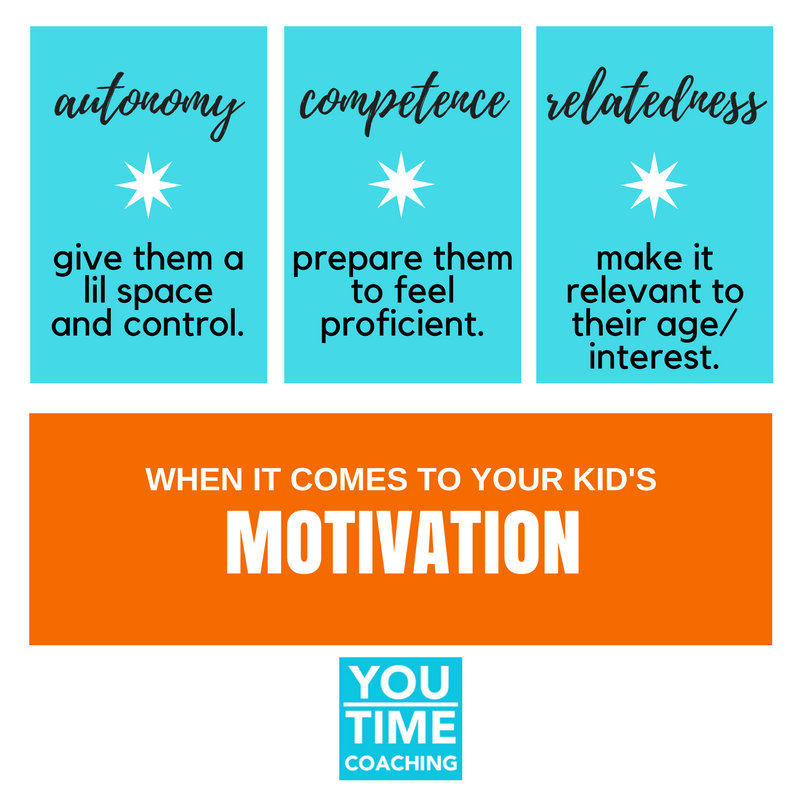
What goes into your kid’s motivation?
Just like when a kid doesn’t get their way, the thoughts kids have about their parents are changing by the minute. The importance behind these thoughts is where the focus should lay. Communication is typically always an underlying relationship issue between parents and kids. Check out these other blogs for helpful tips on communication with your teens, How to Love Your Kids When They Are Tough to Love and Do NOT Try to be Your Child’s Best Friend.
Feel free to leave comments below or on any of our social media pages to get a conversation going!

by YouTime Coaching | May 12, 2017 | Anxiety, Behavior, Children, Depression, Distress, emotional problems, high school, Kids, Listening, parenting, Teenagers
Part II: From the Parent’s Perspective
In Part I, we met Emma, the brave high-school girl that traveled down the bumpy road towards self-acceptance. Through all of the anxiety, depression, and frustration of trying to understand “who she really is”, Emma found a way to finally accept the things she struggled with in life. Go ahead and get a refresher, or just read Part I for the first time here.
As a parent, seeing your child struggle can be heart wrenching. Some parents want to swoop in to help ease the discomfort (both yours and your child’s), while others may think these are “necessary learning experiences”. Many parents though are not even aware of how they respond to these types of conflicts (btw if you are curious to learn more about your conflict style, find out more through this assessment YouTime Coaching Conflict Mode Assessment)

As a parent one of the most impactful things you can do is be present for your child. Not passive, avoidant, accommodating, but present. Whether your 50 years old or 15, we all have the same needs (we just may meet them differently).
A parent’s own fear, insecurity, anger, and even sadness can prevent them from being fully present for their kids when they may need it the most. The symptoms of struggle for a young person may not be blatantly obvious, which makes being present, aware, and appropriately involved that much more important.
In our interview, Emma’s mother (Kate) shares a little bit about her experience during the time that her daughter was trying to “figure it all out”.
YouTime: When did you realize that your child had challenges that affected her everyday life?
Kate: When she was around nine we noticed challenges with school work. When she hit middle school the social challenges began to appear more than ever and the insecurities controlled her.
YouTime: What was the evaluation and assessment process like for you and your child?
Kate: When she was in the third grade her school contacted us regarding her inability to pay attention. She had no idea what that meant and thought nothing of it, she was a typical happy child and as for myself, I instantly went into denial because my daughter was “perfect”, it was the teacher right?! It was NOT my child with the issue. I was very defensive and protective… Eventually, I agreed to have her tested for ADHD and with research and family support I realized that even with ADHD she is still “perfect”. The real challenge began in middle school when the depression and the anxiety took control of her. It was and still is very trying at times and has had a major effect on our family and relationship with parents of her peers.
YouTime: What were some of the biggest frustrations for you as a parent?
Kate: My biggest frustration had to be adjusting in how I helped her with school work or approach personal situations when talking to her. The mom in me wants to yell “just finish the work, sit still, why can’t you do this, who cares what people think….”. But I know I can’t approach her like that if I want her to remain open and talk to me. She shuts down when I appear frustrated and withdraws herself. I have learned to not react before I think and to try to understand that she thinks and how she learns differently than I do.
YouTime: Did you have any strategies for maintaining a balanced mind during this time period?
Kate: Prayer. I do not know another honest way to answer that question. I know there are those who would answer differently but for me that is the only strategy I have had.
YouTime: What do you attribute most for the positivity in your relationship with your daughter now?
Kate: I do not make her feel like she is anything less than perfect to me and that her ADHD, reading disorder, depression and anxiety are all things that make her even more perfect. I have done my best to help her see these traits as gifts in one way or another. I fail daily, I am not a perfect parent but making notes with reminders on them all around the house for her, simply reminding her at lunch with a text telling her to remember certain things and not making her feel like I am annoyed by her inability to stay on task or hold friendships at school.
YouTime Coaching Take Home:
Take this page straight out of Kate’s book, “I fail daily, I am not a perfect parent…”
Parenting an adolescent is quite a challenging task, let alone having to continue managing the things going on in your own life. This is a beautiful example of how appropriate parental support, involvement, and mindfulness can have a major positive impact on a young person’s life.
If you or anyone you know could use some support in being more present for your kids send us over some of your thoughts and questions.

by YouTime Coaching | Apr 26, 2017 | Anxiety, Behavior, Brain, Children, Depression, Distress, emotional problems, high school, Kids, Listening, parenting, Teenagers |
Part I: Emma’s Perspective
Most of us can remember during our teenage years the mundane writing assignments gifted to us by our teachers (not always their fault). They asked you to write essays “discussing the role of family in To Kill a Mockingbird, paying close attention to Aunt Alexandra.” or “from Steinbeck’s, Of Mice and Men, please discuss his descriptions of the natural world. What role does nature play in the novella’s symbolism?”.
Memory refreshed? Okay good, I’ll stop.
In most cases, the teachers will typically receive 3-4 variations of the same essay, coming from very similar perspectives. Reading these staple books, understanding their overarching themes and processing what it means to our current reality is quite useful. Yet still, during such a crucial time of physical and emotional growth for adolescents there is no replacement for a chance to write about something personal, of deep meaning, and most importantly brutal honesty.
So with all of this in consideration, what happens when you ask a teenager a more potentially vulnerable, subjective, and open-ended question to write an essay on? For example…

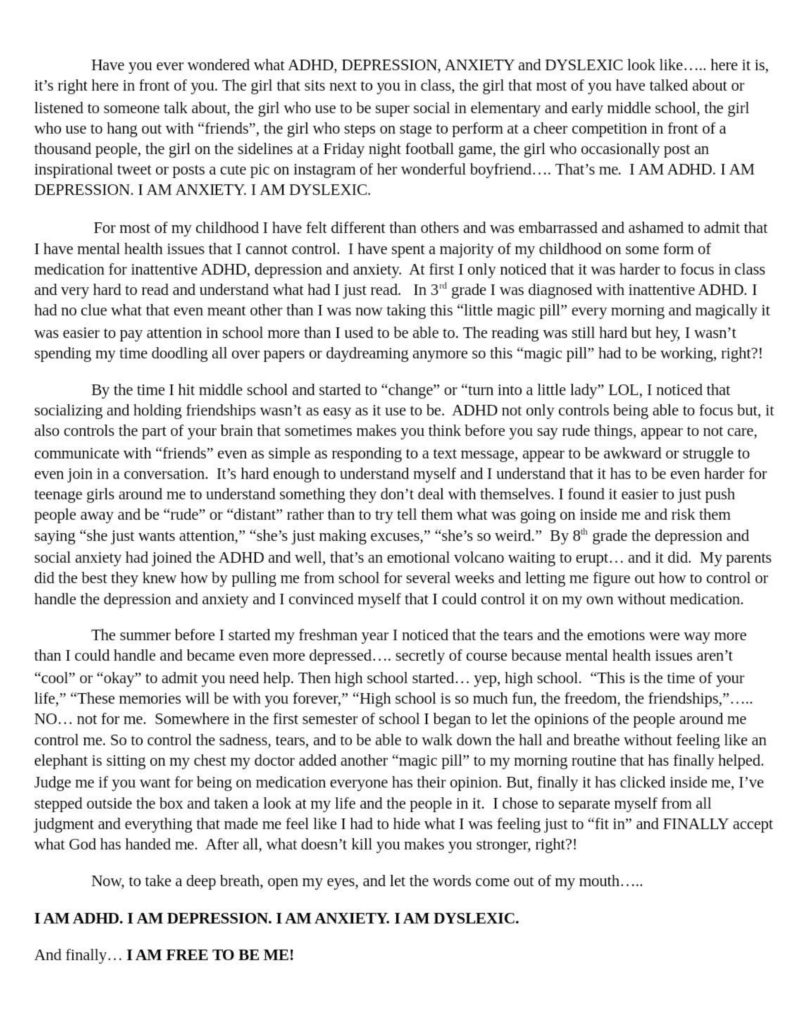
This leads us to Emma. On paper, Emma may sound like any ordinary high-school student. In reality, she is much more. Her personal journey towards self-acceptance is inspiring and can hopefully resonate with other kids the same age.
Here is Emma’s essay:
 Amazing, huh?
We were able to snag some more of Emma’s time and ask her a few questions.
YouTime Coaching: Do you remember a moment when you realized things were “different” for you?
Emma: In elementary school things were easy and kids didn’t see me any different. Middle school is when I would say I started to realize that I could not complete things as fast or as easily as the other kids around me and I started to notice that I would say things without thinking, I would struggle to fit in with conversations my friends were have or when I would say something they would say “that isn’t even what we were talking about or that is stupid” and they were right, I found myself just saying random things to fit in. Eventually, I stopped talking in fear of sounding stupid or them laughing.
YouTime Coaching: What were some of your biggest frustrations during this process of understanding for you?
Emma: I would say my biggest frustrations are probably feeling so lonely and feeling like I will never find anyone that understands me. I am in high school now and teenagers are cruel, to be honest. Walking into a classroom and fearing the teacher will ask me to read out loud, walking into the lunchroom seeing all my old friends that I am no longer friends with because I did not know how to be a friend so to say… those are some of my biggest frustrations with myself.
YouTime Coaching: Who and what did you find most helpful in making some of the challenges more manageable?
Emma: My parents are so supportive and I know it has been so hard on them. I would say my mom has helped me more than anyone over the years. She has provided me with any ounce of information on ADHD, depression, anxiety, and dyslexia that she can find to help me understand what is going on with me. I would also say having a parent that is so motivated to educate herself in understanding me has been my biggest help.
YouTime Coaching: If you had a couple pieces of advice for another teenager going through something similar, what would the advice be?
Emma: Know that you are enough! Stop trying to “fit in” with kids that do not understand you and that do not care to understand you. TALK to someone, do not hold it in! Find someone that you are comfortable with and tell them how you feel no matter how dumb you may think it sounds. Oh, and fidget cubes… Those are lifesavers in school!!!!
YouTime’s take-home:
It could be a slip in grades, change in friends, hard time expressing emotions, or even controlling them. Teenagers can present their struggles very differently. Reaching the level of self-acceptance that Emma experienced takes a lot of courage, awareness, and support. Hopefully this story can be a testament to the power of parenting, genuine support for your teens, and that self-acceptance is a reality even in the midst of many personal challenges.

by YouTime Coaching | Jan 25, 2017 | Appreciation, Arguments, Attitudes, Behavior, Behavioral Change, behavioral issues, Brain, Change, Children, Communication, Control, Emotions, Growth, high school, Listening, parenting, parents, Problems, Reaction, Teenagers
Nobody said that raising a teenager would be easy and some parents may even think they should be rewarded a medal once they survive it. Statements that are made about adolescence and teenage years such as, “Surviving it“, “Getting through it”, are the real area of concern.
Although these times can be filled with risk-taking behaviors, a surge of independence, what seams to be minimal communication, and an abundance of “pushing back”, they must remain open to “the work” of the adolescent years.
WHAT’S “THE WORK” OF ADOLESCENCE?
Emerging science is proving at great lengths that some of the ways we used to think about adolescence may be quite off. On a weekly basis YouTime Coaching receives emails and phone calls that very honestly communicate the frustrations of being a parent to an adolescent.
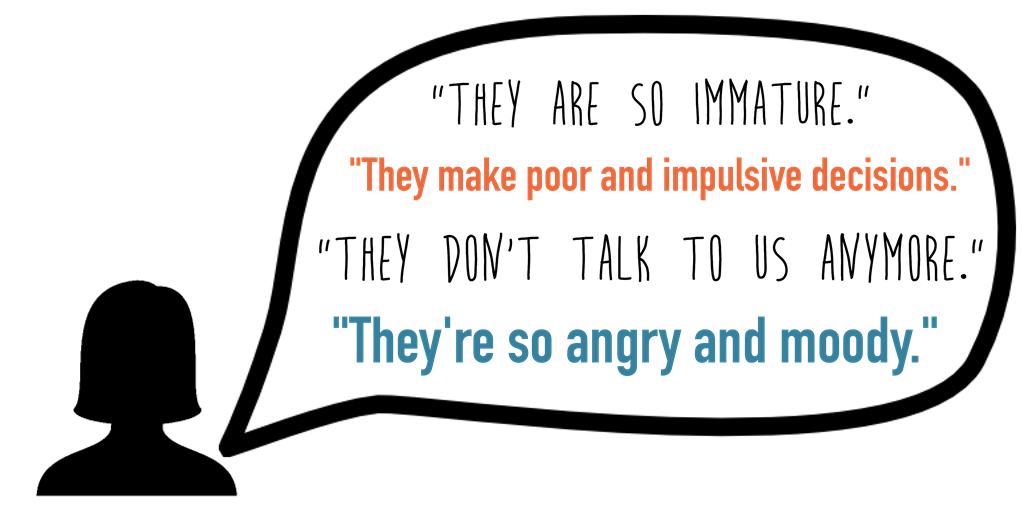
Here’s what the conversation topics look like…

Here are a few things you need to know about the what the science is telling us.
“THEY JUST NEED TO GROW UP” MENTALITY WILL NOT HELP.
This line of thinking has existed for years and rightfully so, adolescence is a time of immaturity. The problem that lies within this way of thinking is that it frames adolescence as a period of time in which you must survive, simply try and get through, endure, and come out with minimal long-term scars.
Here’s a helpful change of perspective… Adolescence is not simply about maturity vs immaturity. During adolescence the brain goes through a rapid growth period and because of these changes new behaviors and abilities present themselves. All of those common “frustrations” (above) that we hear from parents aren’t just things that you need to endure but are newly developed abilities that will end up laying the groundwork for core personality traits your child will develop for use in adulthood.
Pushing boundaries, exploring decision making, getting a taste for independence, and being emotional may drive you crazy and caused tons of stress, but are all integral building blocks that each adolescent must go through. Use this time to cultivate positive experiences and lessons from those frustrations. Most importantly, be an active part of “the work” that goes into these crucial developmental period in your child’s life.
KNOW THE UPSIDES AND DOWNSIDES TO ADOLESCENCE.
Parent’s tend to have a keen eye for a child’s impulsive decision making, risky-behaviors, pushing boundaries with sources of authority, and their kids not wanting to spend time with them. What all of these behaviors have in common… they have an upside and a downside.
Novelty seeking and reward driven behaviors can motivate a child to explore new ways of doing things, allow them to keep an open mind to additional perspectives, and be open to change. The downside could lead to risky behaviors without a major thought or concern for the outcome, which leaves a child vulnerable.
Adolescence spending a lot of time with friend (and therefor little time with their parents) could help them develop strong social connections and support networks which are heavily correlated with happiness and mental wellness. The downside is that not being around adults and only being around peers increases their chances of risky behavior and minimizes the opportunity for guidance and knowledge from an adult figure, in turn increasing risky behaviors.
You see, each new ability and behavior that is formed during adolescence can have a profound impact on their develop towards adulthood. Stay engaged, but be aware of these new found abilities that your child may possess.
The inspiration for this blog came from an article written by Dr. Daniel Siegel. Dr. Siegel is a world renowned scientist and expert in the field of mindfulness. He has a wonderful ability to take complicated scientific findings and communicate them in a way that makes them practical and exciting. Please read his article “The Amazing, Tumultuous, Wild, Wonderful, Teenage Brain.” on mindful.org.
P.S.
If you are a parent or a young person who has had some challenges and would like to share your story, let us know in the comment section below! If you have any questions, and we mean any, you can send them right over to [email protected] or visit our page at www.YouTimeCoach.com.
by YouTime Coaching | Apr 22, 2014 | Communication, Compromise, Emotional Intelligence, Emotions, Get, Give, Listening, Receive, Relationships, Science
Sure he looks calm, cool, and collective, because he has to be! Former FBI negotiator Gary Noesner explains to us how to get anybody on your side.
There are 6 keys steps that Gary shares with us. It is important to hit all of them as best as you can. If you feel like you can’t manage that (not a big deal and not a simple task at the beginning) than simply tackle a couple that you are confident you can handle.

Step 1:
Don’t Try to Win
In a hostage situation, we never go in saying “We’re gonna wink and this person’s gonna lose.” Its not about getting you to comply with what I want or accept my point of view. It’s about us working together to reach the best agreement we can. A win is a mutual thing.
*YouTime Practical Applications*
Your relationship with your spouse, boss, or any other meaningful relationship.
 Step 2:
Keep Your Emotions In Check
Self-control is essential when trying to influence someone’s decision-making process. If you get angry or display frustration, if your body language says you’re pissed off, you’ve lost already. But if you behave in positive ways, it has a tendency to be mimicked. It’s hard to have a two-way argument when only one person is arguing.
*YouTime Practice Applications*
Once again any meaningful relationships, when you are having a “bad day”, when you need something from somebody.
Interested in the science of mimicking?
Check out this interesting article on mirror neurons.
The Mind’s Mirror – American Psychological Association
Step 3:
Keep Their Emotions In Check
 When people are argumentative and raising their voices, what they are really saying is, “I want you to hear me, I’m angry.” So acknowledge that. “You sound like you are really upset.” Slow down and wait to articulate your point of view. Imagine a child’s teeter-totter at an angle: When emotions are high rationality is low. Before you can gain cooperation, you have to lower emotions.
*YouTime Practical Applications*
At the beginning of arguments to establish acceptance, to normalize somebody’s feelings, when you absolutely need people to hear your valid points, and definitely use this you are considered “a bad listener”.
 Step 4:
Be a Good Listener
Take the time to understand the other person’s point of view and you’re much more likely to be successful in getting what you want. Be open physically too: Face the person, make good eye contact, be attentive and smile – it’s one of the most powerful influencing tools we know.
*YouTime Practical Applications*
Use when speaking with a female (the love listeners) and effective during communicating sensitive topics.
Step 5:
Start Small
If you treat an argument like a zero-sum game, it prevents you from taking a more appropriate intermediate step, which is, let’s find some common areas. Tackle the issue that has the best chance for compromise. Lock that one down, then move on to the more difficult ones, knowing they may not be solvable.
*YouTime Practical Application*
When arguing with “bigger concept” type people, when compromise is what you are looking for, and when the issue you are dealing with is a longer term “process” problem.
Step 6:
Give to Receive
 If you demonstrate a willingness to be open and flexible – that you’re willing to meet halfway, that there are aspects of your position you might modify – it puts a burden on them. It’s like saying, “It’s your turn to show that you, too, can be sensible.” Most reasonable, intelligent people will say, “OK, this person has stepped to on the a limb, they’re are willing to work with me. Now I have to show something.”
*YouTime Practical Application*
Use when dealing with reasonable people, somebody that is rigid may not take well to this method. Use if you are communicating to somebody that believes you are a rigid person. Always give to receive, the law of reciprocity is on your side.
*This article was adapted and sourced from Men’s Journal, April 2014. The article was written by Maria Fontoura.