
by YouTime Coaching | May 12, 2017 | Anxiety, Behavior, Children, Depression, Distress, emotional problems, high school, Kids, Listening, parenting, Teenagers
Part II: From the Parent’s Perspective
In Part I, we met Emma, the brave high-school girl that traveled down the bumpy road towards self-acceptance. Through all of the anxiety, depression, and frustration of trying to understand “who she really is”, Emma found a way to finally accept the things she struggled with in life. Go ahead and get a refresher, or just read Part I for the first time here.
As a parent, seeing your child struggle can be heart wrenching. Some parents want to swoop in to help ease the discomfort (both yours and your child’s), while others may think these are “necessary learning experiences”. Many parents though are not even aware of how they respond to these types of conflicts (btw if you are curious to learn more about your conflict style, find out more through this assessment YouTime Coaching Conflict Mode Assessment)

As a parent one of the most impactful things you can do is be present for your child. Not passive, avoidant, accommodating, but present. Whether your 50 years old or 15, we all have the same needs (we just may meet them differently).
A parent’s own fear, insecurity, anger, and even sadness can prevent them from being fully present for their kids when they may need it the most. The symptoms of struggle for a young person may not be blatantly obvious, which makes being present, aware, and appropriately involved that much more important.
In our interview, Emma’s mother (Kate) shares a little bit about her experience during the time that her daughter was trying to “figure it all out”.
YouTime: When did you realize that your child had challenges that affected her everyday life?
Kate: When she was around nine we noticed challenges with school work. When she hit middle school the social challenges began to appear more than ever and the insecurities controlled her.
YouTime: What was the evaluation and assessment process like for you and your child?
Kate: When she was in the third grade her school contacted us regarding her inability to pay attention. She had no idea what that meant and thought nothing of it, she was a typical happy child and as for myself, I instantly went into denial because my daughter was “perfect”, it was the teacher right?! It was NOT my child with the issue. I was very defensive and protective… Eventually, I agreed to have her tested for ADHD and with research and family support I realized that even with ADHD she is still “perfect”. The real challenge began in middle school when the depression and the anxiety took control of her. It was and still is very trying at times and has had a major effect on our family and relationship with parents of her peers.
YouTime: What were some of the biggest frustrations for you as a parent?
Kate: My biggest frustration had to be adjusting in how I helped her with school work or approach personal situations when talking to her. The mom in me wants to yell “just finish the work, sit still, why can’t you do this, who cares what people think….”. But I know I can’t approach her like that if I want her to remain open and talk to me. She shuts down when I appear frustrated and withdraws herself. I have learned to not react before I think and to try to understand that she thinks and how she learns differently than I do.
YouTime: Did you have any strategies for maintaining a balanced mind during this time period?
Kate: Prayer. I do not know another honest way to answer that question. I know there are those who would answer differently but for me that is the only strategy I have had.
YouTime: What do you attribute most for the positivity in your relationship with your daughter now?
Kate: I do not make her feel like she is anything less than perfect to me and that her ADHD, reading disorder, depression and anxiety are all things that make her even more perfect. I have done my best to help her see these traits as gifts in one way or another. I fail daily, I am not a perfect parent but making notes with reminders on them all around the house for her, simply reminding her at lunch with a text telling her to remember certain things and not making her feel like I am annoyed by her inability to stay on task or hold friendships at school.
YouTime Coaching Take Home:
Take this page straight out of Kate’s book, “I fail daily, I am not a perfect parent…”
Parenting an adolescent is quite a challenging task, let alone having to continue managing the things going on in your own life. This is a beautiful example of how appropriate parental support, involvement, and mindfulness can have a major positive impact on a young person’s life.
If you or anyone you know could use some support in being more present for your kids send us over some of your thoughts and questions.

by YouTime Coaching | Apr 26, 2017 | Anxiety, Behavior, Brain, Children, Depression, Distress, emotional problems, high school, Kids, Listening, parenting, Teenagers |
Part I: Emma’s Perspective
Most of us can remember during our teenage years the mundane writing assignments gifted to us by our teachers (not always their fault). They asked you to write essays “discussing the role of family in To Kill a Mockingbird, paying close attention to Aunt Alexandra.” or “from Steinbeck’s, Of Mice and Men, please discuss his descriptions of the natural world. What role does nature play in the novella’s symbolism?”.
Memory refreshed? Okay good, I’ll stop.
In most cases, the teachers will typically receive 3-4 variations of the same essay, coming from very similar perspectives. Reading these staple books, understanding their overarching themes and processing what it means to our current reality is quite useful. Yet still, during such a crucial time of physical and emotional growth for adolescents there is no replacement for a chance to write about something personal, of deep meaning, and most importantly brutal honesty.
So with all of this in consideration, what happens when you ask a teenager a more potentially vulnerable, subjective, and open-ended question to write an essay on? For example…

This leads us to Emma. On paper, Emma may sound like any ordinary high-school student. In reality, she is much more. Her personal journey towards self-acceptance is inspiring and can hopefully resonate with other kids the same age.
Here is Emma’s essay:
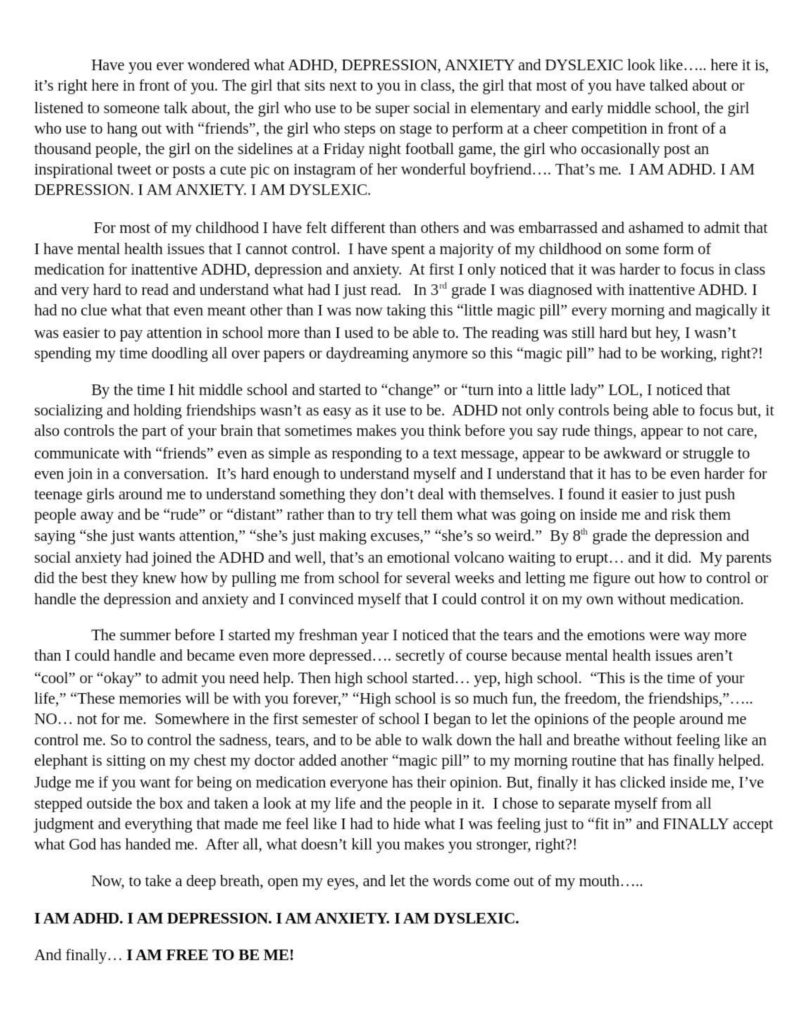 Amazing, huh?
We were able to snag some more of Emma’s time and ask her a few questions.
YouTime Coaching: Do you remember a moment when you realized things were “different” for you?
Emma: In elementary school things were easy and kids didn’t see me any different. Middle school is when I would say I started to realize that I could not complete things as fast or as easily as the other kids around me and I started to notice that I would say things without thinking, I would struggle to fit in with conversations my friends were have or when I would say something they would say “that isn’t even what we were talking about or that is stupid” and they were right, I found myself just saying random things to fit in. Eventually, I stopped talking in fear of sounding stupid or them laughing.
YouTime Coaching: What were some of your biggest frustrations during this process of understanding for you?
Emma: I would say my biggest frustrations are probably feeling so lonely and feeling like I will never find anyone that understands me. I am in high school now and teenagers are cruel, to be honest. Walking into a classroom and fearing the teacher will ask me to read out loud, walking into the lunchroom seeing all my old friends that I am no longer friends with because I did not know how to be a friend so to say… those are some of my biggest frustrations with myself.
YouTime Coaching: Who and what did you find most helpful in making some of the challenges more manageable?
Emma: My parents are so supportive and I know it has been so hard on them. I would say my mom has helped me more than anyone over the years. She has provided me with any ounce of information on ADHD, depression, anxiety, and dyslexia that she can find to help me understand what is going on with me. I would also say having a parent that is so motivated to educate herself in understanding me has been my biggest help.
YouTime Coaching: If you had a couple pieces of advice for another teenager going through something similar, what would the advice be?
Emma: Know that you are enough! Stop trying to “fit in” with kids that do not understand you and that do not care to understand you. TALK to someone, do not hold it in! Find someone that you are comfortable with and tell them how you feel no matter how dumb you may think it sounds. Oh, and fidget cubes… Those are lifesavers in school!!!!
YouTime’s take-home:
It could be a slip in grades, change in friends, hard time expressing emotions, or even controlling them. Teenagers can present their struggles very differently. Reaching the level of self-acceptance that Emma experienced takes a lot of courage, awareness, and support. Hopefully this story can be a testament to the power of parenting, genuine support for your teens, and that self-acceptance is a reality even in the midst of many personal challenges.
by YouTime Coaching | Nov 15, 2013 | Behavior, behavioral issues, emotional problems, money, parenting, poverty, Rich kids, social problems, Stress
If your child experiences poverty before the age of 5 research shows that there are serious negative outcomes that will most likely be coming their way. These negative affects could results in:
- Protracted Stress (long-term)
- Behavioral Issues (conduct disorder, anger regulation issues, getting into fights…etc)
- Social Problems (social anxiety, body image issues, giving into peer pressure, bullying…etc)
- Emotional Problems (depression, anxiety…etc)
Does this mean that American’s are forced to make more money in order to ensure that their child will grow up to be “normal”. The short answer, NOPE. I am afraid to say ladies and gentlemen but,
MONEY IS NOT THE ANSWER
Before getting into this next section I would like to take a second to say that the facts, findings, research, and opinions expressed are not to minimize or criticize any individual’s parenting. The following is used to serve as a platform for discussion and questioning on this very important topic. Parenting is an extremely arduous process and by no means has anybody perfected it. I applaud parents that try their best with what they are given and can ask for help when necessary. I hope these findings allow you to ask the important questions to help your family, friends family, and children.
Recent research is showing significant increases in the social, emotional, and behavioral disturbances of the children that come from affluent families. Kids that come from families that make $150,000+ (over 2x the national average), have parents in high-status careers, attend the most prestigious schools, and have well-educated parents are at risk now too.
Some of the findings of this research shows that kids coming from affluent families are at risk for:
- Substance abuse (high alcohol use, binge-drinking, marijuana use, and other hard drugs)
- Delinquency from school
- Wide-spread cheating
- Stealing from parents or peers
- Maladjustment in school and social environments
A common misconception amongst affluent parents, and this is reinforced my many sources of media, is that money and education will prevent these events from happening or even solve them.
“If facts alone were enough to change an individual’s behavior long-term, then there would be no overeating, alcohol abuse, cigarette smoking, or drug use. There needs to be more then just the facts.”
YOUR OPINION
WHAT IS CAUSING THIS?
I want your opinion.
Share your thoughts below as to why children coming from affluent families may be experiencing more depression, anxiety, social problems, and substance abuse issues then before.
Some questions to think about:
- Why is this happening to kids coming from affluent families?
- Why is the magic school year 7th grade for most of these issues to present themselves?
- Are you experiencing these issues? If so, how has the experience affected your family and what words can you offer others?
In the next blog, I will share with you the findings of some on-going research that breaks down why this may be happening and how to fix it.