by YouTime Coaching | Sep 26, 2017 | Advice, Anxiety, Attitudes, boundaries, Children, Communication, Compromise, Consistency, Decisions, Emotions, Expectations, Failure, Fear, Fighting, Focus, Life Coaching, Listening, parenting, parents, positive reinforcement, Trust
As a parent, ever wonder what is going on inside your kid’s mind?
Through the positive work we have completed with adolescence, young adults, and families we’ve heard and seen almost everything. Kids want their freedom (sometimes without responsibility) and respect, while parents struggle with communication, setting boundaries, and timing.
Here are ten real thoughts direct from clients about their parents.
#1 I can’t talk to them because they will just get angry at me.
#2 All they care about are grades.
#3 They tell me to stop doing things that they do all the time and it’s bullshit.
#4 They won’t understand if I told them or will make me feel like it isn’t important.
#5 They choose when it’s convenient to say no and get upset.
#6 I don’t want to be like them.
#7 I tell them what they want to hear.
#8 When I actually try to talk to them about something that happened, I just get in trouble.
#9 When you start lecturing, I stop listening.
#10 When you trash my friends, I start disliking you, not them.
Remember, parenting is an imperfect process and so is being a kid. We are not sharing this list so you can take on all of the items one by one, instead, use it as a guide to see where more attention could be placed. When it comes to your kid’s motivation things can drastically change as they get older but if you’re able to adapt with the times, stay hip, and simultaneously hold true to healthy principles then this process could be easier on you.
Here’s just one easier way to think about motivation. Remember, in parenting, effort counts.
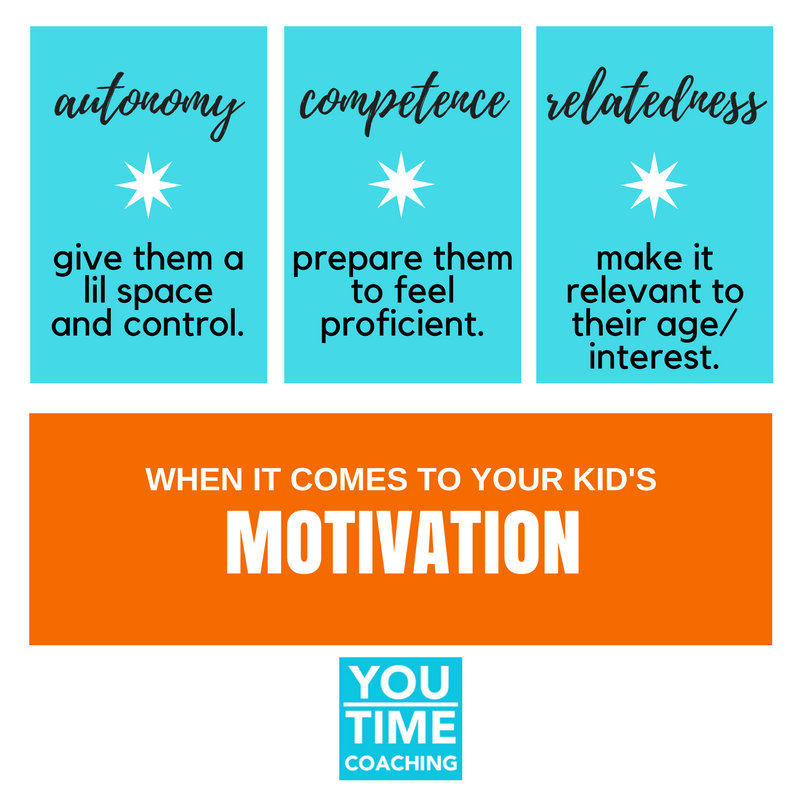
What goes into your kid’s motivation?
Just like when a kid doesn’t get their way, the thoughts kids have about their parents are changing by the minute. The importance behind these thoughts is where the focus should lay. Communication is typically always an underlying relationship issue between parents and kids. Check out these other blogs for helpful tips on communication with your teens, How to Love Your Kids When They Are Tough to Love and Do NOT Try to be Your Child’s Best Friend.
Feel free to leave comments below or on any of our social media pages to get a conversation going!
by YouTime Coaching | Apr 22, 2014 | Communication, Compromise, Emotional Intelligence, Emotions, Get, Give, Listening, Receive, Relationships, Science
Sure he looks calm, cool, and collective, because he has to be! Former FBI negotiator Gary Noesner explains to us how to get anybody on your side.
There are 6 keys steps that Gary shares with us. It is important to hit all of them as best as you can. If you feel like you can’t manage that (not a big deal and not a simple task at the beginning) than simply tackle a couple that you are confident you can handle.

Step 1:
Don’t Try to Win
In a hostage situation, we never go in saying “We’re gonna wink and this person’s gonna lose.” Its not about getting you to comply with what I want or accept my point of view. It’s about us working together to reach the best agreement we can. A win is a mutual thing.
*YouTime Practical Applications*
Your relationship with your spouse, boss, or any other meaningful relationship.
 Step 2:
Keep Your Emotions In Check
Self-control is essential when trying to influence someone’s decision-making process. If you get angry or display frustration, if your body language says you’re pissed off, you’ve lost already. But if you behave in positive ways, it has a tendency to be mimicked. It’s hard to have a two-way argument when only one person is arguing.
*YouTime Practice Applications*
Once again any meaningful relationships, when you are having a “bad day”, when you need something from somebody.
Interested in the science of mimicking?
Check out this interesting article on mirror neurons.
The Mind’s Mirror – American Psychological Association
Step 3:
Keep Their Emotions In Check
 When people are argumentative and raising their voices, what they are really saying is, “I want you to hear me, I’m angry.” So acknowledge that. “You sound like you are really upset.” Slow down and wait to articulate your point of view. Imagine a child’s teeter-totter at an angle: When emotions are high rationality is low. Before you can gain cooperation, you have to lower emotions.
*YouTime Practical Applications*
At the beginning of arguments to establish acceptance, to normalize somebody’s feelings, when you absolutely need people to hear your valid points, and definitely use this you are considered “a bad listener”.
 Step 4:
Be a Good Listener
Take the time to understand the other person’s point of view and you’re much more likely to be successful in getting what you want. Be open physically too: Face the person, make good eye contact, be attentive and smile – it’s one of the most powerful influencing tools we know.
*YouTime Practical Applications*
Use when speaking with a female (the love listeners) and effective during communicating sensitive topics.
Step 5:
Start Small
If you treat an argument like a zero-sum game, it prevents you from taking a more appropriate intermediate step, which is, let’s find some common areas. Tackle the issue that has the best chance for compromise. Lock that one down, then move on to the more difficult ones, knowing they may not be solvable.
*YouTime Practical Application*
When arguing with “bigger concept” type people, when compromise is what you are looking for, and when the issue you are dealing with is a longer term “process” problem.
Step 6:
Give to Receive
 If you demonstrate a willingness to be open and flexible – that you’re willing to meet halfway, that there are aspects of your position you might modify – it puts a burden on them. It’s like saying, “It’s your turn to show that you, too, can be sensible.” Most reasonable, intelligent people will say, “OK, this person has stepped to on the a limb, they’re are willing to work with me. Now I have to show something.”
*YouTime Practical Application*
Use when dealing with reasonable people, somebody that is rigid may not take well to this method. Use if you are communicating to somebody that believes you are a rigid person. Always give to receive, the law of reciprocity is on your side.
*This article was adapted and sourced from Men’s Journal, April 2014. The article was written by Maria Fontoura.