by YouTime Coaching | Mar 14, 2019 | Academics, Children, college, determination, Emotions, Focus, Motivation, parenting, parents, Support
Will your kid struggle as a freshman in college? Absolutely. Does the experience always need to be negative and feel like nothing good comes from it? Absolutely not.
When a kid is sent to college the exodus from being a child and living within their parent’s home to being a young adult truly begins. One major problem… teenagers being forced into an adult world, without being mentally equipped and prepared like an adult can lead to a lot of… [parents, fill in the blank]
Now Mom and Dad, please sit down and take three deep breathes because things are going to be alright.
Download our free parent assessment to see if your kid is truly
struggling and needs some additional support:
The Skinny On Your Freshman’s Struggle
Sure, your freshman kid could sustain some physical and emotional wounds during their college experience, but you kind of signed them up for it. Listen, all those nights you got on them for watching tv and making sure they started studying, the nights you made them their favorite dinner, those times you washed/dried their clothes (and probably folded), and the genuine efforts to hold to an 11pm curfew has all finally paid off.
They will have to do most or all of these things on their own now! [cue horror film music]
The question isn’t, “will my kid struggle?” it is, “how will they struggle and how will we respond?”.
To help you out a bit, here are some of the top re-occurring struggles for college students. I’ll include some pointers and a few “heads-up”.
[bctt tweet=”Kid struggling at school? Tweet us about it with the hashtag #thestruggleisreal” username=”@YouTimeCoaching”]
A FEW TOP COLLEGE STRUGGLES:
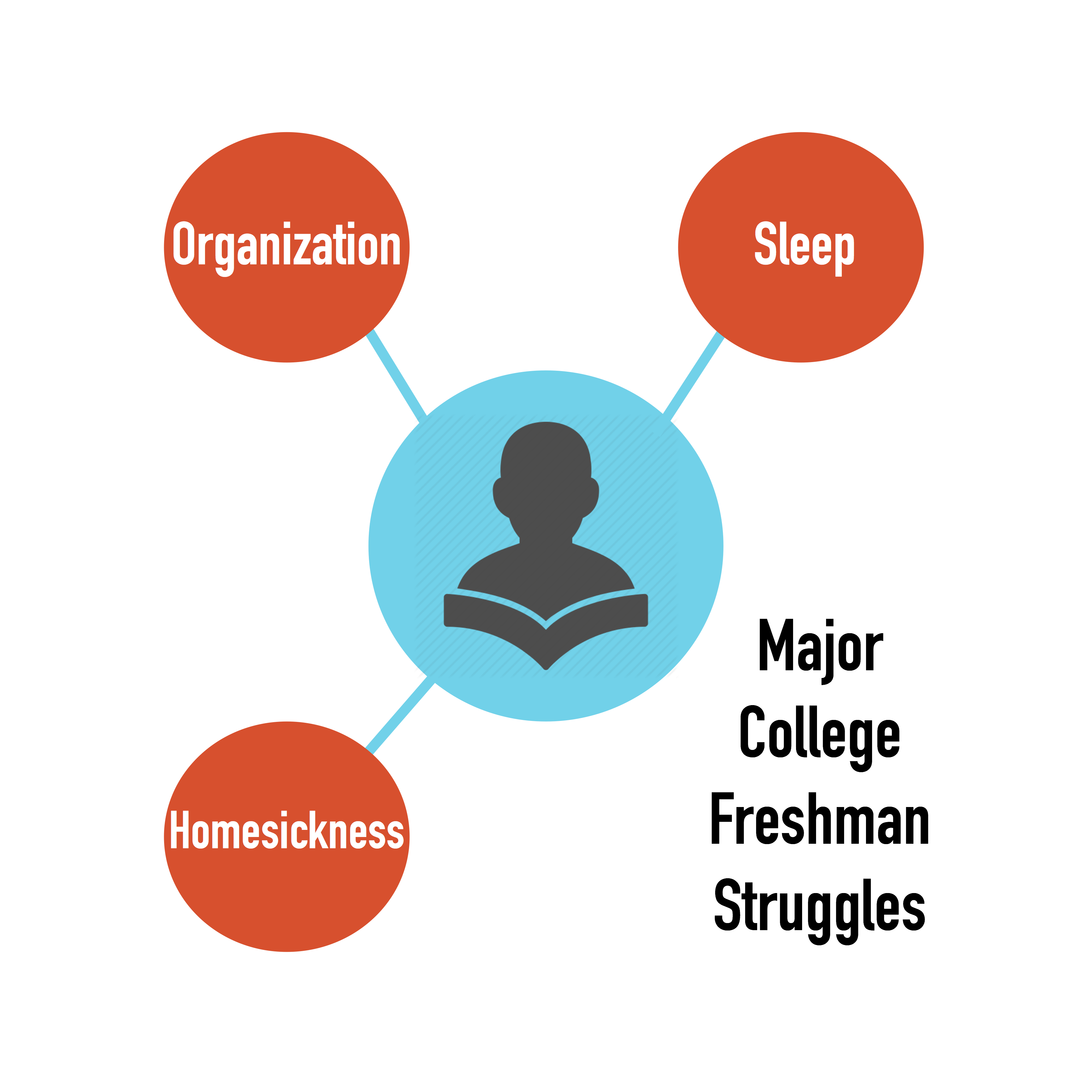 1. Homesickness
Some parents love the fact that their kid misses home, while also sympathizing with them. Keep in mind that homesickness is just as much about needs that are not being met at school as it is missing what they used to have. When you do get the coveted phone call from your freshman kid at school, listen to them closely and just maybe you will be able to see if their homesickness is a result of having challenging classes, finding it hard to connect with others, or if they simply want a care package mailed to them (always a winner).
2. Organization
College is typically more demanding than high-school in terms of work and very frequently much less structured in terms of homework/study time. This transition can be challenging for freshman and It is common to see a slip in grades because of this in addition to managing all their new freedoms. From frequently losing their cell phone or homework to their train of thought, organization can impact both physical and mental arenas. If your freshman kid shows signs of struggle with their organization skills, don’t panic. Together, look into a coaching program like www.YouTimeCoach.com and/or looking into the schools learning center services.
3. Sleep
When we are the ones lacking sleep, it is easy to notice the difference. Freshmen in college have this notion that they must perform at least 4 all-nighters the first semester, set a world record for cups of coffee or red bulls in a night, and put their ZZZ’s on the back burner. The reason behind this could be school work, a noisy environment, health issues, or higher priorities (pretty much everything). The college experience has so much to offer a freshman student, but this can create some priority confusion and FOMO (fear of missing out). A little trick, as your kid comes back for the holiday, take note of their sleep patterns. Typically the kids pulling late night study (or party) sessions will sleep in pretty late the first few nights home.
Keep these pieces of information handy for when your kid shows signs and symptoms of struggle. The best thing you can do for your kid is to be supportive, actively listen to them, empathize, and practice the skill of being non-judgmental. The pay off will be far greater than reacting through fear and anxiety.
Any questions regarding your kid, college, and their struggles?
Please email [email protected] or go to www.YouTimeCoach.com and click on the “Hire Us” page.

by YouTime Coaching | Jan 18, 2017 | Attitudes, Behavior, Behavioral Change, Beliefs, Change, Commitment, Consistency, determination, Diet, Health, Mindset, Momentum, Preparation, Results, Therapy
Hey ladies and gentlemen, Captain Positive here to give you a dose of reality… the New Year may not be all that you are expecting. Fun fact is that people are absurdly good at reminiscing over all the good and bad things that have already happened in our past, but typically have more of an issue visualizing their future and things like New Year’s Resolutions take a major hit.
Not only do I bring you this wonderful news but I will also share with you, because it is quite important, the 3 things you can do in order to efficiently undermine your New Year’s resolutions.
After reading this blog you will basically be certified in how to teach others to properly screw up their plans for the New Year! (exciting… I know.) With this knowledge comes great power, because in order to be successful with your resolution(s) you must know what works in addition to whats makes you fall miserably on your face (and don’t worry, we all know that feeling). So the power is yours once you are done reading this. Choose how to use this information wisely.
[bctt tweet=”In order to be successful with your resolution(s) you must know what works in addition to whats makes you fall miserably on your face (and don’t worry, we all know that feeling).” username=”youtimecoaching”]
I present to you the “Reverse RPM” theory. As most of you know “RPM” stands for “revolutions per minute” and is a relative calculation of speed, so for this presentation the “Reverse RPM” theory will show you how to completely halt any forward progress, momentum, and speed you are looking to create for attaining your New Year’s goals.
Reverse RPM Theory
(R) Results
Problem:
Many of us have developed a wonderful tendency to be predominantly results and outcome driven. We start a diet and we only look to lose weight (and we better see results fast or on to the next diet found in Self Magazine).
Of the top ten most popular resolutions (Check them out here!) all of them take preparation, planning, and time. We typically undermine our resolutions by looking at them as short-term, outcome-oriented endeavors.
Solution:
A “New Year’s Resolution” is exactly that, a year-long resolution and goal. Do you stop going to the gym or eating healthy once you lose those 30 lbs. on June 21st of the new year? Well, you shouldn’t but lots of people do. Your resolution is a long-term goal that should be process-oriented, not simply outcome.
Sure you have an outcome in mind, but this outcome stays in your peripherals while the next small baby step stays in your direct line of vision. Your journey to get there needs to be clearly planned out, broken down, and assigned start/completion dates (download “My Mini Goals Worksheet” here).
(P) Preparation
Problem:
How many of you bozos knew that the new year started on a Monday? Who wants to get healthy and make changes over the weekend when you can start on Monday?! Are you going to dig yourself into a hole the weekend before or prepare yourself for an easier transition?
Assuming you already created a resolution, we can safely say that you have at least identified that there are behaviors that are problematic and stand in the way of your goals. Don’t we all! The first step after realizing you have “problem behaviors” is to prepare yourself in order to make the change. Unfortunately, our hedonistic (pleasure seeking) culture can sometimes force us into the “action stage” before proper planning. The result, 2 weeks of hard work towards your goal and reverting back to old ways (looks like your cigarettes will have their old best friend back).
Solution:
First, do a little detective work to figure out what your actual behaviors are, when they happen, and what triggers them (download “Track My Triggers and Patterns Worksheet” here). Second, really find out why you are looking to make these changes. First write down what positive benefits the change will bring to you (and others), followed by writing down how maintaining the problem behaviors have hurt you (and others).
Next, you must commit. Scream your goal from the biggest damn mountain top you can find (please don’t do this). Seriously though, tell friends and family what your intentions are with this resolution. People are more likely to feel accountable if others know what they are trying to do.
(M) Momentum
Problem:
Newton’s Law of Intertia (as it applies to New Year’s Resolutions)
An object at rest will remain at rest unless acted on by healthy and mindful decisions. An object in motion continues in motion with the same speed and in the same direction unless acted upon by your problematic behaviors.
Wait, so since I am going to be “all healthy and stuff” starting in January, that means I can shove my face with booze and food throughout the holidays and think of exercise as the walk to the bathroom. Don’t start in a hole.
Maybe I can smoke my face off and start fresh on January 1st. Or, since I will be saving so much money in the new year with my positive changes, I will definitely balance that out by spending tons of money over the holidays. Don’t start in a hole.
Don’t use December as an escape goat for your troublesome behaviors. This only will make things harder with a higher likelihood of failing to progress with your resolution.
Solution:
Start planning after the first week in December. Already into January? No problem! Part of successful goal setting is being flexible and adapting to what’s realistically going on around you. Spend 2 weeks planning out your path of success and seek out those that will support you in this (download the “My Support Team Worksheet” here). Most people try to begin their resolution after one of their most problematic months and that is a recipe for disaster! Set a realistic start date that allows you spend a couple week planning out your moves.
YouTime take home message:
Remember, knowledge is not power, it is only potential power. You have the choice in how to use it. So go on and use that huge brain of yours to properly plan or even screw up the new year and share your resolutions below!
by YouTime Coaching | Aug 2, 2013 | Confidence, determination, happiness, Hope, normal, perseverance, Reframing, Stroke, TED Talks
Recently, I came across a TED talk video that featured a mother and father (Roberto D’Angelo and Francesca Fideli) who were happily married in 2002 and gave birth to their beautiful son, Mario, in 2011. For many parents, children are a continuation of themselves, their lives, their ancestry, their story. Parents truly feel as though they have produced a miracle and a thing of absolute beauty to be cherished for many years to come.
What happens when the same beauty, child, and miracle has a stroke?
Mario experienced what is known as a “Perinatal Stroke” at only 10 days of age. He was unable to control the left side of his body. While Mario lost some control in his newly formed life so did his parents while they were ambushed with a flood of emotions ranging from the feeling of failure, anxiety, depression, and confusion. What can a parent do in order to instill a sense of certainty, security, and safety?
Mario’s parents worked hard to help their child recover. They began a pilot program for Mirror Neuron Rehabilitation.
As D’Angelo explains, “The theory of mirror neuron says that, in your brain, as you watch me do this, you are activating exactly the same neurons as if you do the actions.”
The goal for this program was to show Mario items, demonstrate how to pick them up, and use them. This would in turn be mirrored by Mario himself. What they discovered was that Mario was paying just as much attention to his parents emotions as he was to their body movements.
Following this discovery Roberto and Francesca thought, what are we missing?
What am I missing? What is wrong?
These questions come up quite frequently for parents and their children. Fortunately, Roberto and Francesca made the necessary shift in mindset to help their son Mario, but many people stay stuck in the “What is missing?” head game.
What Mario’s parents did, and what I encourage you to do RIGHT NOW is restructure that thought of “What is missing?” to “What can I offer?”.
What is missing? vs What can I offer?
 Ask your self important questions such as, “What do the individuals that know me best think I have to offer?” and “What can I offer to other people, my environment, and this world?”
AND
From now on, when you are faced with the question, “What am I missing?”. Ask yourself,“What can I offer?”
Look at little Mario now!