by YouTime Coaching | Feb 24, 2019 | Growth, parenting, positive reinforcement
“My ADHD child never gets angry.”, said nobody ever.
We will keep this article short and sweet. When your child gets irritated, upset, and loses their cool it totally takes a toll on a parent’s emotional balance. While your child is busy making themselves feel heard and noticed, you may also feel inclined to do so.
Regardless of how irrational or unpredictable your child’s defiance or anger may be, there is one thing we know to be true. Whether you like it or not, when your kid “falls apart” it is very easy and common for parents to “fall apart” as well.
[bctt tweet=”When your child gets irritated, upset, and loses their cool it totally takes a toll on a parent’s emotional balance, but there are ways to handle it properly!” username=”@youtimecoaching”]
This can present itself in a few ways…
• You start yelling or “not using your regular tone of voice”.
• There’s an increased inclination to punish your kid.
• More susceptible to excusing broken boundaries (avoidance conflict mode)
• The parent can shut down and stop communication (ex. “I don’t have time for this!”)
• You stop listening to your kid altogether.
DOWNLOAD: 10 Parenting Strategies For Raising Children With ADHD….
That Actually Work!
Don’t get me wrong, this is not putting all of it on the parents. In the end, you want to be the best support possible for your child, while also keeping your head screwed on straight and staying within your skill-set. Doing this will bring you BOTH relief.
[bctt tweet=”Tips to bring you and your children relief when parenting your angry kid with #ADHD.” username=”@youtimecoaching”]
Having a child with ADHD means they may already struggle with impulsive behaviors, trouble regulating emotions, or could have a low-stress tolerance. Remember in many cases, how your child perceives the situation could be at the heart of the anger.
First, ask yourself, why is my child upset?
… they don’t feel heard or noticed
… they don’t fully understand the problem (needs help processing it)
… they can’t see other options to the issue
… there is a “layered stress effect” from other things going on in their life
… they are hungry, lonely, or tired
While I am sure you can come up with more (I have been amazed at what upsets young people), the point is that the source can be many things.
As a parent, I will throw you a bone.
Here are two things you need to know and practice when your child is “falling apart”.
1. Don’t fall apart. Be the tone.
Sorry, I had to say it. The truth is that when your child is going through this moment of suffering you can practice observing with a nonjudgmental approach. Take a breath and listen to them, EVEN if their anger seems to be turned towards you (parents typically take the brunt of the storm #truth). Set the tone with your child and practice patience, understanding, and observe their moment of suffering (I know it is occasionally hard to feel empathetic/sympathetic towards your kid during these times, and that is more about the moment of suffering you are experiencing. Be kind to yourself, by being calm and patient, and the effects will spread to your kid.
2. Know your “tendencies” when you reach your limits.
Some parents completely disengage from their kids when they have had enough. We call it the “whatever” parent (if you are a “whatever” parents, email info@youtimecoaching ASAP). Other parents will tend to assign harsher punishments as a sign that they have had enough. Discipline is much more effective than punishments. Look at the previous punishments you have assigned and see the effectiveness (…does your kid still leave his crap all of the place? Probably.). With discipline, you are shaping your child’s behaviors and reinforcing the desired ones. If they are yelling, remain calm, do not react to it, listen to what they are saying (and where it is coming from), and model the voice tone and language you wish to hear. You may even have to ask them calmly to speak softer or have this conversation in a different environment.
Parenting quote for the day:
“Don’t yell at your kids. Lean in real close and whisper, it’s much scarier.”
DOWNLOAD: 10 Parenting Strategies For Raising Children With ADHD….
That Actually Work!

by YouTime Coaching | Sep 26, 2017 | Advice, Anxiety, Attitudes, boundaries, Children, Communication, Compromise, Consistency, Decisions, Emotions, Expectations, Failure, Fear, Fighting, Focus, Life Coaching, Listening, parenting, parents, positive reinforcement, Trust
As a parent, ever wonder what is going on inside your kid’s mind?
Through the positive work we have completed with adolescence, young adults, and families we’ve heard and seen almost everything. Kids want their freedom (sometimes without responsibility) and respect, while parents struggle with communication, setting boundaries, and timing.
Here are ten real thoughts direct from clients about their parents.
#1 I can’t talk to them because they will just get angry at me.
#2 All they care about are grades.
#3 They tell me to stop doing things that they do all the time and it’s bullshit.
#4 They won’t understand if I told them or will make me feel like it isn’t important.
#5 They choose when it’s convenient to say no and get upset.
#6 I don’t want to be like them.
#7 I tell them what they want to hear.
#8 When I actually try to talk to them about something that happened, I just get in trouble.
#9 When you start lecturing, I stop listening.
#10 When you trash my friends, I start disliking you, not them.
Remember, parenting is an imperfect process and so is being a kid. We are not sharing this list so you can take on all of the items one by one, instead, use it as a guide to see where more attention could be placed. When it comes to your kid’s motivation things can drastically change as they get older but if you’re able to adapt with the times, stay hip, and simultaneously hold true to healthy principles then this process could be easier on you.
Here’s just one easier way to think about motivation. Remember, in parenting, effort counts.
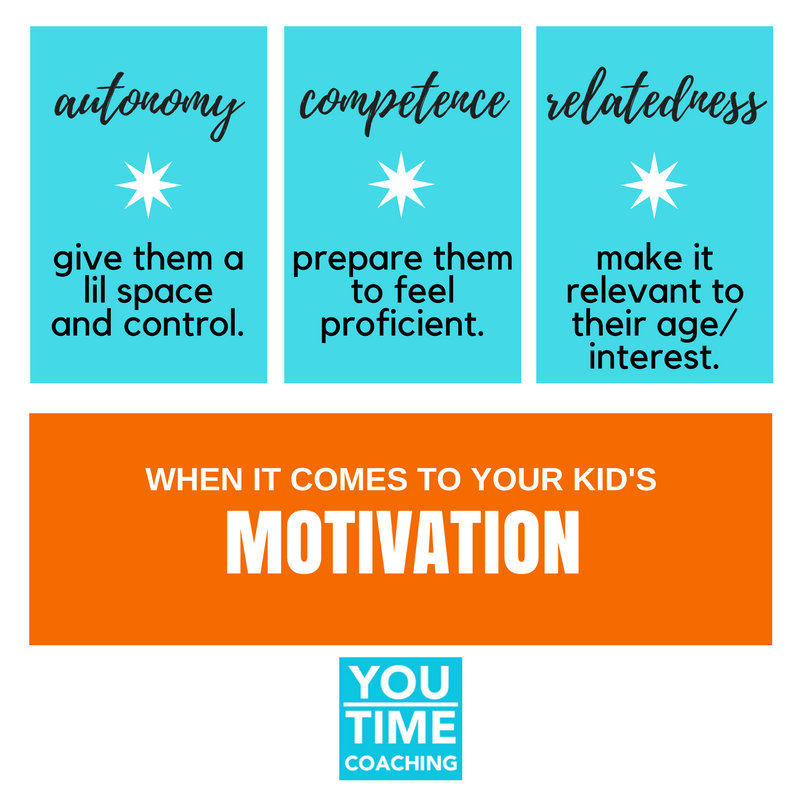
What goes into your kid’s motivation?
Just like when a kid doesn’t get their way, the thoughts kids have about their parents are changing by the minute. The importance behind these thoughts is where the focus should lay. Communication is typically always an underlying relationship issue between parents and kids. Check out these other blogs for helpful tips on communication with your teens, How to Love Your Kids When They Are Tough to Love and Do NOT Try to be Your Child’s Best Friend.
Feel free to leave comments below or on any of our social media pages to get a conversation going!
by YouTime Coaching | May 19, 2017 | Advice, Appreciation, Behavior, Benefit, boundaries, Children, Communication, Direction, Dreams, Growth, Human Needs, Insight, Kids, parenting, parents, Positive Psychology, positive reinforcement, Support, Teenagers, Understanding
Kids can be a pain in the ass sometimes.
Harsh words? Maybe. One thing is for sure though, those words are definitely filled to the brim with truth… harsh truth. This isn’t taking away from your unconditional love for them, it’s simply acknowledging that kids can sometimes do things that are very tough to love.
This is why parents turn to advice from others, seek out simple solutions, and time hacks. Sometimes it isn’t all that easy and you give into your frustrations, irritations, and anger. As parents, you are teachers, EVEN WHEN IT SEEMS YOUR KID DOES NOT WANT TO LEARN FROM YOU. Because the eyes are always on you, the advice you get absolutely needs to be solid.
YouTime Coaching’s extensive work with high-school and college students along with all of the hours worth of support for parents has allowed us to understand some keys elements in how to be a great teacher for your child even during those tough times. When it comes down to it, a child wants to understand, perceive they have some control, and feel supported in a non-judgmental way.
The hardest times to be a “good teacher” with your kids? (never thought you’d ask!)
Just to mention a few:
- when setting boundaries
- when you are angry, frustrated, or irritated (and sometimes hungry)
- when parents are on different pages
- when you feel as though your child is not listening
- when “nothing else seems to work”
- when your kid is an adolescent
- anytime
We don’t want you to be good teachers… we want you to be in many cases the kind of teacher “you wish you had growing up”, the kind of teacher that is more emotionally available than some families had in previous generations, and most importantly we want you to be the type of teacher that not only shows but explains the benefits in learning from failures, how to be compassionate to yourself and others, and have enough awareness/knowledge about what they are doing and why they are doing it.
For these reasons and with an entire year of putting together some of the most effective researched methods of teaching, motivation, and human behavior we have creating the “R.I.S.E. Method of Parent Teaching”.
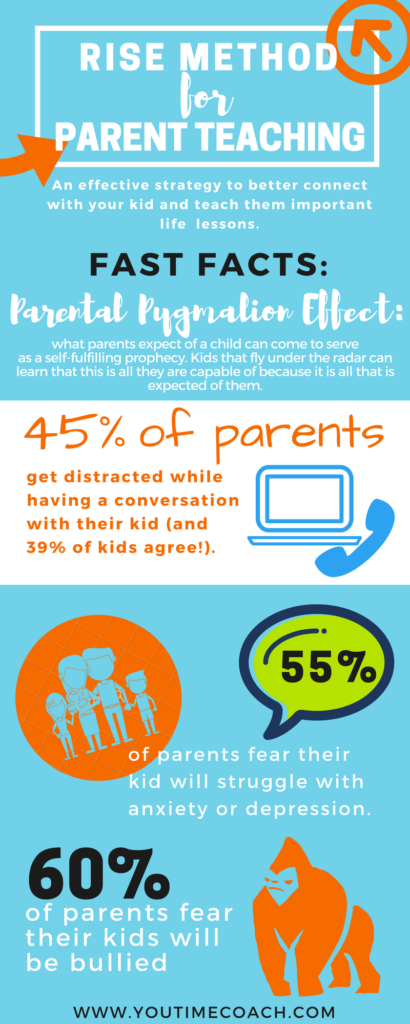
The premise behind the acronym “R.I.S.E.” is for parents to use the powers of awareness, communication, non-judgmental support, and compassion as a way to elevate their parenting and ultimately their relationship with their child.
Use can use this method while trying to set boundaries with your children, teach them important lessons, disciplining (btw before disciplining your kid read this amazing article, https://www.verywell.com/what-is-child-discipline-620113), and even just trying to improve your communication with them.
Remember, punishment is easy, discipline is hard. Implementing this method may be challenging and outside your comfort zone, if you need some guidance please drop us a line!
DOWNLOAD THE R.I.S.E. METHOD HERE.

by YouTime Coaching | Mar 25, 2015 | boundaries, Communication, limits, parenting, parents, Positive, positive reinforcement, punishments, relaxation, rewards, Teenagers
Parenting a teenager can be a challenge and require a lot of skill and energy. However, there are a few tips that can help make it a lot easier.
Step 1: Be positive about your expectations.
Studies show that people often perform and act according to what is expected of them. If little is expected, little will be achieved. This is known as the Pygmalion effect, and it has been seen with the expectations a parent has of a child.
DOWNLOAD: Parenting Strategies For Raising Teenagers…. That Actually Work!
If you expect that your teenager is going to fail in school, for example, this increases the likelihood that they will fail. However, thinking the opposite can have a positive effect. It’s important not to have expectations that are too overwhelming (become the President) or too specific (my son is going to be a quarterback), because expectations become limiting, but rather to have positive expectations based on the teen’s interests, skills and personality.
Step 2: Use rewards, not punishments.
It has been shown that punishments have a varying effect on discouraging a negative behavior, but rewards are guaranteed to work to encourage positive behavior. Rewards don’t have to be material, as many times sincere praise will work very well to encourage the teen.
Usually, with teenagers, parents tend to focus on the negative behaviors, sometimes taking the good things for granted. This actually serves to perpetuate the negative behaviors more. However, shifting the focus and being generous with praise can help you achieve better results.
Step 3: Adjust limits
![]() Teenagers need different limits than children, and what is more, they need limits that are adjusted as they grow up. However, it often happens that parents don’t revise the limits until a serious fight happens or something else equally out of the ordinary occurs. To prevent this, it’s a good idea to revise limits consistently to maintain a balance between the teen’s freedom and responsibility.
Teenagers need different limits than children, and what is more, they need limits that are adjusted as they grow up. However, it often happens that parents don’t revise the limits until a serious fight happens or something else equally out of the ordinary occurs. To prevent this, it’s a good idea to revise limits consistently to maintain a balance between the teen’s freedom and responsibility. Step 4: Remain calm
![]() Teens are dramatic, as their emotional experiences are often extreme. They say they “hate” their parents, which is something no parent wants to hear. However, in the face of these emotions that the teen yet can’t control, it’s very important to remain calm and be there for them, as these outbursts usually don’t reflect actual hatred, but pain and anger that the teen doesn’t know how to handle yet.
Teens are dramatic, as their emotional experiences are often extreme. They say they “hate” their parents, which is something no parent wants to hear. However, in the face of these emotions that the teen yet can’t control, it’s very important to remain calm and be there for them, as these outbursts usually don’t reflect actual hatred, but pain and anger that the teen doesn’t know how to handle yet.
Step 5: Keep communications channels open
![]() While the teen needs more freedom, they still need guidance and help. It’s very important that they can feel as if they can receive it in their own home with their family. Teenagers need to be able to come to their parents with different problems and situations, so they shouldn’t feel like they would receive only blame or anger. Rather, they need to feel that they will be supported. For this, it’s important to reinforce these ideas through words and actions.
While the teen needs more freedom, they still need guidance and help. It’s very important that they can feel as if they can receive it in their own home with their family. Teenagers need to be able to come to their parents with different problems and situations, so they shouldn’t feel like they would receive only blame or anger. Rather, they need to feel that they will be supported. For this, it’s important to reinforce these ideas through words and actions.
Need help parenting your teenager?
Learn more about Parent Coaching through YouTime Coaching by clicking HERE.
Sources: