
by YouTime Coaching | Sep 26, 2017 | Advice, Anxiety, Attitudes, boundaries, Children, Communication, Compromise, Consistency, Decisions, Emotions, Expectations, Failure, Fear, Fighting, Focus, Life Coaching, Listening, parenting, parents, positive reinforcement, Trust
As a parent, ever wonder what is going on inside your kid’s mind?
Through the positive work we have completed with adolescence, young adults, and families we’ve heard and seen almost everything. Kids want their freedom (sometimes without responsibility) and respect, while parents struggle with communication, setting boundaries, and timing.
Here are ten real thoughts direct from clients about their parents.
#1 I can’t talk to them because they will just get angry at me.
#2 All they care about are grades.
#3 They tell me to stop doing things that they do all the time and it’s bullshit.
#4 They won’t understand if I told them or will make me feel like it isn’t important.
#5 They choose when it’s convenient to say no and get upset.
#6 I don’t want to be like them.
#7 I tell them what they want to hear.
#8 When I actually try to talk to them about something that happened, I just get in trouble.
#9 When you start lecturing, I stop listening.
#10 When you trash my friends, I start disliking you, not them.
Remember, parenting is an imperfect process and so is being a kid. We are not sharing this list so you can take on all of the items one by one, instead, use it as a guide to see where more attention could be placed. When it comes to your kid’s motivation things can drastically change as they get older but if you’re able to adapt with the times, stay hip, and simultaneously hold true to healthy principles then this process could be easier on you.
Here’s just one easier way to think about motivation. Remember, in parenting, effort counts.
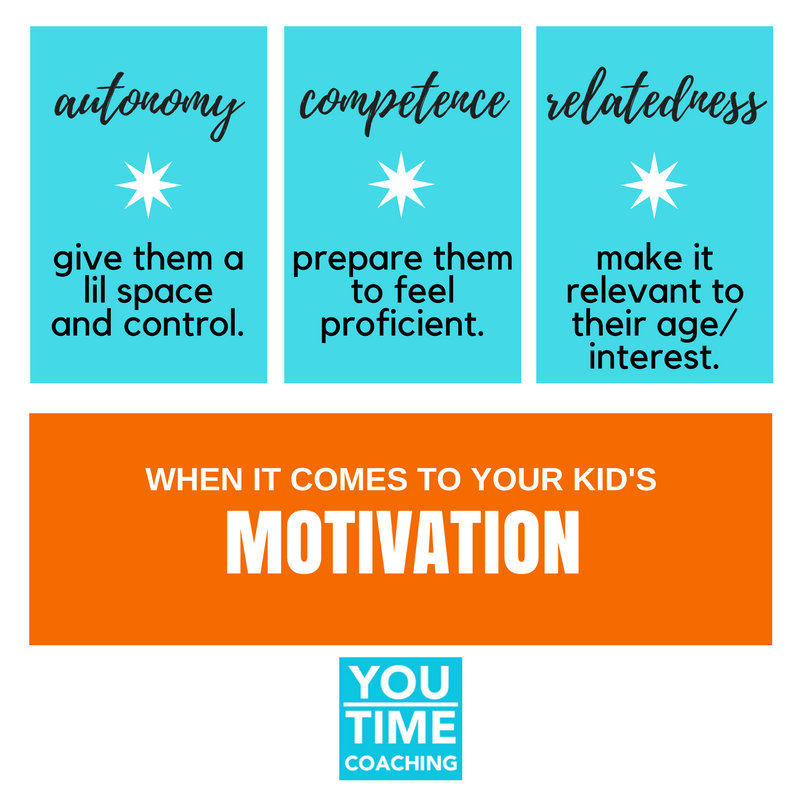
What goes into your kid’s motivation?
Just like when a kid doesn’t get their way, the thoughts kids have about their parents are changing by the minute. The importance behind these thoughts is where the focus should lay. Communication is typically always an underlying relationship issue between parents and kids. Check out these other blogs for helpful tips on communication with your teens, How to Love Your Kids When They Are Tough to Love and Do NOT Try to be Your Child’s Best Friend.
Feel free to leave comments below or on any of our social media pages to get a conversation going!

by YouTime Coaching | Feb 8, 2017 | Academics, Anxiety, Change, Confidence, Fear, Focus, Life Coaching, Mental Health, Outcomes, Positive Psychology, Results, Stress
It’s natural for students to feel nervous as standardized tests approach.
But it’s also very easy for this anxiety to spiral out of control and affect their overall well-being. No test is worth that! (Not to mention that being paralyzed by fear is not the ideal condition for a test-taking brain.) Test anxiety can be rooted in a lack of mastery of the material, uncertainty about test-taking conditions, and/or dread of the long-term consequences of falling short—and often, some combination of the three.
If your student is suffering, take heart: test stress is not inevitable!
Each of these anxieties can be dealt with and you can minimizing test stress. Here are some strategies that can apply to almost any student preparing for almost any test.
- Own the fear. Telling a student their fear is “all in their head” is counterproductive. Of course it is—all emotions are in our heads! Instead, help your student determine what they should and should not worry about. If your student lacks mastery in a subject, their test anxiety may be very real. If they worry over material they’ve already mastered, then you’re dealing with a different type of anxiety entirely.
- One step at a time. Gradually acclimating your student to test pressures can help normalize the test-taking process for them. Completing practice tests, working under timed conditions, and learning to work in noisy environments can all help your student prepare for their experience in the testing center. A coffee shop or library—where they will have to work through sniffling, conversations, street noise, and other things that fray nerves—is a great place to prepare.
- Think outside the test. Sometimes the very format of the standardized test causes panic. In this case, help your student develop skills with something other than the test. Developing reading comprehension questions using a novel or newspaper article, or applying geometry skills by designing a bookcase or coffee table, may help your student master skills in a fun, non-threatening way.
- Practice good test hygiene. Habits can make or break a test-taker. Set routines for your student. For example, if the test will happen on a Saturday morning, set aside every Saturday morning for test prep. Work on maintaining good posture and a positive but aggressive attitude toward the test. Finally, consider mindfulness exercises that will help your student quiet their inner critic.
More than anything, emphasize keeping things in perspective. Though the SAT or ACT may seem all-important, remember that most students take the test two or three times, and there’s much more to a college application than just test scores!

This blog was written by Signet Education’s Director of Education, Sheila Akbar. Sheila is also Signet’s resident admissions and test prep expert. She has been preparing students for the SAT, ACT, and GRE for over ten years in both one-on-one and in classroom settings. Sheila holds both a BA and an MA in Near Eastern Languages and Civilizations from Harvard University and holds two PhDs from Indiana University in Comparative Literature and Near Eastern Languages and Cultures.

Signet Education provides individualized tutoring, test prep, admissions consulting, and organizational coaching for students.

by YouTime Coaching | Dec 14, 2016 | Children, choice, Kids, Life Coaching, parenting, parents
Finding a Life Coach or Mentor for your kid can be like just going into the grocery store or TJ Maxx/Marshalls, you walk in to buy one thing and walk out with $100 worth of items that were never on the original list.
(entering scene) SHINY THINGS and CHOICES.
We want to make your search for a quality Life Coach simple and most importantly transparent for you and your family. To help you in this next step, take a gander below at, “2 Crazy Important Factors When Looking for a Life Coach” and “2 Mandatory Reminders for Parents When Looking for a Life Coach”.
There are plenty of reasons why families look for additional support with their teens/young adult children. It is a move that can greatly impact not only the younger person, but the family as a whole. Follow these 6 very important gold nuggets of information during your search, and if you have any more questions without wanting to feel pressured into purchasing a “I don’t know what I’m getting myself into” Life Coaching package, please email us at [email protected].
2 Crazy Important Factors When Looking for a Life Coach:
#1 Their coaching is proven to work.
Life Coaches and Mentors should not guarantee results, BUT what they should do is provide transparency about what they base their coaching methods off of. For instance, YouTime Coaching uses multiple personal/professional change and motivation based theories and methods when working with younger people. YouTime makes it a priority to engrain the “Stages of Change” model into our work with young people, which has been backed by, oh, just a mere 35 years of scientific research.
You should ask your potential Life Coach and/or Mentor how they use this within their work with your kid and family. Many Life Coaches have programs that sound very appealing with no research backing their methods, leaving an uncertain risk of backfiring and unknown results.
#2 Your coach and young person should be like peas and carrots, peanut butter and jelly, mashed potatoes and… you get it.
The goal is not a perfect fit, but a healthy one. Any therapeutic relationship (especially when it is goal-oriented) will heavily rely on a trusting, safe, and secure relationship. Keep in mind, a healthy relationship still takes time to develop but after the first 4-weeks or so you and your young person should have a pretty good understanding of the relationship with their coach.
For example, YouTime Coaching sets up a phone call with the parents (to get to know them and learn more about what is going on with their young person), followed by a “meet-up” with the young person (to get to know/introduce ourself, and start establishing a non-judgmental rapport), wrapping up with a last call to the parents (to get/give perspective on the meeting and determine next steps).
Make sure your coach is putting in the time to get to know your young person and not simply trying to “solve their problems”, which may seems alluring but can be counter-intuitive in the long run. You can find more transparency by communicating with your kid during the process, asking questions, and seeing if “parent check-ins” are appropriate with your Life Coach.
2 Mandatory Reminders for Parents When Looking for a Life Coach
#1 Your insider trading information for the day… your neighbor’s kids work with a Life Coach.
The Smith’s… they work with one. The Johnson’s son… he definitely works with one. The family that just moved around the corner… yeah, their daughter works with one. Maybe they aren’t your neighbors but it’s more common than you think. Being a pro-active parent instead of reactive in getting your kid the support they need is something that should be made priority. We can not tell you the number of times we’ve heard, “I wish there were more companies like you out there.” Not to toot our own horn, but factually there are not enough quality Life Coaches that specialize in working with young people, let alone integrating in the parents to the process.
Start your research now, even if they are not open to it, because some day (sooner than you probably expected), they will need the support.
#2 Waiting a long-time to contact a Life Coach for your kid may say more about your parenting style.
Life Coaches are not in the business of labeling “bad parents” and “bad children”, so no one is pointing fingers. Based on what we have seen with all of the families we’ve worked with, sometimes it is hard to pull the trigger. YouTime has worked with kids returning from Wilderness Therapy Programs, kids with ADHD, executive functioning/process speed deficits, anxiety, depression, low self-esteem, motivational challenges, and much more. Throughout working with these kids, we have learned a lot about parents.
As a parent, the initial call to a Life Coach specializing in working with young people and families should be filled with questions and a curious mind to what the process may entail. Do not minimize the importance of this initial step. Sometimes your kid may know you are doing this, and other times may not. Regardless, be well informed and equipped for when your kid or you may actually need some real specialized support.
There you go! Take this information, do your research, email us if you need help, and know that working with a Life Coach is a decision you and your kid make, not the coach.
Parenting Quote of the Day:

by YouTime Coaching | Dec 7, 2016 | Academics, Attitudes, Behavioral Change, Change, Children, Communication, Direction, Life Coaching, Mental Health, parenting, parents, Problems, Self-Change, Self-Esteem, social problems, Stigma, Teenagers, Therapy, Trust |
Even a healthy and well-adjusted young person will have their fair share mood swings, moments of pushing back, impulsive decisions, and overall lapses in judgement. This is why parenting a young person consistently takes the top spot in The New York Times’ list of “Top 10 Easiest Professions”… yeaaaa right.
Whether the young person is in high-school or college it can sometimes be quite challenging to distinguish between “normal” and “could use some help”. So let’s clear a couple things up first regarding “help”.
Stigma.
Yes, unfortunately “getting help” still carries a substantially heavy stigma with it. For instance, it is very easy to assume that when you seek out professional help that something is broken and needs to be fixed. The young person is not broken, and neither are you. Here are a few other stigmas that may keep you and the young person from benefiting from additional support.
Misconceptions about getting help for a high-school/college age young person:
- If I get help, I am weak.
- This means I am crazy.
- (Typically parents) This is a waste of money.
- All you do is talk about my feelings.
- I will get medicated.
- Other people will think it’s (I’m) weird.
Stigmas have the power to not only prevent a young person from getting more specialized support but in many cases can create pretty harmful negative beliefs about who they are, how they are doing, and what their options are to start feeling better.
From the very beginning of the process, YouTime Coaching implements many strategies to combat some of these misconceptions. Here are a couple:
Trust Trust Trust:
With young people, trust is huge. That is why YouTime Coaching focuses right away on building a safe, secure, and trusting relationship between the young person and their coach. We believe that the young person’s relationship with their coach within the first month will determine much of their success in their work together. The coaches use strategic communication styles, in-between session check-ins, and work hard to create an relaxed judgment free zone.
Breaking the “Parent-Young person” Dynamic:
Sometimes simply being a parent makes it challenging to talk about the “tough things” with your young person. They see you through the “parent filter”, while you see them through the “young person filter”. YouTime’s Coaches are young, genuinely compassionate, and have the natural ability to connect with young people where it may otherwise be challenging for a parent to break through.
Take a look at www.YouTimeCoach.com to learn more about the process of coaching with young person, parents, and families.
When to get specialized help for your young person?
With the exception of when the young person asks for it, knowing when to seek out help can be challenging. Having some insight to what your young person’s baseline behaviors are can be helpful in assessing their/your need for some extra support. Here are a few things to keep on your radar but keep in mind that simply because you may see a change in these areas does not not necessarily mean your young person is struggling. It just means, keep communicating with them and finding ways to meaningfully connect, all while keeping your finger on the pulse to see if more evidence points to a “would it help it get some support?” talk.
- Their social life.
Questions to think about:
Has their friend group noticeably changed?
Are they spending a lot more time on their own?
Are they now jumping pretty hard into the party scene?
Is the young person having noticeable challenges in balancing their social life with other areas?
- Communication.
Questions to think about:
Has the young person’s communication patterns (language used, frequency, depth) drastically changed?
Is the young person “asking for help” but not necessarily coming right out and saying it?
Do you notice a rapid shift in mood when communicating with the young person?
Are you lost on how to communicate with the young person?
Have others communicated their concerns with you? (friends, teachers, bosses, siblings..etc)
- Academics.
Questions to think about:
Is there a noticeable drop in grade?
Are you seeing frequent absences or tardiness at school/work?
Have you received concerned communication from teachers?
Is your young person having trouble concentrating/focusing?
*if any young person you’re with has shown open, serious, and/or committed signs of harming themselves or others, please do not hesitate, call 911 and get professional help right away.
Remember, these questions are good starting points to give you a better understanding of what conversations to have with the young person, a professional, or somebody already in their support circle.
At the end of the day, if you still feel like something may be “off” with your kid and need to further figure out a plan of action, reach out to YouTime Coaching at [email protected].
by YouTime Coaching | Mar 31, 2014 | Advice, Anxiety, Change, Confidence, Depression, Life Coaching, Outdoors, Teenagers, Therapy, Wilderness, Wilderness Therapy
My career allows me to work with some amazing people that have been through some truly unique experiences. This is just one of the many.
Simon, was struggling with many of the harsh realities life threw directly at him. His journey to understanding himself and developing a spot in the world is a different one then that of a typical teenager. In the wilderness is where he began to heal, rehabilitate and become a truly remarkable person.
I had the chance to ask Simon some candid questions about his experience:
(the name of the client is being protected for confidentiality purposes).
Most people aren’t familiar with “Wilderness Therapy”.
Can you describe what it is in your own words?
There are a wide variety of programs that fall under the category of “Wilderness Therapy”. However, there are a few primary characteristics that you can pretty much find universally throughout the programs. Essentially wilderness therapy is a form of therapeutic intervention, in which the patients live in and hike around the wilderness. The length of the patient’s stay varies greatly (I’ve heard of intensive programs reaching up to six months) but the average tends to be around 6-12 weeks. The aim of these programs is to allow the patient some time for introspection by withdrawing them from whatever unhealthy living situation they were in, and putting them in a therapeutic, isolated environment supposedly conducive to objective perspective. Again, there are many factors specific to each individual program, but these are the basic concepts I associate with “Wilderness Therapy”.

What were some of the hardest and scariest things you experienced during the process?
Along with the differences of programs, the details regarding the patient’s entry into wilderness can also vary greatly. Some parents choose to tell their kids beforehand, or give them an option to choose between different programs-but many of them hire transporters to escort them. Since I was, and a majority of the other kids were “transported”, I can say that this is definitely one of the tougher parts of the process. Being in the heat of an unhealthy lifestyle and being plucked from my bedroom in the middle of the night by two hired men was traumatic to say the least. I think this is one of the times where kids are most likely to make impulsive decisions and, though it may be necessary for some, can start the process of “rehabilitation” on a dangerous note. The next hardest thing afterword is adjusting to the program and looking forward. Many kids (myself included) were under the impression that the process takes only a few weeks, and that their parents would bring them home directly after. The wilderness therapists do very little to clear up those misconceptions and I was lied to several times in an effort to maintain my emotional stability. Though it is up to personal opinion on whether or not that is reasonable, I think this proves to be the overarching difficulty in the wilderness process. The various stages of denial about the length of your wilderness stay and how everyone insists they aren’t going to aftercare can be devastating once those illusions are shattered. Of course, many kids eventually accept that it was perhaps necessary to have this revealed to them gradually, but there are also those who hold strong grudges against their parents and the therapeutic programs for the lies told in the beginning.

What were your initial feelings when you arrived at wilderness?
My initial feelings when I arrived at my wilderness program are hard to categorize into single words. I suppose I could say it was overwhelming disbelief, and confusion, and sometimes regret. But infused in each one of those emotions was always anger, and that wasn’t relieved until far later in the process. Arriving at my base camp was shocking, and I hadn’t known it was an outdoor wilderness therapy until the moment I was dropped off on the mountain. When I met the other kids I felt comforted to see that others had adjusted, but I felt like an outcast, and I felt dreadfully alone. I immediately thought that it was a mistake. My Mom had checked off the wrong program from the list and that if she knew where I was, would not hesitate to withdraw me. This steadfast, impassioned denial is a phenomenon that appeared to occur in almost every kid I met, and can last several weeks into the program before it is accepted. The limited communication allowed between me and my Mom was a major contributor to this false hope, but had I not had that hope to hold on to, it may have been unbearable. The beginning of the process was undeniably tough, and though it was necessary, was a hazy and unstable time for me.
At what point did you realize “I understand now” and felt as though you knew what needed to change?
I can say with confidence that there was no single moment where I felt as though I had “all of a sudden” understood. Throughout the year long process my emotional state changed rapidly and the introspection resembled more closely a series of bargaining than sudden deliberate epiphanies. As the time in my program wore on the pain I was feeling was changing, and it was becoming subtle, but it still hurt just as much. As these changes occurred, I naturally adapted and was thus making unconscious internal changes and broadening my perspective. After I felt that I had matured, I was still only halfway through my aftercare program. I began to feel anxious and antsy and thought I was ready to go home. At this point, it still had not dawned on me that I had to make external changes as well as internal ones.

It was around this time that I began to realize this process wasn’t all about me. Even though I was the one who was in Utah, I understood that it was my fault, that I owed it to my mom. It’s too easy to feel like you’re the only victim out there. Somehow all the pain and injustice I’d caused my mom had, in a sense, slipped my mind. I began to think about the things I had to change for her benefit, even though it meant sacrifice, and that seems to be the most tangible checkpoint of understanding I’d had.
For city folks, like me, what were some of the more unique experiences being in the wilderness?
Looking back, I wish I could have enjoyed the actual “wilderness” part more than I did. Because I was in such an overwhelming mind state, it was often hard to separate myself from inside my head. Something they constantly try to teach out there is how to live in the moment. Of course, I had and still have many excuses for why I couldn’t do that, but the times that I was able to were certainly the most peaceful. Something that was shocking to me was how easily everyone adapted to the actual “wilderness” aspect. Within a week I could identify all fifty of the bags containing strange dried food, I could manage the ten-mile days with the forty-pound pack, and my made up knots were actually holding the shelter up. The lifestyle seemed alien on my first day, and everyday afterword, felt more and more like home.
My program was in Utah, and unlike most other wilderness programs, we traveled all around the state. I saw a very wide range of untouched nature, and the constant immersion in it gave me an appreciation I hadn’t had before. Like most unique experiences, I’ve romanticized my time in the woods, and though in reality I was miserable and counting the days, I’m able now to remember some of the happiness and pure wholesomeness I felt there.
Change is difficult for a lot of people.
If you could offer some advice to help others out, based off of your experience, what would it be?
The best advice I can offer is to broaden your perspective. I think that often one of the reasons kids get sent away is because of severe egocentrism and lack of empathy. I always knew how angry I was feeling, but it wasn’t until I understood the anger I’d caused my mom, that I was really able to change. Though there are other factors, I felt like every kid I met was suffering from relationship issues with their parents. In the heat of this process it’s hard to conceptualize the reality of the situation, but the fact is that your parents sent you away in hopes of you getting better. I think that the details of the situation can often overshadow the basic injustice both parents and kids feel, and that if the issues were stripped down, kids and parents could relate on the injustice and learn to empathize.
Another aspect of change I observed was the widespread misconception that changing meant losing. So many kids are filled with a stubborn sense of pride and are so concerned with “giving in”. I understand that certain situations may require an unmoving and passionate stance, though many times it’s an excuse to avoid feeling weak. Throughout the process I felt that I had two options: succumb to my mothers will or refuse to change. The reality isn’t nearly so black and white. At some point I realized that my mom and I had a similar goal (me achieving happiness) and that there were ways we could reach it together. The sacrifices I eventually resolved to make gained me my mom’s support, and from there we began to make changes together without the dissolution of my pride.
Now that you have been home from your wilderness
program for sometime, what has changed and how do you maintain what you learned out there?
Every kid has the idea built up in his or her mind of what it’s going to be like at home. For me personally, it was all I thought about, a comfort to remind me of the light at the end of the tunnel. The reality of the situation is that coming home is not like the fantasy you’ve it made out to be. I think a majority of kids, myself included, thought that being home would mean an undying, sustaining happiness. Problems and insecurities that may have arose in or before programs will follow you back home and demand to be confronted. That being said, it’s not always easy to figure out how to adjust. One of the most impactful changes I experienced was having a lifestyle and small community of people to relate to, and going home to everyone who knew very little about the past year of my life. The first few months at home felt very isolated for me, and I was having a hard time finding the right place for myself.
Many months down the line, things have changed quite a bit. After some time the pieces began to fall in to place and I melted back in to the natural cycle here. I learned enough about adjusting to new situations, and sacrificing, and started developing a code that would lead me to a healthy life. However, despite my comfort here, my memories of wilderness and after care are still very present in my daily life. I like to think back on them as something to hold on to, a very personal memoir that contributed largely to where I am now. I suppose it is up to everyone’s own interpretation to determine what role those memories might play, but I think its healthy to confront and confide in those past experiences, and to access them when needed.
If you could share 3 values you learned through your wilderness experience, what would they be?
The list of values taught during wilderness would be far too extensive if I were to thoroughly answer this question. Though, there are a few very important ones that came to mind first. Before I state these three, I want to make the distinction that I learned the core parts of these values not from the programs themselves, but from the experience as a whole.
The first value I’d like to point out is perspective. If you take the time to examine the wilderness culture, staff, and other kids, there’s a world of knowledge to be gained. I must say that merely being in the presence of that community exposed me to a variety of different lifestyles and personalities that I had not encountered. Since wilderness, I’ve been able to remember the world through the eyes of the people I met, and it’s always a refreshing outlook.
The second value I learned was adaptability. As I explained in some of the previous questions, the entry in to wilderness is shocking and fast-paced. There are changes you are forced to face immediately, whether or not you have previous outdoors experience. I think that this shift prompted me to try and understand some of the changes I’d face in the future (for instance, the transition back home) and has prepared me to face dramatic change from a more realistic and manageable approach.
The final value I’d like to bring forth is empathy. Perhaps the hardest, and most important lesson I learned was how to differentiate what I was feeling from my mom’s intentions. Unlike perspective, this wasn’t the ability to see from my mom’s point of view, rather, to try and feel what she was feeling and understand that. I think that this value is imperative to success at home, but is often tossed aside by kids’ sense of pride.