by YouTime Coaching | Jun 25, 2019 | Advice, Anxiety, Arguments, Behavior, Emotions, Expectations, Failure, parenting, parents, Uncategorized
The gymnastics of raising a child is one of the most memorable and rewarding experiences even when the role of being a parent challenges us to the core. Reactive Parenting is a direct response to those challenges.
Parenting is unique as it tests your boundaries on a daily basis and those tests frequently evolve. As a kid develops from infancy through adolescence and early adulthood, they will provide a parent with plenty of opportunities to carve out their own style of handling all that is thrown at them.
The way that a parent communicates and interacts with their child can affect their overall functioning and development in a multitude of ways. While there are pros and cons to various existing parenting techniques, one of the most detrimental is reactive parenting. Keep in mind that parents exhibit a variety of parenting styles and this is not an “all or nothing” discussion. We are talking about when reactive parenting dominates the household, drives most of the interactions, and is (for whatever reason) the most frequent “go to” response.
Reactive parenting is where a parent, acts on
their emotions when responding to a child’s
behavior.
This often times results in interactions fueled by anger, aggression, irritation, and hostility. Some examples of reactive parenting include using the phrases, “Stop” or “Right. We will not be going to/doing that” or constantly using commanding language like “Do/don’t do that”. These types of interactions will find their way into day to day life with a child and in some cases are necessary.
As someone who was born in 1985, I am very aware of the “snowflake” argument. Some parents attempt to raise their kids without reprimanding them, avoiding the use of words such as “no” or “bad (girl/boy)”. While the solution in many minds is likely quite simple, the problems are typically a little more complex. Parents verbalizing criticisms will not disappear any time soon and this is not inherently the problem. Projecting you’re own anger, impatience, and frustrations onto a child is an issues that falls in-line with reactive parenting and will usually come with direct side effects. So, what are some of the reasons for why a parent might be more reactive instead of proactive in their approach to parenting?
Three reasons for being prone to reactive parenting:
- Feeling overwhelmed
One of the most frequent things you hear from new parents is that there is a severe lack of sleep. Now that the kids are a little more grown up it doesn’t mean that things like work, relationships, money, or other sources of stress won’t interrupt your sleep cycle. Lack of sleep is a huge contributor to stress and anxiety.
Just think of visiting a friend who just got a puppy. It small, fuzzy, cuddly, cute and screams, “take me home” with their eyes. Suddenly, it pees on the ground. Do you, A) Point your finger at it and yell “bad dog” and stick their nose in it, B) Hit and yell at the puppy, C) Not get angry, because after all it’s not your house, not your puppy, and not your problem. So you just let the owner know what happened (please choose “C”). You are able to do this because you are able to separate yourself from the emotions around the puppy having an accident. You create space for objectivity. Also, keep in mind that the catalyst for being stressed/overwhelmed could be something unrelated to your kid (but your kid won’t know this).
2. H.A.L.T.: Feeling Hunger, Anger, Loneliness, and/or Tiredness
The H.A.L.T. strategy can help identify times where you need to take a step back, create some space, satisfy an underlying need, and re-approach more strategically. When you first wake up, come home from work, had a late night, had an argument (you get it), simply ask yourself if you are hungry, angry, lonely, or tired. If so, find a way to meet that need before moving forward with any other major decisions, conversations, or interactions.
3. Negatively reinforced learned behavior from other parental figures
This is just one of the reasons why reactive parenting is so detrimental to child behavior. The parent-child relationship is the first major relationship to develop in a child’s life and shapes the child’s perspective of what healthy relationships should look like. You are a parent, but at one point was a child with parents that had particular parenting styles. Sometimes particular behaviors are replicated when that was what you were raised like, while others are sometimes overcompensated to “prevent” feelings that you had growing up. These forces that impact our behaviors or sometimes invisible to us, so take a second to think about how your biography is shaping your child’s prologue.
Reactive parenting could lead children into thinking that negative and even abusive relationships are normal when they really are not. Children learn a substantial amount of how the world works and how they should behave in the world from their parents. Therefore, parents who use reactive parenting are teaching their children that reacting with anger and frustration towards their children is the correct way to parent.
Curious about your parenting style? Try Psych Central’s Parenting Style Quiz HERE.

by YouTime Coaching | Sep 26, 2017 | Advice, Anxiety, Attitudes, boundaries, Children, Communication, Compromise, Consistency, Decisions, Emotions, Expectations, Failure, Fear, Fighting, Focus, Life Coaching, Listening, parenting, parents, positive reinforcement, Trust
As a parent, ever wonder what is going on inside your kid’s mind?
Through the positive work we have completed with adolescence, young adults, and families we’ve heard and seen almost everything. Kids want their freedom (sometimes without responsibility) and respect, while parents struggle with communication, setting boundaries, and timing.
Here are ten real thoughts direct from clients about their parents.
#1 I can’t talk to them because they will just get angry at me.
#2 All they care about are grades.
#3 They tell me to stop doing things that they do all the time and it’s bullshit.
#4 They won’t understand if I told them or will make me feel like it isn’t important.
#5 They choose when it’s convenient to say no and get upset.
#6 I don’t want to be like them.
#7 I tell them what they want to hear.
#8 When I actually try to talk to them about something that happened, I just get in trouble.
#9 When you start lecturing, I stop listening.
#10 When you trash my friends, I start disliking you, not them.
Remember, parenting is an imperfect process and so is being a kid. We are not sharing this list so you can take on all of the items one by one, instead, use it as a guide to see where more attention could be placed. When it comes to your kid’s motivation things can drastically change as they get older but if you’re able to adapt with the times, stay hip, and simultaneously hold true to healthy principles then this process could be easier on you.
Here’s just one easier way to think about motivation. Remember, in parenting, effort counts.
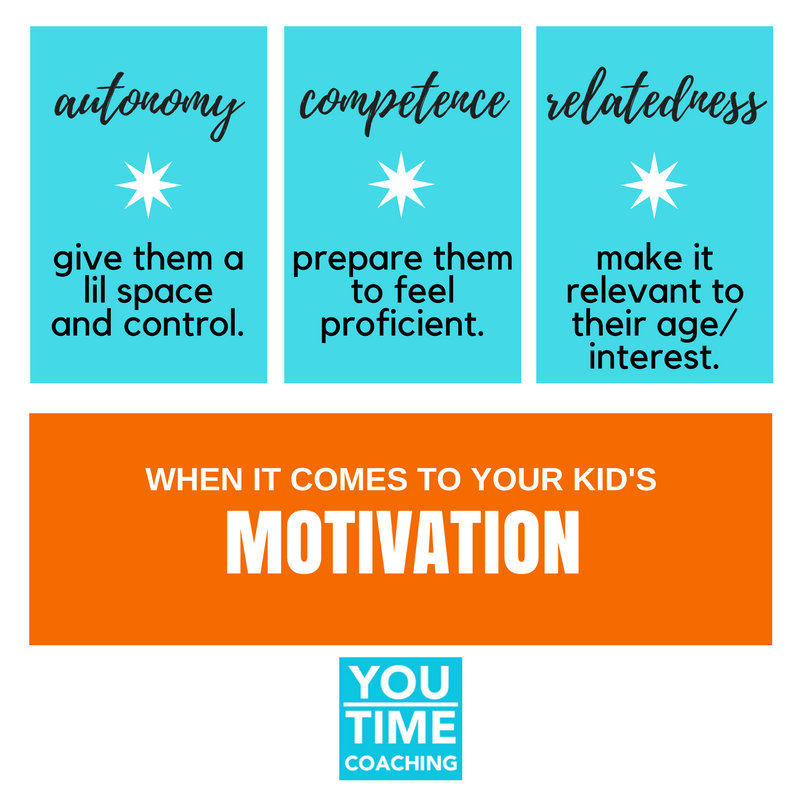
What goes into your kid’s motivation?
Just like when a kid doesn’t get their way, the thoughts kids have about their parents are changing by the minute. The importance behind these thoughts is where the focus should lay. Communication is typically always an underlying relationship issue between parents and kids. Check out these other blogs for helpful tips on communication with your teens, How to Love Your Kids When They Are Tough to Love and Do NOT Try to be Your Child’s Best Friend.
Feel free to leave comments below or on any of our social media pages to get a conversation going!
by YouTime Coaching | Apr 18, 2012 | Action, Attitudes, Beliefs, Change, Failure, Motivation, Potential, Purpose, Results, Self-Esteem, Success
Are you programmed for success or failure?
Lets get started:
Phase 1:
What are beliefs?
How do we create our belief system?
Lets begin with a simple definition of the word belief. For the purpose of how we will use the word, the definition of belief is,
a FEELING of ABSOLUTE CERTAINTY that something is TRUE.
I hope I made it clear enough that there are three major factors in defining a belief.
1. It is a feeling
2. You are absolutely certain of this feeling
3. This feeling is true.
If you were to tell me that you believe you could of run in the Boston Marathon this past Monday, than you are saying, “I AM ABSOLUTELY CERTAIN I COULD RUN IN THE MARATHON”.
I would say, good luck against those Kenyans.
Now, what do beliefs have to do with success or failure?
Phase 2:
Take out a pen, pencil, or marker and draw this diagram.
Case 1: Potential & Results
Lets start in the top right hand corner.
Do human beings have a lot of potential?
YES!! Humans are capable of incredible things.
Do human beings live up to their potential, giving us equally as incredible results?
NO! Don’t get me wrong humans do amazing things, but, as a whole, humans are capable of doing a lot more for themselves, others, and the environment that they live in.
…So based off of the diagram above, what is the culprit for having
HIGH POTENTIAL, but LITTLE RESULTS?
You got it! There is not enough ACTION.
Case 2: Action & Results
So we need some more action to achieve great results, right?
Not necessarily.
Imagine I ask you to go around your neighborhood to 100 homes, knock on their doors, and try to sell them a new diet pill by saying,
“Hey Buddy, buy this pill from me”.
I BELIEVE, a vast majority would decline purchasing.
This proves that HIGH ACTION does not always yield HIGH RESULTS.
Case 3: Belief
Relationship Example:
Your friends tell you that they have someone that would be perfect for you. So you get set up on a date, but with a group of people (feels a little more safe). When you look at the man or woman that you are supposed to be set up with, you realize, holy shit they are gorgeous.
Suddenly…The feeling in the pit of your stomach. It is telling you, “I am not as good looking as them, they probably won’t go for me. A guy/girl like that only go for good-looking people, I’ve got no chance.”
With this BELIEF (revisit the definition up top), are you going to be at a “high potential” to get the guy/girl you are suppose to be set-up with?
No.
With this belief in addition to low potential, do you believe you are going to pursue this as much as possible?
No.
Why would you pursue something you know will not work and is a waste of time.
DEFEATING BELIEF + LITTLE POTENTIAL
+ LITTLE ACTION = ?????????
LITTLE and DISAPPOINTING RESULTS!
Phase 3:
Take the mindset of someone that is rich, poor, happy, or sad and you can easily see why this cycle can serve as being a breading ground for success or failure.
This is why the rich get richer, the poor get poorer, the happy get happier, and the sad get sadder!
It all comes down to our beliefs. What we feel is absolutely true.
Am I confident?
Am I good enough?
Am I smart enough?
Am I good looking enough?
Changing your attitude and belief about these concepts, will drastically change our cycle and results!
Make this your focus.
Revisit your beliefs today and see what you can change.