
by YouTime Coaching | Sep 26, 2017 | Advice, Anxiety, Attitudes, boundaries, Children, Communication, Compromise, Consistency, Decisions, Emotions, Expectations, Failure, Fear, Fighting, Focus, Life Coaching, Listening, parenting, parents, positive reinforcement, Trust
As a parent, ever wonder what is going on inside your kid’s mind?
Through the positive work we have completed with adolescence, young adults, and families we’ve heard and seen almost everything. Kids want their freedom (sometimes without responsibility) and respect, while parents struggle with communication, setting boundaries, and timing.
Here are ten real thoughts direct from clients about their parents.
#1 I can’t talk to them because they will just get angry at me.
#2 All they care about are grades.
#3 They tell me to stop doing things that they do all the time and it’s bullshit.
#4 They won’t understand if I told them or will make me feel like it isn’t important.
#5 They choose when it’s convenient to say no and get upset.
#6 I don’t want to be like them.
#7 I tell them what they want to hear.
#8 When I actually try to talk to them about something that happened, I just get in trouble.
#9 When you start lecturing, I stop listening.
#10 When you trash my friends, I start disliking you, not them.
Remember, parenting is an imperfect process and so is being a kid. We are not sharing this list so you can take on all of the items one by one, instead, use it as a guide to see where more attention could be placed. When it comes to your kid’s motivation things can drastically change as they get older but if you’re able to adapt with the times, stay hip, and simultaneously hold true to healthy principles then this process could be easier on you.
Here’s just one easier way to think about motivation. Remember, in parenting, effort counts.
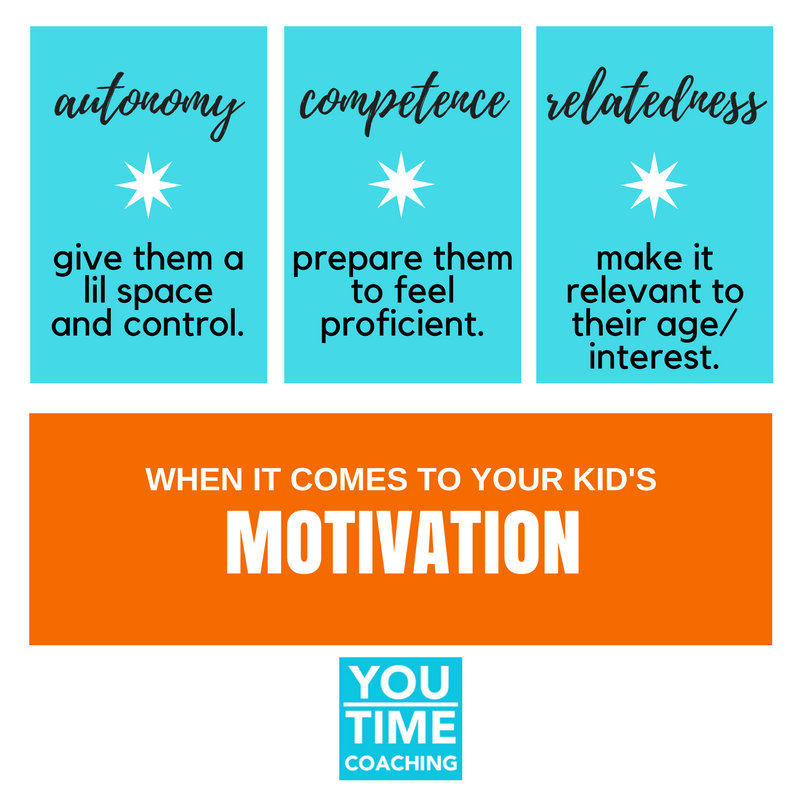
What goes into your kid’s motivation?
Just like when a kid doesn’t get their way, the thoughts kids have about their parents are changing by the minute. The importance behind these thoughts is where the focus should lay. Communication is typically always an underlying relationship issue between parents and kids. Check out these other blogs for helpful tips on communication with your teens, How to Love Your Kids When They Are Tough to Love and Do NOT Try to be Your Child’s Best Friend.
Feel free to leave comments below or on any of our social media pages to get a conversation going!

by YouTime Coaching | Mar 2, 2017 | Academics, Advice, Beliefs, Benefit, college, Decisions, high school, Preparation, steps, Success
A gap year is a year that students take between high school and college, usually doing some sort of structured, non-academic activity.
Sounds nuts. Why would anyone do this?
The reasons are many, but here are a few of the more common ones:
- A student is academically burnt out and needs a break from academics to recharge
- A student doesn’t yet have the maturity to succeed in college (did you know that the male brain and executive functioning capacity doesn’t fully mature until the late 20’s?!)
- A student has a passion that they want to pursue prior to college
- A student’s not that into the idea of college, (or parents aren’t that into the idea of dropping $200K on a “meh, I guess I’ll go” response)
- A student wants to gain more experience to then be able to make the best of college
- A student feels like they need another go at the college admissions process
Thinking the gap year might be right for your student? Here are some pros and cons to consider.
GAP YEAR: Pros
- According to an Australian study published in August in the Journal of Educational Psychology, taking a gap year is linked to higher motivation in college.
- Taking a structured Gap Year invariably serves to develop the individual into a more focused student with a better sense of purpose and engagement in the world.
- According to American Gap Association statistics, taking a gap year helped focus student academic and career paths: 84% say it helped them acquire skills to be successful in future careers, and 73% say the experience increased their college readiness.
GAP YEAR: Cons
- Some students may view the gap year as a vacation. Without a clear plan, the gap year can pass by without doing much positive good for your student. If your student isn’t willing to put in the work to plan a productive gap year, then they shouldn’t take one.
- Financial concerns can impact a student’s gap year. Not every parent can support their children completely during the gap year. Your student may need to work, or they may be able to secure a scholarship or grant from a gap year program or college.
Common Concerns
Even after discussing the pros and cons of a gap year, I typically hear three major concerns from parents:
- “Next year, my student will be ‘too old’ for college.” College isn’t high school: a college classroom often includes both lower- and upperclassmen, sometimes with graduate students or non-traditional students mixed in. Age is rarely an issue, especially a single year.
- “How do I know my student will go back to school?” This is one of my favorite excuses, because the best counter-argument is simply to wait until they work a full-time job. After 40-hour work weeks, most teenagers will beg to go back to school! In fact, according to a study, 90% of students who took a gap year ended up going back to school within a year. If you’re still concerned that your student may “drop out”, it may be wise to gain admission to a college that will allow a deferral enrollment for the following year.
- “Why should my student wait if s/he is ready now?” Adapting to a new set of academic and social responsibilities is not easy for everyone; the first semester of college is often a difficult transition. It can be fun and fulfilling to tackle these responsibilities on your own schedule, without the added burden of a strict class schedule, the stress of dorm living, or tuition. Your student may be ready intellectually now, but a gap year will likely leave them extremely prepared, not just ready.
If your student is considering a gap year, I always stress a well-rounded and structured approach, with an emphasis on personal growth. For example:
Summer: Apply for summer employment and begin planning for your upcoming fall.
September–January: You may want to participate in academic, social, and career enrichment opportunities specifically designed for gap years; some great places to find these opportunities are:
February–June:
- Apply for a job with the skills you learned from the fall, intern at a potential future workplace, or take a course at your local community college.
- You can also travel, especially if you needed the fall to help you save up for your trip.
July–September: Continue any of the opportunities you’ve started over the past year. Don’t forget to take time to relax and connect with friends!
The above plan is designed to help your student begin college after a gap year with a set of advantages: a rested mind, additional education (potentially in both the academic and career arenas), increased confidence from spending time in “the real world,” and an extra year of overall maturity. Too often, we allow personal growth to happen while we’re busy with other things. But especially during key transition times, the self should be the priority. Imagine how much more a student with a clear sense of passion and purpose can get out of the college experience!
Remember: college is ultimately about your student becoming their own person. Deferring enrollment until after a gap year can be a very rewarding stage on this personal journey, but only if it’s the right fit for your student!

Jay Bacrania CEO & Co-Founder of Signet Education
This blog was written by Signet Education’s CEO & Co-Founder, Jay Bacrania with assistance from Signet tutor, Matt Grzecki. Jay has worked extensively with both special needs and high achieving students. He has taken a broad academic path that spans the sciences and humanities. Jay holds an BA in Comparative Study of Religion from Harvard University and attended Berklee College of Music for two years for Jazz Trumpet Performance. Beyond tutoring, Jay is interested in managing and refining Signet Education. You can almost always bet on finding him there at all hours, teaching or finding ways to make Signet even better!
Signet Education provides exceptional individualized tutoring, test prep, admissions consulting, and organizational coaching for students.
by YouTime Coaching | Feb 25, 2014 | Brain, Certainty, Control, Decisions, happiness, Harvard, Mental Effort, Mental Health, Positive Psychology, Relationships, Shawn Achor, Stress, Uncertainty
Let’s talk happiness for a second.
Imagine that the amazing Professor Ben-Shahar or Shawn Achor, both of Harvard University’s Positive Psychology program asked
 |
| Tal Ben-Shahar |
YOU to give a lecture to a group of students on how to create happiness, make decisions that will increase your happiness levels, and ways to predict how happy you will be in any given circumstance.
 |
| Shawn Achor |
Maybe right now you have already formulated a speech in your mind that will be flawlessly delivered to the eager crowd of young students. They will hear your words of wisdom and leave the lecture hall feeling confident, optimistic and ridiculously more happy!
Or maybe not…
Recent major personal life changes, decisions, and transitions have motived me to write this piece on happiness. I will be sure to update everybody on these big life changes in a blog very soon.
Answer this quick question:
What do you have in your life right now that creates happiness for you?
My answer to this question contained items such as:
- Good relationships
- An amazing fiancé
- A great apartment
- A wonderful doggie (love you Bipsy!)
- A great job
- Financial security
- A nice car
- Health insurance
And a few other things that came quickly to mind.
Research shows that ONLY 10% of your long-term happiness is derived from these external factors.
There secret to 90% of your long-term happiness?
Answer: How your brain reacts to these external factors.
One of the biggest challenges with individuals and happiness today is that they believe they have absolutely no control over it.
When people lack certainty in their life and have an abundance of uncertainty, they are at a high risk of experiencing unhealthy amounts of anxiety.
Unfortunately debilitating levels of anxiety and happiness can not exist at the same time. This is why many therapists have clients create a “positive thought jar”. Individuals can not maintain a negative and positive thought in their minds at the same time. When you experience yourself focusing on a negative thought, go to your positive thought jar, and pull out a positive affirmation to combat the negative thinking.
It is funny and maybe you know this, most individuals feel they have little control over their own happiness yet 90% is derived through a process that happens within you!
Stop predicting and start looking at the hard facts.
Become a detective by taking some of your biggest stressors, successes, decisions, and relationships and begin dissecting what makes them stressful, exciting, negative, successful and/or challenging for you.
This is worth the mental effort!
Take 10 minutes now to play detective and figure out how your brain reacts to the list you created above.
YouTime’s Summary:
It is important understand that happiness does not come from the external factors around you, it is created within you by the way your brain reacts to those external factors.
The amount of expensive, lavish, and desirable possessions you have in your life is meaningless UNTIL your brain creates meaning for these things. The way your brain creates meaning to those possessions and relationships is unique to you. Take the time to understand yourself, your inner drives, and how you choose to react to your environment.
It is your brain.
It is your happiness.
Take control.
For more information regarding research on happiness, please visit:
Http://goodthinkinc.com/research/