
by YouTime Coaching | Feb 28, 2019 | Behavior, behavioral issues, Brain, Children, Control, Health, parenting
If you, a friend, family member, significant other, or even an imaginary friend have ADHD, then you know a couple things to be true.
First, chronic procrastination, disorganization, and poor sleep habits are at the core. Even so, please don’t let this fool you.
Let’s face the truth, there are stigmas, biases, and stereotypes about anyone with ADHD (kids and adults with ADHD have their own “special” stigmas…etc). Looking at someone else’s eight or ten year old kid and saying, “Well, glad thats not my problem.”, “That kid needs to be on meds.”, “Their parents need to really control them better.”…. and you get the point.
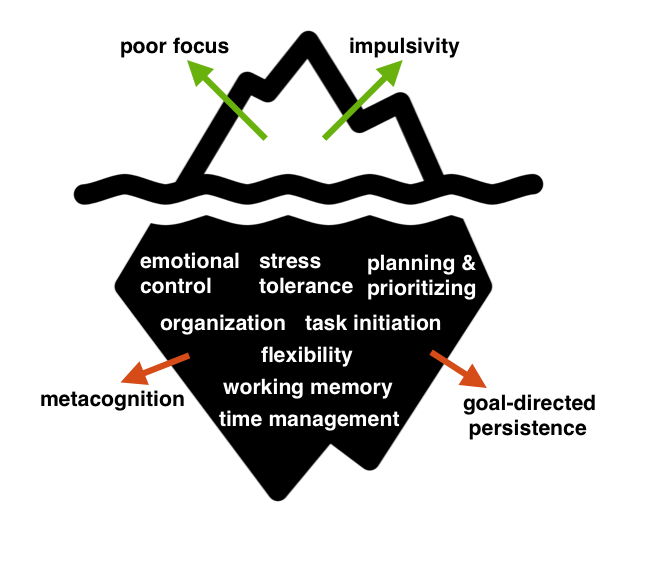
ADHD is like an iceberg.
I know you have all heard the analogies about icebergs, and at this point it may be getting old, but for your kid’s sake stick with me because the each iceberg analogy equally deserves its own attention, especially when we are talking about a disorder that effects sustained attention. You can do it. I think you get the point… below the surface can get messy.
Practice: Acknowledge and let go of your assumptions
Assumptions can lead us down some slippery paths, but more importantly it drastically affects our approach to problems and challenges. When we make assumptions, it impacts the experience of everyone involved.
Use your imagination and visualize any tough situation for your kid. Don’t go for the home run on this, simply choose something that brings up moderate levels of emotion. Now just sit there, think about this scenario, and complete a couple exercises.
• Take a second and write down what feelings come up for you (stress, irritation, anger…etc).
• Make a list of the reasons why you believe caused this to happen (laziness, not being motivated…etc).
• Sit down for one minute and breathe. Focus on your lungs expanding on your in breathe and your muscles softening on your out breathe. If your mind drifts to a distraction, bring yourself back to your breathe. Just one minute.
• After your minute of breathing ask yourself, could there be any other reason behind my child’s behavior? Could your child’s intentions behind the behavior be different than you thought?
At the end of the day, you can afford to take a minute and step away from an emotionally charged situation. This time away can help you gain just a little more clarity and open-mindedness, which last time I checked can go a long way to a kid.
*this blog was derived from the amazing book Mindful Parenting for ADHD by Dr. Mark Bertin.

by YouTime Coaching | Apr 26, 2017 | Anxiety, Behavior, Brain, Children, Depression, Distress, emotional problems, high school, Kids, Listening, parenting, Teenagers |
Part I: Emma’s Perspective
Most of us can remember during our teenage years the mundane writing assignments gifted to us by our teachers (not always their fault). They asked you to write essays “discussing the role of family in To Kill a Mockingbird, paying close attention to Aunt Alexandra.” or “from Steinbeck’s, Of Mice and Men, please discuss his descriptions of the natural world. What role does nature play in the novella’s symbolism?”.
Memory refreshed? Okay good, I’ll stop.
In most cases, the teachers will typically receive 3-4 variations of the same essay, coming from very similar perspectives. Reading these staple books, understanding their overarching themes and processing what it means to our current reality is quite useful. Yet still, during such a crucial time of physical and emotional growth for adolescents there is no replacement for a chance to write about something personal, of deep meaning, and most importantly brutal honesty.
So with all of this in consideration, what happens when you ask a teenager a more potentially vulnerable, subjective, and open-ended question to write an essay on? For example…
This leads us to Emma. On paper, Emma may sound like any ordinary high-school student. In reality, she is much more. Her personal journey towards self-acceptance is inspiring and can hopefully resonate with other kids the same age.
Here is Emma’s essay:
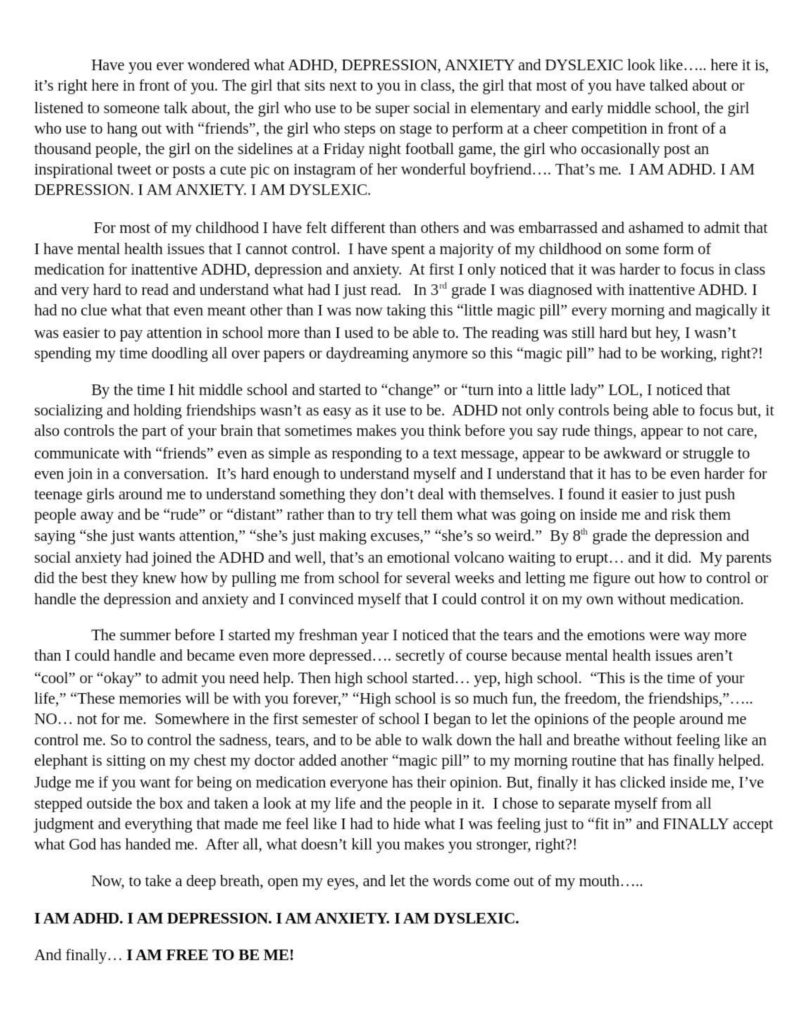 Amazing, huh?
We were able to snag some more of Emma’s time and ask her a few questions.
YouTime Coaching: Do you remember a moment when you realized things were “different” for you?
Emma: In elementary school things were easy and kids didn’t see me any different. Middle school is when I would say I started to realize that I could not complete things as fast or as easily as the other kids around me and I started to notice that I would say things without thinking, I would struggle to fit in with conversations my friends were have or when I would say something they would say “that isn’t even what we were talking about or that is stupid” and they were right, I found myself just saying random things to fit in. Eventually, I stopped talking in fear of sounding stupid or them laughing.
YouTime Coaching: What were some of your biggest frustrations during this process of understanding for you?
Emma: I would say my biggest frustrations are probably feeling so lonely and feeling like I will never find anyone that understands me. I am in high school now and teenagers are cruel, to be honest. Walking into a classroom and fearing the teacher will ask me to read out loud, walking into the lunchroom seeing all my old friends that I am no longer friends with because I did not know how to be a friend so to say… those are some of my biggest frustrations with myself.
YouTime Coaching: Who and what did you find most helpful in making some of the challenges more manageable?
Emma: My parents are so supportive and I know it has been so hard on them. I would say my mom has helped me more than anyone over the years. She has provided me with any ounce of information on ADHD, depression, anxiety, and dyslexia that she can find to help me understand what is going on with me. I would also say having a parent that is so motivated to educate herself in understanding me has been my biggest help.
YouTime Coaching: If you had a couple pieces of advice for another teenager going through something similar, what would the advice be?
Emma: Know that you are enough! Stop trying to “fit in” with kids that do not understand you and that do not care to understand you. TALK to someone, do not hold it in! Find someone that you are comfortable with and tell them how you feel no matter how dumb you may think it sounds. Oh, and fidget cubes… Those are lifesavers in school!!!!
YouTime’s take-home:
It could be a slip in grades, change in friends, hard time expressing emotions, or even controlling them. Teenagers can present their struggles very differently. Reaching the level of self-acceptance that Emma experienced takes a lot of courage, awareness, and support. Hopefully this story can be a testament to the power of parenting, genuine support for your teens, and that self-acceptance is a reality even in the midst of many personal challenges.

by YouTime Coaching | Jan 25, 2017 | Appreciation, Arguments, Attitudes, Behavior, Behavioral Change, behavioral issues, Brain, Change, Children, Communication, Control, Emotions, Growth, high school, Listening, parenting, parents, Problems, Reaction, Teenagers
Nobody said that raising a teenager would be easy and some parents may even think they should be rewarded a medal once they survive it. Statements that are made about adolescence and teenage years such as, “Surviving it“, “Getting through it”, are the real area of concern.
Although these times can be filled with risk-taking behaviors, a surge of independence, what seams to be minimal communication, and an abundance of “pushing back”, they must remain open to “the work” of the adolescent years.
WHAT’S “THE WORK” OF ADOLESCENCE?
Emerging science is proving at great lengths that some of the ways we used to think about adolescence may be quite off. On a weekly basis YouTime Coaching receives emails and phone calls that very honestly communicate the frustrations of being a parent to an adolescent.
Here’s what the conversation topics look like…
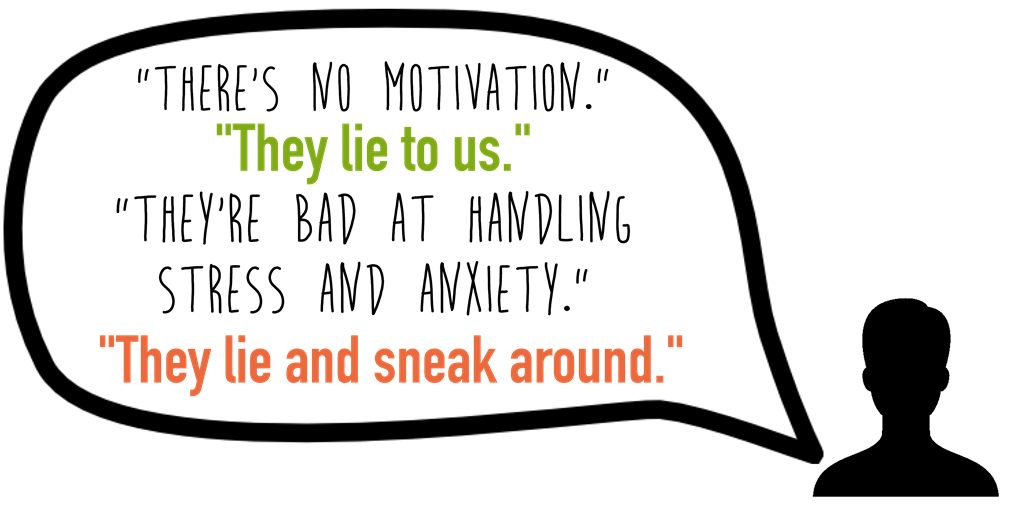
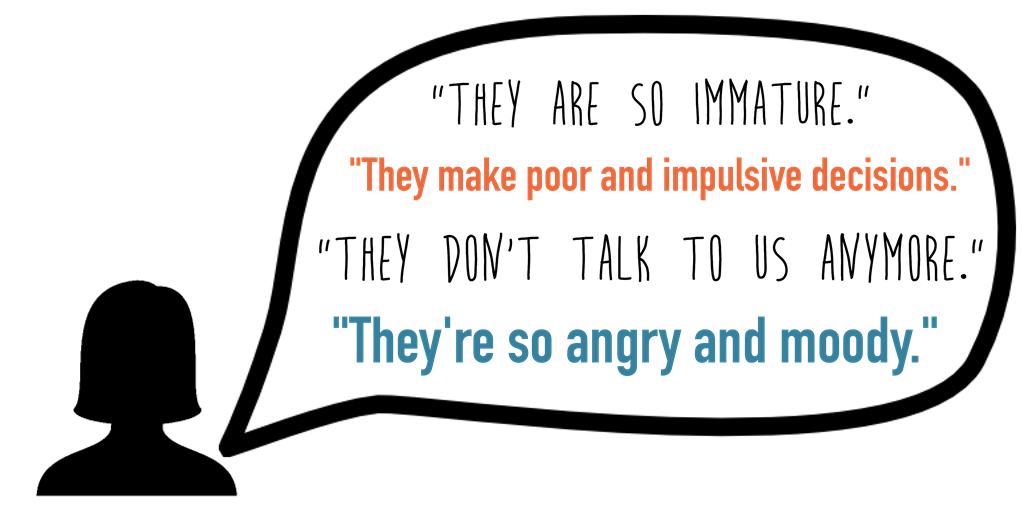
Here are a few things you need to know about the what the science is telling us.
“THEY JUST NEED TO GROW UP” MENTALITY WILL NOT HELP.
This line of thinking has existed for years and rightfully so, adolescence is a time of immaturity. The problem that lies within this way of thinking is that it frames adolescence as a period of time in which you must survive, simply try and get through, endure, and come out with minimal long-term scars.
Here’s a helpful change of perspective… Adolescence is not simply about maturity vs immaturity. During adolescence the brain goes through a rapid growth period and because of these changes new behaviors and abilities present themselves. All of those common “frustrations” (above) that we hear from parents aren’t just things that you need to endure but are newly developed abilities that will end up laying the groundwork for core personality traits your child will develop for use in adulthood.
Pushing boundaries, exploring decision making, getting a taste for independence, and being emotional may drive you crazy and caused tons of stress, but are all integral building blocks that each adolescent must go through. Use this time to cultivate positive experiences and lessons from those frustrations. Most importantly, be an active part of “the work” that goes into these crucial developmental period in your child’s life.
KNOW THE UPSIDES AND DOWNSIDES TO ADOLESCENCE.
Parent’s tend to have a keen eye for a child’s impulsive decision making, risky-behaviors, pushing boundaries with sources of authority, and their kids not wanting to spend time with them. What all of these behaviors have in common… they have an upside and a downside.
Novelty seeking and reward driven behaviors can motivate a child to explore new ways of doing things, allow them to keep an open mind to additional perspectives, and be open to change. The downside could lead to risky behaviors without a major thought or concern for the outcome, which leaves a child vulnerable.
Adolescence spending a lot of time with friend (and therefor little time with their parents) could help them develop strong social connections and support networks which are heavily correlated with happiness and mental wellness. The downside is that not being around adults and only being around peers increases their chances of risky behavior and minimizes the opportunity for guidance and knowledge from an adult figure, in turn increasing risky behaviors.
You see, each new ability and behavior that is formed during adolescence can have a profound impact on their develop towards adulthood. Stay engaged, but be aware of these new found abilities that your child may possess.
The inspiration for this blog came from an article written by Dr. Daniel Siegel. Dr. Siegel is a world renowned scientist and expert in the field of mindfulness. He has a wonderful ability to take complicated scientific findings and communicate them in a way that makes them practical and exciting. Please read his article “The Amazing, Tumultuous, Wild, Wonderful, Teenage Brain.” on mindful.org.
P.S.
If you are a parent or a young person who has had some challenges and would like to share your story, let us know in the comment section below! If you have any questions, and we mean any, you can send them right over to [email protected] or visit our page at www.YouTimeCoach.com.
by YouTime Coaching | Feb 25, 2014 | Brain, Certainty, Control, Decisions, happiness, Harvard, Mental Effort, Mental Health, Positive Psychology, Relationships, Shawn Achor, Stress, Uncertainty
Let’s talk happiness for a second.
Imagine that the amazing Professor Ben-Shahar or Shawn Achor, both of Harvard University’s Positive Psychology program asked
 |
| Tal Ben-Shahar |
YOU to give a lecture to a group of students on how to create happiness, make decisions that will increase your happiness levels, and ways to predict how happy you will be in any given circumstance.
 |
| Shawn Achor |
Maybe right now you have already formulated a speech in your mind that will be flawlessly delivered to the eager crowd of young students. They will hear your words of wisdom and leave the lecture hall feeling confident, optimistic and ridiculously more happy!
Or maybe not…
Recent major personal life changes, decisions, and transitions have motived me to write this piece on happiness. I will be sure to update everybody on these big life changes in a blog very soon.
Answer this quick question:
What do you have in your life right now that creates happiness for you?
My answer to this question contained items such as:
- Good relationships
- An amazing fiancé
- A great apartment
- A wonderful doggie (love you Bipsy!)
- A great job
- Financial security
- A nice car
- Health insurance
And a few other things that came quickly to mind.
Research shows that ONLY 10% of your long-term happiness is derived from these external factors.
There secret to 90% of your long-term happiness?
Answer: How your brain reacts to these external factors.
One of the biggest challenges with individuals and happiness today is that they believe they have absolutely no control over it.
When people lack certainty in their life and have an abundance of uncertainty, they are at a high risk of experiencing unhealthy amounts of anxiety.
Unfortunately debilitating levels of anxiety and happiness can not exist at the same time. This is why many therapists have clients create a “positive thought jar”. Individuals can not maintain a negative and positive thought in their minds at the same time. When you experience yourself focusing on a negative thought, go to your positive thought jar, and pull out a positive affirmation to combat the negative thinking.
It is funny and maybe you know this, most individuals feel they have little control over their own happiness yet 90% is derived through a process that happens within you!
Stop predicting and start looking at the hard facts.
Become a detective by taking some of your biggest stressors, successes, decisions, and relationships and begin dissecting what makes them stressful, exciting, negative, successful and/or challenging for you.
This is worth the mental effort!
Take 10 minutes now to play detective and figure out how your brain reacts to the list you created above.
YouTime’s Summary:
It is important understand that happiness does not come from the external factors around you, it is created within you by the way your brain reacts to those external factors.
The amount of expensive, lavish, and desirable possessions you have in your life is meaningless UNTIL your brain creates meaning for these things. The way your brain creates meaning to those possessions and relationships is unique to you. Take the time to understand yourself, your inner drives, and how you choose to react to your environment.
It is your brain.
It is your happiness.
Take control.
For more information regarding research on happiness, please visit:
Http://goodthinkinc.com/research/