by YouTime Coaching | Sep 26, 2017 | Advice, Anxiety, Attitudes, boundaries, Children, Communication, Compromise, Consistency, Decisions, Emotions, Expectations, Failure, Fear, Fighting, Focus, Life Coaching, Listening, parenting, parents, positive reinforcement, Trust
As a parent, ever wonder what is going on inside your kid’s mind?
Through the positive work we have completed with adolescence, young adults, and families we’ve heard and seen almost everything. Kids want their freedom (sometimes without responsibility) and respect, while parents struggle with communication, setting boundaries, and timing.
Here are ten real thoughts direct from clients about their parents.
#1 I can’t talk to them because they will just get angry at me.
#2 All they care about are grades.
#3 They tell me to stop doing things that they do all the time and it’s bullshit.
#4 They won’t understand if I told them or will make me feel like it isn’t important.
#5 They choose when it’s convenient to say no and get upset.
#6 I don’t want to be like them.
#7 I tell them what they want to hear.
#8 When I actually try to talk to them about something that happened, I just get in trouble.
#9 When you start lecturing, I stop listening.
#10 When you trash my friends, I start disliking you, not them.
Remember, parenting is an imperfect process and so is being a kid. We are not sharing this list so you can take on all of the items one by one, instead, use it as a guide to see where more attention could be placed. When it comes to your kid’s motivation things can drastically change as they get older but if you’re able to adapt with the times, stay hip, and simultaneously hold true to healthy principles then this process could be easier on you.
Here’s just one easier way to think about motivation. Remember, in parenting, effort counts.
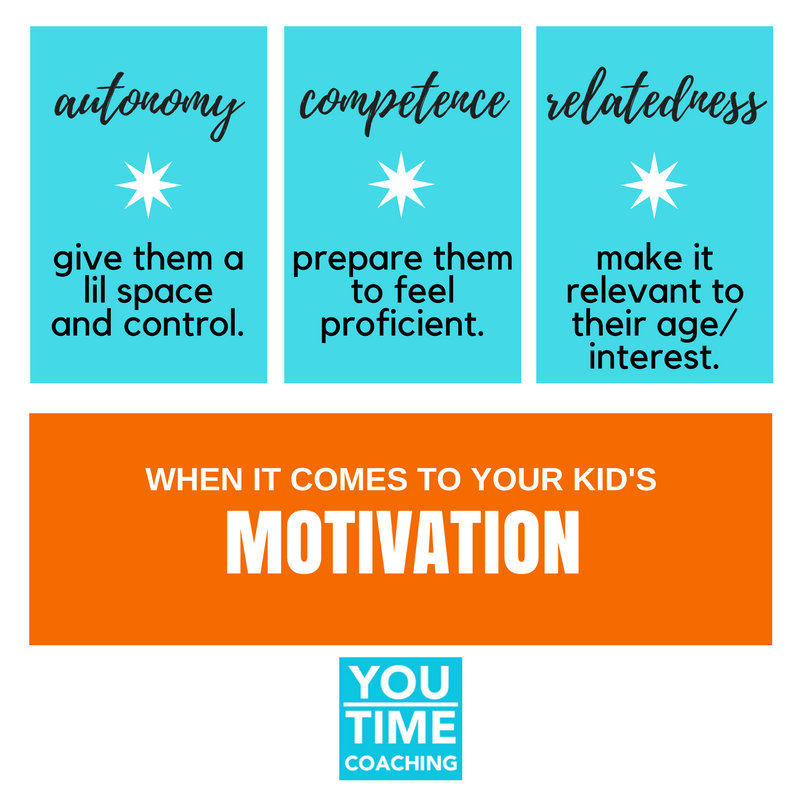
What goes into your kid’s motivation?
Just like when a kid doesn’t get their way, the thoughts kids have about their parents are changing by the minute. The importance behind these thoughts is where the focus should lay. Communication is typically always an underlying relationship issue between parents and kids. Check out these other blogs for helpful tips on communication with your teens, How to Love Your Kids When They Are Tough to Love and Do NOT Try to be Your Child’s Best Friend.
Feel free to leave comments below or on any of our social media pages to get a conversation going!

by YouTime Coaching | Jan 25, 2017 | Appreciation, Arguments, Attitudes, Behavior, Behavioral Change, behavioral issues, Brain, Change, Children, Communication, Control, Emotions, Growth, high school, Listening, parenting, parents, Problems, Reaction, Teenagers
Nobody said that raising a teenager would be easy and some parents may even think they should be rewarded a medal once they survive it. Statements that are made about adolescence and teenage years such as, “Surviving it“, “Getting through it”, are the real area of concern.
Although these times can be filled with risk-taking behaviors, a surge of independence, what seams to be minimal communication, and an abundance of “pushing back”, they must remain open to “the work” of the adolescent years.
WHAT’S “THE WORK” OF ADOLESCENCE?
Emerging science is proving at great lengths that some of the ways we used to think about adolescence may be quite off. On a weekly basis YouTime Coaching receives emails and phone calls that very honestly communicate the frustrations of being a parent to an adolescent.
Here’s what the conversation topics look like…
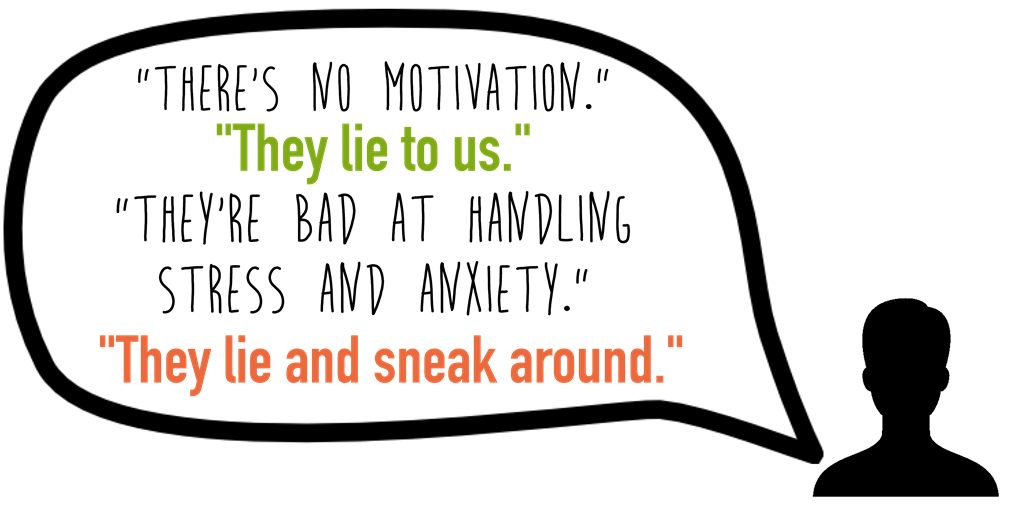
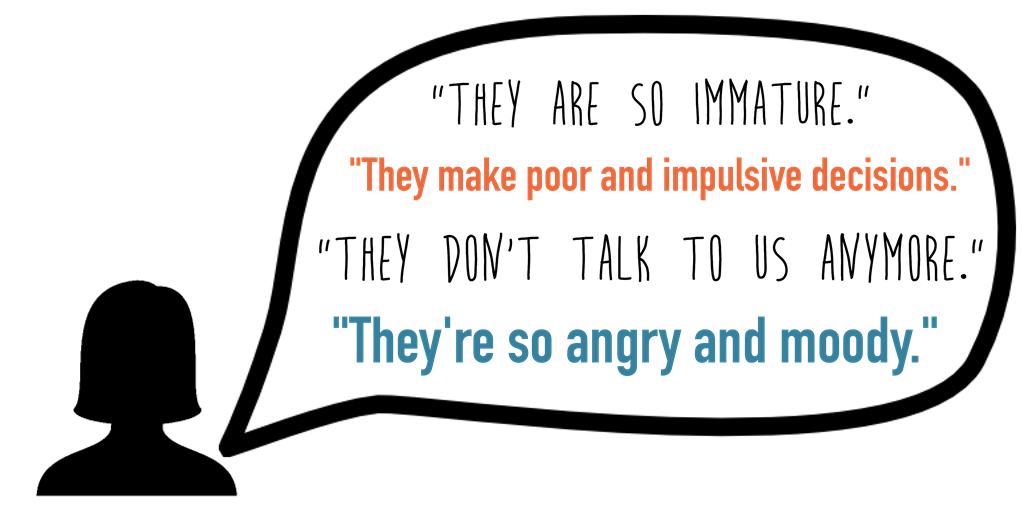
Here are a few things you need to know about the what the science is telling us.
“THEY JUST NEED TO GROW UP” MENTALITY WILL NOT HELP.
This line of thinking has existed for years and rightfully so, adolescence is a time of immaturity. The problem that lies within this way of thinking is that it frames adolescence as a period of time in which you must survive, simply try and get through, endure, and come out with minimal long-term scars.
Here’s a helpful change of perspective… Adolescence is not simply about maturity vs immaturity. During adolescence the brain goes through a rapid growth period and because of these changes new behaviors and abilities present themselves. All of those common “frustrations” (above) that we hear from parents aren’t just things that you need to endure but are newly developed abilities that will end up laying the groundwork for core personality traits your child will develop for use in adulthood.
Pushing boundaries, exploring decision making, getting a taste for independence, and being emotional may drive you crazy and caused tons of stress, but are all integral building blocks that each adolescent must go through. Use this time to cultivate positive experiences and lessons from those frustrations. Most importantly, be an active part of “the work” that goes into these crucial developmental period in your child’s life.
KNOW THE UPSIDES AND DOWNSIDES TO ADOLESCENCE.
Parent’s tend to have a keen eye for a child’s impulsive decision making, risky-behaviors, pushing boundaries with sources of authority, and their kids not wanting to spend time with them. What all of these behaviors have in common… they have an upside and a downside.
Novelty seeking and reward driven behaviors can motivate a child to explore new ways of doing things, allow them to keep an open mind to additional perspectives, and be open to change. The downside could lead to risky behaviors without a major thought or concern for the outcome, which leaves a child vulnerable.
Adolescence spending a lot of time with friend (and therefor little time with their parents) could help them develop strong social connections and support networks which are heavily correlated with happiness and mental wellness. The downside is that not being around adults and only being around peers increases their chances of risky behavior and minimizes the opportunity for guidance and knowledge from an adult figure, in turn increasing risky behaviors.
You see, each new ability and behavior that is formed during adolescence can have a profound impact on their develop towards adulthood. Stay engaged, but be aware of these new found abilities that your child may possess.
The inspiration for this blog came from an article written by Dr. Daniel Siegel. Dr. Siegel is a world renowned scientist and expert in the field of mindfulness. He has a wonderful ability to take complicated scientific findings and communicate them in a way that makes them practical and exciting. Please read his article “The Amazing, Tumultuous, Wild, Wonderful, Teenage Brain.” on mindful.org.
P.S.
If you are a parent or a young person who has had some challenges and would like to share your story, let us know in the comment section below! If you have any questions, and we mean any, you can send them right over to [email protected] or visit our page at www.YouTimeCoach.com.

by YouTime Coaching | Jan 18, 2017 | Attitudes, Behavior, Behavioral Change, Beliefs, Change, Commitment, Consistency, determination, Diet, Health, Mindset, Momentum, Preparation, Results, Therapy
Hey ladies and gentlemen, Captain Positive here to give you a dose of reality… the New Year may not be all that you are expecting. Fun fact is that people are absurdly good at reminiscing over all the good and bad things that have already happened in our past, but typically have more of an issue visualizing their future and things like New Year’s Resolutions take a major hit.
Not only do I bring you this wonderful news but I will also share with you, because it is quite important, the 3 things you can do in order to efficiently undermine your New Year’s resolutions.
After reading this blog you will basically be certified in how to teach others to properly screw up their plans for the New Year! (exciting… I know.) With this knowledge comes great power, because in order to be successful with your resolution(s) you must know what works in addition to whats makes you fall miserably on your face (and don’t worry, we all know that feeling). So the power is yours once you are done reading this. Choose how to use this information wisely.
[bctt tweet=”In order to be successful with your resolution(s) you must know what works in addition to whats makes you fall miserably on your face (and don’t worry, we all know that feeling).” username=”youtimecoaching”]
I present to you the “Reverse RPM” theory. As most of you know “RPM” stands for “revolutions per minute” and is a relative calculation of speed, so for this presentation the “Reverse RPM” theory will show you how to completely halt any forward progress, momentum, and speed you are looking to create for attaining your New Year’s goals.
Reverse RPM Theory
(R) Results
Problem:
Many of us have developed a wonderful tendency to be predominantly results and outcome driven. We start a diet and we only look to lose weight (and we better see results fast or on to the next diet found in Self Magazine).
Of the top ten most popular resolutions (Check them out here!) all of them take preparation, planning, and time. We typically undermine our resolutions by looking at them as short-term, outcome-oriented endeavors.
Solution:
A “New Year’s Resolution” is exactly that, a year-long resolution and goal. Do you stop going to the gym or eating healthy once you lose those 30 lbs. on June 21st of the new year? Well, you shouldn’t but lots of people do. Your resolution is a long-term goal that should be process-oriented, not simply outcome.
Sure you have an outcome in mind, but this outcome stays in your peripherals while the next small baby step stays in your direct line of vision. Your journey to get there needs to be clearly planned out, broken down, and assigned start/completion dates (download “My Mini Goals Worksheet” here).
(P) Preparation
Problem:
How many of you bozos knew that the new year started on a Monday? Who wants to get healthy and make changes over the weekend when you can start on Monday?! Are you going to dig yourself into a hole the weekend before or prepare yourself for an easier transition?
Assuming you already created a resolution, we can safely say that you have at least identified that there are behaviors that are problematic and stand in the way of your goals. Don’t we all! The first step after realizing you have “problem behaviors” is to prepare yourself in order to make the change. Unfortunately, our hedonistic (pleasure seeking) culture can sometimes force us into the “action stage” before proper planning. The result, 2 weeks of hard work towards your goal and reverting back to old ways (looks like your cigarettes will have their old best friend back).
Solution:
First, do a little detective work to figure out what your actual behaviors are, when they happen, and what triggers them (download “Track My Triggers and Patterns Worksheet” here). Second, really find out why you are looking to make these changes. First write down what positive benefits the change will bring to you (and others), followed by writing down how maintaining the problem behaviors have hurt you (and others).
Next, you must commit. Scream your goal from the biggest damn mountain top you can find (please don’t do this). Seriously though, tell friends and family what your intentions are with this resolution. People are more likely to feel accountable if others know what they are trying to do.
(M) Momentum
Problem:
Newton’s Law of Intertia (as it applies to New Year’s Resolutions)
An object at rest will remain at rest unless acted on by healthy and mindful decisions. An object in motion continues in motion with the same speed and in the same direction unless acted upon by your problematic behaviors.
Wait, so since I am going to be “all healthy and stuff” starting in January, that means I can shove my face with booze and food throughout the holidays and think of exercise as the walk to the bathroom. Don’t start in a hole.
Maybe I can smoke my face off and start fresh on January 1st. Or, since I will be saving so much money in the new year with my positive changes, I will definitely balance that out by spending tons of money over the holidays. Don’t start in a hole.
Don’t use December as an escape goat for your troublesome behaviors. This only will make things harder with a higher likelihood of failing to progress with your resolution.
Solution:
Start planning after the first week in December. Already into January? No problem! Part of successful goal setting is being flexible and adapting to what’s realistically going on around you. Spend 2 weeks planning out your path of success and seek out those that will support you in this (download the “My Support Team Worksheet” here). Most people try to begin their resolution after one of their most problematic months and that is a recipe for disaster! Set a realistic start date that allows you spend a couple week planning out your moves.
YouTime take home message:
Remember, knowledge is not power, it is only potential power. You have the choice in how to use it. So go on and use that huge brain of yours to properly plan or even screw up the new year and share your resolutions below!

by YouTime Coaching | Dec 7, 2016 | Academics, Attitudes, Behavioral Change, Change, Children, Communication, Direction, Life Coaching, Mental Health, parenting, parents, Problems, Self-Change, Self-Esteem, social problems, Stigma, Teenagers, Therapy, Trust |
Even a healthy and well-adjusted young person will have their fair share mood swings, moments of pushing back, impulsive decisions, and overall lapses in judgement. This is why parenting a young person consistently takes the top spot in The New York Times’ list of “Top 10 Easiest Professions”… yeaaaa right.
Whether the young person is in high-school or college it can sometimes be quite challenging to distinguish between “normal” and “could use some help”. So let’s clear a couple things up first regarding “help”.
Stigma.
Yes, unfortunately “getting help” still carries a substantially heavy stigma with it. For instance, it is very easy to assume that when you seek out professional help that something is broken and needs to be fixed. The young person is not broken, and neither are you. Here are a few other stigmas that may keep you and the young person from benefiting from additional support.
Misconceptions about getting help for a high-school/college age young person:
- If I get help, I am weak.
- This means I am crazy.
- (Typically parents) This is a waste of money.
- All you do is talk about my feelings.
- I will get medicated.
- Other people will think it’s (I’m) weird.
Stigmas have the power to not only prevent a young person from getting more specialized support but in many cases can create pretty harmful negative beliefs about who they are, how they are doing, and what their options are to start feeling better.
From the very beginning of the process, YouTime Coaching implements many strategies to combat some of these misconceptions. Here are a couple:
Trust Trust Trust:
With young people, trust is huge. That is why YouTime Coaching focuses right away on building a safe, secure, and trusting relationship between the young person and their coach. We believe that the young person’s relationship with their coach within the first month will determine much of their success in their work together. The coaches use strategic communication styles, in-between session check-ins, and work hard to create an relaxed judgment free zone.
Breaking the “Parent-Young person” Dynamic:
Sometimes simply being a parent makes it challenging to talk about the “tough things” with your young person. They see you through the “parent filter”, while you see them through the “young person filter”. YouTime’s Coaches are young, genuinely compassionate, and have the natural ability to connect with young people where it may otherwise be challenging for a parent to break through.
Take a look at www.YouTimeCoach.com to learn more about the process of coaching with young person, parents, and families.
When to get specialized help for your young person?
With the exception of when the young person asks for it, knowing when to seek out help can be challenging. Having some insight to what your young person’s baseline behaviors are can be helpful in assessing their/your need for some extra support. Here are a few things to keep on your radar but keep in mind that simply because you may see a change in these areas does not not necessarily mean your young person is struggling. It just means, keep communicating with them and finding ways to meaningfully connect, all while keeping your finger on the pulse to see if more evidence points to a “would it help it get some support?” talk.
- Their social life.
Questions to think about:
Has their friend group noticeably changed?
Are they spending a lot more time on their own?
Are they now jumping pretty hard into the party scene?
Is the young person having noticeable challenges in balancing their social life with other areas?
- Communication.
Questions to think about:
Has the young person’s communication patterns (language used, frequency, depth) drastically changed?
Is the young person “asking for help” but not necessarily coming right out and saying it?
Do you notice a rapid shift in mood when communicating with the young person?
Are you lost on how to communicate with the young person?
Have others communicated their concerns with you? (friends, teachers, bosses, siblings..etc)
- Academics.
Questions to think about:
Is there a noticeable drop in grade?
Are you seeing frequent absences or tardiness at school/work?
Have you received concerned communication from teachers?
Is your young person having trouble concentrating/focusing?
*if any young person you’re with has shown open, serious, and/or committed signs of harming themselves or others, please do not hesitate, call 911 and get professional help right away.
Remember, these questions are good starting points to give you a better understanding of what conversations to have with the young person, a professional, or somebody already in their support circle.
At the end of the day, if you still feel like something may be “off” with your kid and need to further figure out a plan of action, reach out to YouTime Coaching at [email protected].
by YouTime Coaching | Jan 16, 2013 | Action, Anxiety, Arguments, Attitudes, Certainty, Confidence, Direction, Fear, Fighting, steps, Success
Chapter 2: The Fight
Recap from Chapter 1: “Intro to Fighting” & “The Approach”
1. Arguing only has the POTENTIAL to cause negative outcomes
2. The Approach is the most important aspect of the argument.
3. The Approach directly influences the outcome of the argument.
4. The mental and physiological state you are in prior to the argument will direct the fight.
5. If you are in a state that will undermine your desired outcome of the argument you need a “jarring”.
6. Try the “Opponent Appreciation” and “Movie Theater Effect” techniques to create a more resourceful state and get the result you desire.
Chapter 2: The Fight

Arguing can be an extremely toxic event for any relationship or create an important opportunity for growth. The difference between heading down these two opposing pathways is monumental to relationships. The difference in these two paths can be found in just a handful of decisions.
This blog is to help you navigate how to experience growth, increase closeness, heightened intimacy, and developing feelings of accomplishment through an argument.
 Challenge: Your Relationship to Fighting
Take a second to right down some words that you associate with arguing. These words may be negative, positive, seem unrelated, or from direct experience. You may see fighting as a defense mechanism, a way for you to connect with others, or possibly a tactic that makes you feel important and noticed.
The importance of this exercise is to discover what cognitive relationships you associate to arguments and fighting. Once you recognize if your connection is positive or negative you can begin to witness its effects on “The Approach” and now how to change these limiting beliefs for “The Fight”
Definition
Limiting Belief: (noun) Thoughts and Beliefs that are manifested consciously or subconsciously that serve as obstacles and barriers to a desired or healthy behavior/decision.
“The Fight” is the ACTION stage within this whole process and where most people use their own style to out-perform their opponent and reign victorious.
The problem is developed because these “styles” that people use in their arguments are developed from typically subconscious feelings and can easily be expressed irrationally, untimely, and at your partners expense.
Our goal here is to develop arguing skills that will allow us to experience healthy growth, connection, certainty, and significance.
“Top 5 Rules to Successful Arguing”
1.Stay on Task
One of the biggest mistakes individuals make in arguing is that they do not stay on task. Understand what you are arguing about and keep this in mind with each point you bring up. When you feel like you are drifting away from the main topic, take second to regroup and jump back in. The last thing you want to be doing is yelling about who left the lights on, when the actual argument is about calling to say you will be home late.
2. Use “I” Statements
 Let’s face it, humans typically get defensive very quickly and on a large scale. No female wants to feel like a piece of property, while no man wants to feel completely bossed around. When addressing personal preferences and perspectives start your statement with, “I feel as though vs. You always” in order to convey (on a conscious and subconscious level) that you understand this may not be the case BUT this is how it makes you feel.
3. Cool-off
Under no circumstance should anybody be yelling. If it has reached this point, neither of you are being heard, there will be no winner (your relationship will suffer), you are negatively affecting those around you, and the argument has reached the toxic zone. If you feel as though you are going to yell it is completely permissible to say “This is a very important conversation and do think it is necessary to talk about it, but I need to take a couple minutes to regroup”.
4. Be Quiet
 Upwards of 90% of communication is non-verbal and if you don’t silence that yapper for a portion of the argument, you will miss all the important cues. Allow the other person to speak freely without interruption (this may be challenging, but that is normal). Listen to their points and much more importantly, how it makes them feel.
 Isn’t it the most frustrating thing in the world when you begin fighting with somebody who “loves to argue”. Quickly identify if you are one of those people. Do you contest, argue, and disagree with a high percentage of things around you? If so, keep this close to mind when arguing, because you are at higher risk of not “staying on task”. If you are one of these people, you tend to see your way and throw up the blinders for any other perspectives. Be flexible, honest, and open during argument.
Stay tuned next week for Part III of,
“The Science of an Argument”
Chapters 3-4: “The Resolution” and “The Aftermath”
Best,
Jonathan B. Wolf, Ed.M.
YouTime Coaching
www.YouTimeCoach.com
by YouTime Coaching | Apr 18, 2012 | Action, Attitudes, Beliefs, Change, Failure, Motivation, Potential, Purpose, Results, Self-Esteem, Success
Are you programmed for success or failure?
Lets get started:
Phase 1:
What are beliefs?
How do we create our belief system?
Lets begin with a simple definition of the word belief. For the purpose of how we will use the word, the definition of belief is,
a FEELING of ABSOLUTE CERTAINTY that something is TRUE.
I hope I made it clear enough that there are three major factors in defining a belief.
1. It is a feeling
2. You are absolutely certain of this feeling
3. This feeling is true.
If you were to tell me that you believe you could of run in the Boston Marathon this past Monday, than you are saying, “I AM ABSOLUTELY CERTAIN I COULD RUN IN THE MARATHON”.
I would say, good luck against those Kenyans.
Now, what do beliefs have to do with success or failure?
Phase 2:
Take out a pen, pencil, or marker and draw this diagram.
Case 1: Potential & Results
Lets start in the top right hand corner.
Do human beings have a lot of potential?
YES!! Humans are capable of incredible things.
Do human beings live up to their potential, giving us equally as incredible results?
NO! Don’t get me wrong humans do amazing things, but, as a whole, humans are capable of doing a lot more for themselves, others, and the environment that they live in.
…So based off of the diagram above, what is the culprit for having
HIGH POTENTIAL, but LITTLE RESULTS?
You got it! There is not enough ACTION.
Case 2: Action & Results
So we need some more action to achieve great results, right?
Not necessarily.
Imagine I ask you to go around your neighborhood to 100 homes, knock on their doors, and try to sell them a new diet pill by saying,
“Hey Buddy, buy this pill from me”.
I BELIEVE, a vast majority would decline purchasing.
This proves that HIGH ACTION does not always yield HIGH RESULTS.
Case 3: Belief
Relationship Example:
Your friends tell you that they have someone that would be perfect for you. So you get set up on a date, but with a group of people (feels a little more safe). When you look at the man or woman that you are supposed to be set up with, you realize, holy shit they are gorgeous.
Suddenly…The feeling in the pit of your stomach. It is telling you, “I am not as good looking as them, they probably won’t go for me. A guy/girl like that only go for good-looking people, I’ve got no chance.”
With this BELIEF (revisit the definition up top), are you going to be at a “high potential” to get the guy/girl you are suppose to be set-up with?
No.
With this belief in addition to low potential, do you believe you are going to pursue this as much as possible?
No.
Why would you pursue something you know will not work and is a waste of time.
DEFEATING BELIEF + LITTLE POTENTIAL
+ LITTLE ACTION = ?????????
LITTLE and DISAPPOINTING RESULTS!
Phase 3:
Take the mindset of someone that is rich, poor, happy, or sad and you can easily see why this cycle can serve as being a breading ground for success or failure.
This is why the rich get richer, the poor get poorer, the happy get happier, and the sad get sadder!
It all comes down to our beliefs. What we feel is absolutely true.
Am I confident?
Am I good enough?
Am I smart enough?
Am I good looking enough?
Changing your attitude and belief about these concepts, will drastically change our cycle and results!
Make this your focus.
Revisit your beliefs today and see what you can change.