
ADHD in Sports: What an Athlete, Parent, and Coach Needs to Know

ADHD in Sports: What an Athlete, Parent, and Coach Needs to Know

ADHD and Why It Matters in Sports

ADHD (Attention Deficit Hyperactivity Disorder) affects millions of students — and a growing number of high school and college athletes. We can get one thing straight: ADHD isn’t just about forgetting homework or bouncing off walls — it also shows up on the field, court, track, or wherever your kid is trying to shine in sports. 

While ADHD is often discussed in academic settings, it plays a big role in how athletes focus, train, compete, and recover. If your high school or college athlete has ADHD, you’ve probably seen it already. One second, they’re crushing it; the next, they’re staring into space while their coach explains a drill for the third time.

If you’re a parent of a student-athlete with ADHD, a high school or college athlete managing symptoms, or a coach working with neurodiverse players, understanding how ADHD impacts sports is crucial. Let’s talk about how ADHD messes with (and sometimes boosts) sports performance — and what to do about it.

Whether the young person is in middle-school, high-school or college it can sometimes be quite challenging to distinguish between “normal” and “could use some help” (especially these days). So let’s clear a couple things up first regarding “help”.

How ADHD Affects Athletic Performance

Athletes with ADHD may bring a ton of passion and energy to the field — but they also face unique challenges. Here’s how ADHD can influence sports:

 INCONSISTENT FOCUS

  • Trouble following multi-step instructions
  • Drifting attention during plays, drills, or team meetings
  • Zoning out at key moments

IMPULSIVE BEHAVIOR

  • Jumping the gun on plays
  • Taking risks without thinking them through
  • Higher rates of fouls or penalties

EMOTIONAL REACTIVITY

  • Frustration can spiral quickly after mistakes
  • Trouble bouncing back from criticism or losses
  • Difficulty regulating emotions under stress

SLEEP AND RECOVERY STRUGGLES

  • Many athletes with ADHD have disrupted sleep cycles
  • Poor sleep = slower reaction times, lower energy, and higher injury risk

INCREASED INJURY RISK

A study in Sports Health found that college athletes with ADHD are more likely to get injured — likely due to impulsivity or distraction during play.


ADHD Strengths in Sports

It’s not all challenges. In fact, ADHD can be a superpower in the right athletic environment.


  • High energy: Ideal for high-intensity or endurance sports
  • Hyper-focus: Being locked in and maintaining a deep concentration during games
  • Creativity: Thinking outside the box can lead to smart and unexpected plays

Practical Strategies for Success


FOR STUDENT-ATHLETES WITH ADHD:

Use short-term goals:

 Break practice into 10-15 minute mental time blocks with “missions” for each block.

Create a pre-game routine:

Use the same warm-up (include mental rehearsal, paced breathing, progressive muscle relaxation, and an inner-dialogue script to help cue/prime), create a “hype” and “chill” playlist, and be consistent because consistency = less chaos

Ask questions to get clarity:

Don’t pretend to understand a play — clarify it with one of the coaches or another player. Ask for DIRECTIONS or a different way of explaining something if you need it.

Move during downtime:

Stretch, pace, or shake out between drills

Cool down mentally:

Journal, breathe or debrief after games or practices

Prioritize sleep:

No screens in bed, and try to keep

consistent sleep/wake times

Work with your doctor on meds:

Timing matters for performance (with both stimulant and non-stimulant medications)


FOR coaches working WITH athletes who have ADHD:

keep instruction clear and short.

Adhd impacts working memory and sustained attention. Communicating in this way will help reduce some of those added challenges.

repeat key information or provide an ADDITIONAL visual or kinesthetic example 

most people learn through a combination of teaching styles. some players may need you or a teammate to physically demonstrate, write directions down, or HAVE a visual cue, and others may need directions repeated.

allow movement between drills

Movement can help with focus. Come up with a couple of exercises and movements that are appropriate for the environment. the goal is to provide structure and support that will allow for self-regulation while minimizing distractions for others.

Don’t over-personalize the behaviors:

frequently, fidgeting AND quick/intense EMOTIONS can be perceived as disrespect. with someone who has adhd, it is typically far from the truth.

help build emotional resilience after setbacks:

Journal, breathe, or debrief after games and practices.

connection over consequence:

ask how you can support them, not just discipline them.


FOR parents of athletes with ADHD:

Build routines at home:

 Focus on establishing routines around getting your gear together, meals and snacks, and bedtime

Talk to your kid(s) about how adhd can show up in sports: 

Use this article or the resources at the end to guide your conversation.

normalize needing extra support

adhd is a NEURODEVELOPMENTAL disorder, not a character flaw. there are plenty of professional athletes facing the same struggle and need extra support.

advocate with coaches and school staff:

adhd support doesn’t stop in the classroom. plus, someone with adhd needs to have that advocacy muscle to flex. leading by example provides positive modeling for the young person. 

focus on progress, not perfection:

Your kid’s inner critic is likely already too harsh, so focus on progress and the process VS. outcomes and perfection. adhd minds frequently have issues with “all or nothing thinking, “ so teach them to live in the gray sometimes. 


Helpful ADHD Resources for Student-Athletes and Families

Helpful ADHD Resources for Student-Athletes and Families

Final Takeaway: ADHD Isn’t a Limitation — It’s a Playbook You Need to Learn

Whether you’re a parent, a coach, or an athlete on the field, understanding ADHD is the key to unlocking performance, potential, and peace of mind.

ADHD athletes are not broken—they’re just built differently. They can reach their optimal performance with the right structure, support, and mindset. 

If you would like to find out more about our coaching, visit the ‘GET HELP NOW‘ page by clicking above or sending us a message below. You can also reach out to YouTime Coaching at [email protected]

Send us a message:

14 + 12 =

How to Know When a Young Person Needs a Life Coach

How to Know When a Young Person Needs a Life Coach

Even a healthy and well-adjusted young person will have their fair share mood swings, moments of pushing back, impulsive decisions, and overall lapses in judgement. This is why parenting a young person consistently takes the top spot in The New York Times’ list of “Top 10 Easiest Professions”… yeaaaa right.

Whether the young person is in middle-school, high-school or college it can sometimes be quite challenging to distinguish between “normal” and “could use some help” (especially these days). So let’s clear a couple things up first regarding “help”.

1. OH THE LABELS

Yes, unfortunately “getting help” still carries a substantially heavy stigma with it. For instance, it is very easy to assume that when you seek out professional help that something is broken and needs to be fixed. The young person is not broken, and neither are you. Here are a few other stigmas that may keep you and the young person from benefitting from additional support.

Misconceptions about getting help for a high-school or college age young person:

    • If I get help, I am weak.
    • This means I am crazy.
    • (Typically parents) This is a waste of money.
    • All you do is talk about my feelings.
    • I will get medicated.
    • Other people will think it’s (I’m) weird.

    Stigmas have the power to not only prevent a young person from getting more specialized support but in many cases can create pretty harmful negative beliefs about who they are, how they are doing, and what their options are to start feeling better.

    From the very beginning of the process, YouTime Coaching implements many strategies to combat some of these misconceptions. Here are a couple:

    2. TRUST TRUST TRUST

    With young people, trust is huge. That is why YouTime Coaching focuses right away on building a safe, secure, and trusting relationship between the young person and their coach. We believe that the young person’s relationship with their coach within the first month will determine much of their success in their work together. The coaches use strategic communication styles, in-between session check-ins, and work hard to create an relaxed judgment free zone.

    3. Breaking the “Parent-Young person” Dynamic

    Sometimes simply being a parent makes it challenging to talk about the “tough things” with your young person. They see you through the “parent filter”, while you see them through the “young person filter”. YouTime’s Coaches are young, genuinely compassionate, and have the natural ability to connect with young people where it may otherwise be challenging for a parent to break through.

    Take a look at www.YouTimeCoach.com to learn more about the process of coaching with young person, parents, and families.

    When to get specialized help for a young person?

    With the exception of when the young person asks for it, knowing when to seek out help can be challenging. Having some insight to what your young person’s baseline behaviors are can be helpful in assessing their/your need for some extra support. Here are a few things to keep on your radar but keep in mind that simply because you may see a change in these areas does not not necessarily mean your young person is struggling. It just means, keep communicating with them and finding ways to meaningfully connect, all while keeping your finger on the pulse to see if more evidence points to a “would it help it get some support?” talk.


    1. LOOK AT THEIR SOCIAL LIFE

     (EVEN GIVEN THE CURRENT CIRCUMSTANCES)


    Questions to think about:


    Has their friend group noticeably changed?

    Are they spending a lot more time on their own? 

    Are they now jumping pretty hard into the party scene? 

    Is the young person having noticeable challenges in balancing their social life with other areas?


    2. COMMUNICATION


    Questions to think about:


    Has the young person’s communication patterns (language used, frequency, depth) drastically changed?

    Is the young person “asking for help” but not necessarily coming right out and saying it?

    Do you notice a rapid shift in mood when communicating with the young person?

    Are you lost on how to communicate with the young person?

    Have others communicated their concerns with you? (friends, teachers, bosses, siblings..etc)


    3. ACADEMICS


    Questions to think about:


    Is there a noticeable drop in grade? 

    Are you seeing frequent absences or tardiness at school/work?

    Have you received concerned communication from teachers? 

    Is your young person having trouble concentrating/focusing?


    *if any young person you’re with has shown open, serious, and/or committed signs of harming themselves or others, please do not hesitate, call 911 and get professional help right away.

    Remember, these questions are good starting points to give you a better understanding of what conversations to have with the young person, a professional, or somebody already in their support circle.

    At the end of the day, if you still feel like something may be “off” with your kid and need some help to figure out a plan of action, reach out to YouTime Coaching at [email protected], visit the ‘GET HELP NOW‘ page above, or send us a message below.

    13 + 4 =

    The New Stress Is Upon Us

    The New Stress Is Upon Us

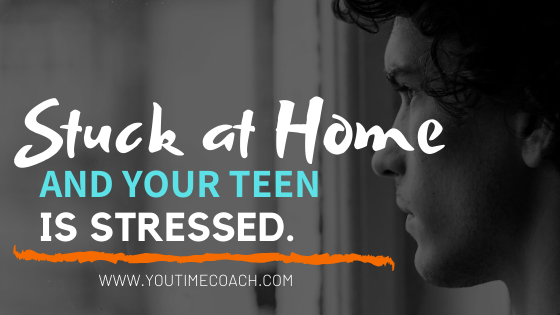
    The stress of being a full-time teenager has recently changed.

    Parenting and being a teen looks very different today than compared to 6 months ago. Being a teenager stuck at home, with all of these imposed changes and not as many obvious outlets can be a disastrous equation. It is not easy. Between the pressures of everyday life as well as their developmental change, it is normal for teenagers to experience what seems to be crazy levels of stress.

    It beats being in school.

    I’ve recently heard this statement from clients a number of times. Of course, there is truth to it and you have to acknowledge this point as a parent. There are three specific things to keep in mind when it comes to your teen during what could be an extremely challenging time. (not all may apply to your teen and it varies to what degree they may experience them)

    THE FIRST POINT: Teens can struggle to see “the bigger picture”. I refer to this as metacognition. When working with teens, they honestly don’t give a shit about hearing the actual word (metacognition) and in fact, are quite bored by words that are unnecessarily long, hard to spell, and don’t seem personally relevant. So, I spend very little time on the word itself and jump into the concepts of “bigger picture”, “taking a step back”, and objective thinking. The visual of being able to experience your (stress/anxiety/depression) “storm” through looking out of a window inside the house versus being in the middle of the storm itself.

    Seeing the bigger picture can help with managing stress levels. It requires that you to take a step back and look at things from an objective perspective.

    Right now, there are plenty of opportunities to be swept away in the sea of news, social media, fear, uncertainty, and imposed lifestyle changes. When a teen has trouble really seeing the bigger picture, it typically forces them to pursue things that are more based on instant gratification and avoidance. Here enters the wonderful world of technology and my second point.

    THE SECOND POINT: Be prepared for a major spike in cell-phone, video game, computer, and tv time. This may be obvious and already underway for many families. Here are the concerns. While you can always throw out the “correlation doesn’t equal causation” defense, there are clear indicators that social media and screen time affects the relationship teens have with anxiety and depression. More specifically, there are plenty of reasons (and data) to support the fact that it is closely tied to increased depression and anxiety in teens (Child Mind Institute Article / Anxiety and Depression Associaton of America Article).

    INSTANTLY download your FREE eBook to reduce at-home screen time with your kids!

      We respect your privacy. Unsubscribe at anytime.
      Powered By ConvertKit

      For kids who already have anxiety/depression (who doesn’t?!) and ADHD, this moment in time and the coming weeks could likely be an uphill battle for most parents. Check out our blog, “Help I’m a Reactive Parent to gain some strategies to better handle the more contested topics of conversation.

      Now is a time when both parents and their teens will be living on electronics. Monitoring usage and incorporating other activities could help keep anxiety and depression at bay.

      THE THIRD POINT: If your teen already has trouble with Anxiety/Depression or ADHD, you may start to see how this really affects them over the course of a day (and you may not like what you see).

      Most parents have a block of time where their children are off at school, being monitored by other adults, and don’t witness first hand just how your child goes about sustaining themselves over the entire day. Many kids hold their shit together as much as possible while at school, only to “let loose” as soon as they get home. Our current circumstances now have everyone in relatively close quarters, a fraction of the freedom to “get out of the house”, and the bonus… most high-schools (that tried to make the online thing work) aren’t grading assignments, don’t expect them to be turned in, or even for kids to really learn the concepts. This is happening for many reasons, but it leaves us with a fundamental problem.

      Kids are at home, can’t leave, and aren’t expected to do school-work. Let’s give a warm welcome the countless hours of video games, social media, youtube videos, and screen time that your teen is going to get. I am on the Advisory Panel for Phase2Parenting, a site that is geared towards providing top-notch advice and resources to parents of teens and tweens. Check out Phase2Parenting’s article, “How Much is Too Much: Technology Addiction and How to Manage It” and get some support while your kids are couped up in the house.

      Small amounts of stress are manageable and even beneficial at times, stress can quickly become overwhelming and can result in decreased physical and mental health for your teenager.

      Email us at [email protected] if you need to talk, have questions, or would like to know how to make this a little easier.

      THE SKINNY ON CBD OIL, ADHD, AND WANTING ANSWERS.

      THE SKINNY ON CBD OIL, ADHD, AND WANTING ANSWERS.

      CBD oil and the Kardashian’s have something in common, they both get a lot of press. With that press coverage, it leaves many families sifting through tons of articles, trying to find some reliable information. Typically when we are searching for answers with some pre-established knowledge about what the options out there are (especially when some of the other options have come up short), we sometimes fall prey to a common cognitive bias.

      Confirmation Bias: a tendency for people to actively search out information that aligns and confirms their preconceptions.

      I’ll give you two reasons why this cognitive error can be harmful in making decisions related to treatment options for ADHD.

      • When falling prey to the confirmation bias you will typically give weight and value to the information that aligns with your preconceptions (regardless of what that information is really saying).

      • While in the grasp of the confirmation bias you will typically discount and minimize information that contradicts your preconceptions (even if that information is important/valuable/necessary).

      Cannabidiol Oil (aka CBD Oil) is a product coming from the marijuana plant. There are many compounds (more than 85) in the cannabis plant, but CBD oil is one that is receiving a lot of enthusiasm. In some cases, it should. In others, we are leaping way beyond what is being presented in the data.


      Want less arguing, better communication, and more smiles to go around with your child? Check out YouTime’s parenting model, The Rise Method. Completely free, just throw your email in below.


      The Research…

      Typically this section starts by saying, “research on CBD Oil is relatively new”. When searching for answers to your own ADHD symptoms or somebody else’s, that is not what you want to see.

      John Mitchell, PhD, a research from the Duke ADHD Program says,

      “When parents or adults look into CBD oil for someone with ADHD it’s not just that there’s a lack of evidence out there right now. There have been no treatment studies. There are no randomized trials that show it works, and there are other treatment options available for kids and adults with ADHD. These are unregulated products. If there are not well-regulated products, how do we know that we’re really getting what’s being advertised?”

      Read in more detail here:

      https://chadd.org/attention-article/cbd-oil-for-adhd/

      or download the PDF here:


      The Benefits of Adding a Furry Friend to Therapy and Coaching

      The Benefits of Adding a Furry Friend to Therapy and Coaching

      It’s been on Dr. Phil.

      Traditional therapy in an office setting can work for many, but for some, it’s tough to get off the ground. Don’t give up, because, for those that have tried or are adverse to traditional therapy, there are many options. One great option is Animal-Assisted Therapy (AAT). It’s possible you have heard about this type of therapy on Dr. Phil, The Doctors, or Dr. Oz, but it’s your lucky day. Read on as Charlsey Gentile, Owner of Life Is Golden Coaching and practitioner of Animal Assisted Therapy explains a bit more about AAT.


      Imagine this — you are taking an enjoyable walk on a cool autumn afternoon where the leaves are changing and the sun is shining.  While on your walk you see someone sitting on a bench. What do you do:

      • Walk by?
      • Say Hello?
      • Smile?
      • Pay no attention at all?
      • Approach the person and engage in conversation?

      In Comes Animal Assisted Therapy (AAT):

      New scenario — it starts the same way, yet the only difference is that the person sitting on the bench is with their dog. Do you react differently in this situation than in the one above? Research shows that people are more inclined to approach an/or engage with others if they have a dog with them (UCLA’s Findings on Animal Assisted Therapy).

      Now imagine you or maybe your child, are about to embark upon a first counseling session. This can often make one feel vulnerable. As humans, we tend to be judgemental of ourselves and feel that others may also be judging us. Now imagine that a dog is at the counseling session. Did you smile or maybe feel less nervous about the situation? Does this sound like a welcomed addition to counseling?  If so, you are in luck! This practice actually exists and it is called Animal-Assisted Therapy (AAT).

      AAT is when a professional in a specific field pair with a trained and certified animal to help enhance his or her practice.  For counseling, dogs can function as a distraction, a point of common interest to start the conversation, help in developing the counseling relationship, and be a non-judgemental (albeit passive) participant in the sessions.

      Benefits of AAT:

      To top it all off, the presence of an animal and/or the act of petting an animal can do the following:

      • Release feel-good hormones
      • Help reduce anxiety
      • Provide comfort
      • Be an icebreaker
      • Lower blood pressure
      • Slow down breathing and heart rate
      • Create a more enjoyable counseling environment.

      For those who love (or even like dogs) or have children who do this can be a wonderful option when looking for support in your own journey.

      [email protected]

      https://sites.google.com/view/lifeisgolden/