
by YouTime Coaching | May 19, 2017 | Advice, Appreciation, Behavior, Benefit, boundaries, Children, Communication, Direction, Dreams, Growth, Human Needs, Insight, Kids, parenting, parents, Positive Psychology, positive reinforcement, Support, Teenagers, Understanding
Kids can be a pain in the ass sometimes.
Harsh words? Maybe. One thing is for sure though, those words are definitely filled to the brim with truth… harsh truth. This isn’t taking away from your unconditional love for them, it’s simply acknowledging that kids can sometimes do things that are very tough to love.
This is why parents turn to advice from others, seek out simple solutions, and time hacks. Sometimes it isn’t all that easy and you give into your frustrations, irritations, and anger. As parents, you are teachers, EVEN WHEN IT SEEMS YOUR KID DOES NOT WANT TO LEARN FROM YOU. Because the eyes are always on you, the advice you get absolutely needs to be solid.
YouTime Coaching’s extensive work with high-school and college students along with all of the hours worth of support for parents has allowed us to understand some keys elements in how to be a great teacher for your child even during those tough times. When it comes down to it, a child wants to understand, perceive they have some control, and feel supported in a non-judgmental way.
The hardest times to be a “good teacher” with your kids? (never thought you’d ask!)
Just to mention a few:
- when setting boundaries
- when you are angry, frustrated, or irritated (and sometimes hungry)
- when parents are on different pages
- when you feel as though your child is not listening
- when “nothing else seems to work”
- when your kid is an adolescent
- anytime
We don’t want you to be good teachers… we want you to be in many cases the kind of teacher “you wish you had growing up”, the kind of teacher that is more emotionally available than some families had in previous generations, and most importantly we want you to be the type of teacher that not only shows but explains the benefits in learning from failures, how to be compassionate to yourself and others, and have enough awareness/knowledge about what they are doing and why they are doing it.
For these reasons and with an entire year of putting together some of the most effective researched methods of teaching, motivation, and human behavior we have creating the “R.I.S.E. Method of Parent Teaching”.
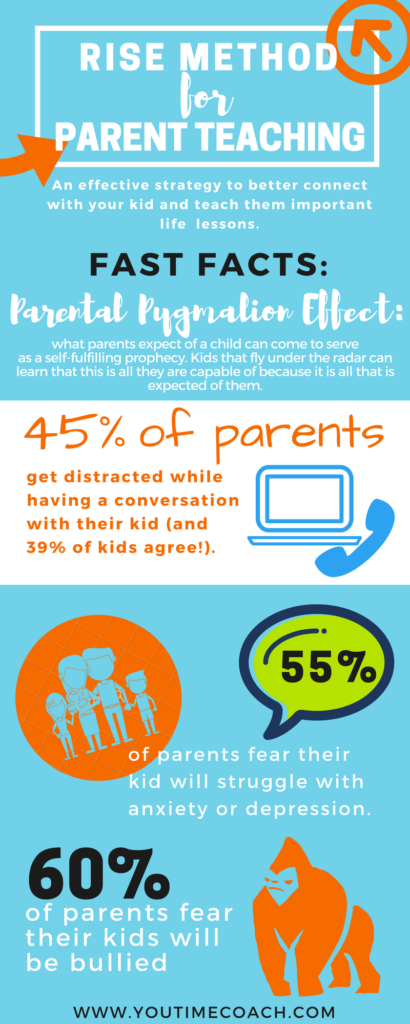
The premise behind the acronym “R.I.S.E.” is for parents to use the powers of awareness, communication, non-judgmental support, and compassion as a way to elevate their parenting and ultimately their relationship with their child.
Use can use this method while trying to set boundaries with your children, teach them important lessons, disciplining (btw before disciplining your kid read this amazing article, https://www.verywell.com/what-is-child-discipline-620113), and even just trying to improve your communication with them.
Remember, punishment is easy, discipline is hard. Implementing this method may be challenging and outside your comfort zone, if you need some guidance please drop us a line!
DOWNLOAD THE R.I.S.E. METHOD HERE.

by YouTime Coaching | May 12, 2017 | Anxiety, Behavior, Children, Depression, Distress, emotional problems, high school, Kids, Listening, parenting, Teenagers
Part II: From the Parent’s Perspective
In Part I, we met Emma, the brave high-school girl that traveled down the bumpy road towards self-acceptance. Through all of the anxiety, depression, and frustration of trying to understand “who she really is”, Emma found a way to finally accept the things she struggled with in life. Go ahead and get a refresher, or just read Part I for the first time here.
As a parent, seeing your child struggle can be heart wrenching. Some parents want to swoop in to help ease the discomfort (both yours and your child’s), while others may think these are “necessary learning experiences”. Many parents though are not even aware of how they respond to these types of conflicts (btw if you are curious to learn more about your conflict style, find out more through this assessment YouTime Coaching Conflict Mode Assessment)

As a parent one of the most impactful things you can do is be present for your child. Not passive, avoidant, accommodating, but present. Whether your 50 years old or 15, we all have the same needs (we just may meet them differently).
A parent’s own fear, insecurity, anger, and even sadness can prevent them from being fully present for their kids when they may need it the most. The symptoms of struggle for a young person may not be blatantly obvious, which makes being present, aware, and appropriately involved that much more important.
In our interview, Emma’s mother (Kate) shares a little bit about her experience during the time that her daughter was trying to “figure it all out”.
YouTime: When did you realize that your child had challenges that affected her everyday life?
Kate: When she was around nine we noticed challenges with school work. When she hit middle school the social challenges began to appear more than ever and the insecurities controlled her.
YouTime: What was the evaluation and assessment process like for you and your child?
Kate: When she was in the third grade her school contacted us regarding her inability to pay attention. She had no idea what that meant and thought nothing of it, she was a typical happy child and as for myself, I instantly went into denial because my daughter was “perfect”, it was the teacher right?! It was NOT my child with the issue. I was very defensive and protective… Eventually, I agreed to have her tested for ADHD and with research and family support I realized that even with ADHD she is still “perfect”. The real challenge began in middle school when the depression and the anxiety took control of her. It was and still is very trying at times and has had a major effect on our family and relationship with parents of her peers.
YouTime: What were some of the biggest frustrations for you as a parent?
Kate: My biggest frustration had to be adjusting in how I helped her with school work or approach personal situations when talking to her. The mom in me wants to yell “just finish the work, sit still, why can’t you do this, who cares what people think….”. But I know I can’t approach her like that if I want her to remain open and talk to me. She shuts down when I appear frustrated and withdraws herself. I have learned to not react before I think and to try to understand that she thinks and how she learns differently than I do.
YouTime: Did you have any strategies for maintaining a balanced mind during this time period?
Kate: Prayer. I do not know another honest way to answer that question. I know there are those who would answer differently but for me that is the only strategy I have had.
YouTime: What do you attribute most for the positivity in your relationship with your daughter now?
Kate: I do not make her feel like she is anything less than perfect to me and that her ADHD, reading disorder, depression and anxiety are all things that make her even more perfect. I have done my best to help her see these traits as gifts in one way or another. I fail daily, I am not a perfect parent but making notes with reminders on them all around the house for her, simply reminding her at lunch with a text telling her to remember certain things and not making her feel like I am annoyed by her inability to stay on task or hold friendships at school.
YouTime Coaching Take Home:
Take this page straight out of Kate’s book, “I fail daily, I am not a perfect parent…”
Parenting an adolescent is quite a challenging task, let alone having to continue managing the things going on in your own life. This is a beautiful example of how appropriate parental support, involvement, and mindfulness can have a major positive impact on a young person’s life.
If you or anyone you know could use some support in being more present for your kids send us over some of your thoughts and questions.

by YouTime Coaching | Apr 26, 2017 | Anxiety, Behavior, Brain, Children, Depression, Distress, emotional problems, high school, Kids, Listening, parenting, Teenagers |
Part I: Emma’s Perspective
Most of us can remember during our teenage years the mundane writing assignments gifted to us by our teachers (not always their fault). They asked you to write essays “discussing the role of family in To Kill a Mockingbird, paying close attention to Aunt Alexandra.” or “from Steinbeck’s, Of Mice and Men, please discuss his descriptions of the natural world. What role does nature play in the novella’s symbolism?”.
Memory refreshed? Okay good, I’ll stop.
In most cases, the teachers will typically receive 3-4 variations of the same essay, coming from very similar perspectives. Reading these staple books, understanding their overarching themes and processing what it means to our current reality is quite useful. Yet still, during such a crucial time of physical and emotional growth for adolescents there is no replacement for a chance to write about something personal, of deep meaning, and most importantly brutal honesty.
So with all of this in consideration, what happens when you ask a teenager a more potentially vulnerable, subjective, and open-ended question to write an essay on? For example…
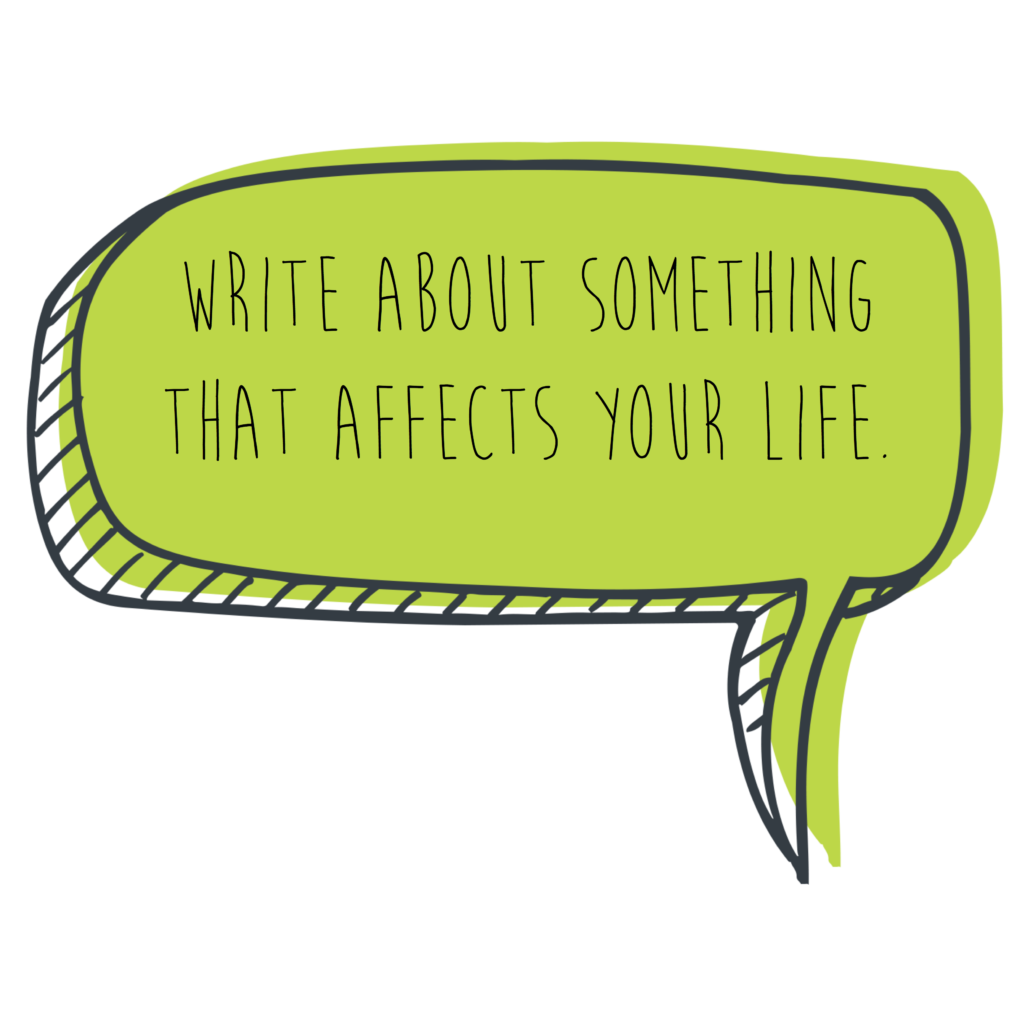
This leads us to Emma. On paper, Emma may sound like any ordinary high-school student. In reality, she is much more. Her personal journey towards self-acceptance is inspiring and can hopefully resonate with other kids the same age.
Here is Emma’s essay:
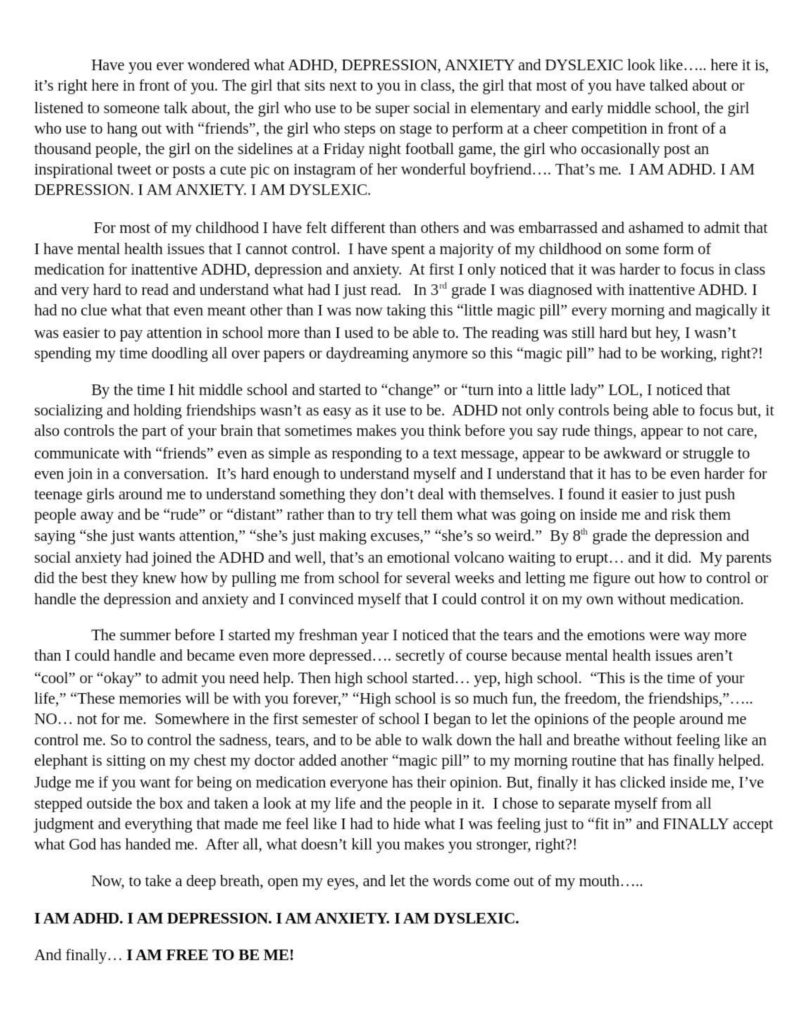 Amazing, huh?
We were able to snag some more of Emma’s time and ask her a few questions.
YouTime Coaching: Do you remember a moment when you realized things were “different” for you?
Emma: In elementary school things were easy and kids didn’t see me any different. Middle school is when I would say I started to realize that I could not complete things as fast or as easily as the other kids around me and I started to notice that I would say things without thinking, I would struggle to fit in with conversations my friends were have or when I would say something they would say “that isn’t even what we were talking about or that is stupid” and they were right, I found myself just saying random things to fit in. Eventually, I stopped talking in fear of sounding stupid or them laughing.
YouTime Coaching: What were some of your biggest frustrations during this process of understanding for you?
Emma: I would say my biggest frustrations are probably feeling so lonely and feeling like I will never find anyone that understands me. I am in high school now and teenagers are cruel, to be honest. Walking into a classroom and fearing the teacher will ask me to read out loud, walking into the lunchroom seeing all my old friends that I am no longer friends with because I did not know how to be a friend so to say… those are some of my biggest frustrations with myself.
YouTime Coaching: Who and what did you find most helpful in making some of the challenges more manageable?
Emma: My parents are so supportive and I know it has been so hard on them. I would say my mom has helped me more than anyone over the years. She has provided me with any ounce of information on ADHD, depression, anxiety, and dyslexia that she can find to help me understand what is going on with me. I would also say having a parent that is so motivated to educate herself in understanding me has been my biggest help.
YouTime Coaching: If you had a couple pieces of advice for another teenager going through something similar, what would the advice be?
Emma: Know that you are enough! Stop trying to “fit in” with kids that do not understand you and that do not care to understand you. TALK to someone, do not hold it in! Find someone that you are comfortable with and tell them how you feel no matter how dumb you may think it sounds. Oh, and fidget cubes… Those are lifesavers in school!!!!
YouTime’s take-home:
It could be a slip in grades, change in friends, hard time expressing emotions, or even controlling them. Teenagers can present their struggles very differently. Reaching the level of self-acceptance that Emma experienced takes a lot of courage, awareness, and support. Hopefully this story can be a testament to the power of parenting, genuine support for your teens, and that self-acceptance is a reality even in the midst of many personal challenges.

by YouTime Coaching | Jan 25, 2017 | Appreciation, Arguments, Attitudes, Behavior, Behavioral Change, behavioral issues, Brain, Change, Children, Communication, Control, Emotions, Growth, high school, Listening, parenting, parents, Problems, Reaction, Teenagers
Nobody said that raising a teenager would be easy and some parents may even think they should be rewarded a medal once they survive it. Statements that are made about adolescence and teenage years such as, “Surviving it“, “Getting through it”, are the real area of concern.
Although these times can be filled with risk-taking behaviors, a surge of independence, what seams to be minimal communication, and an abundance of “pushing back”, they must remain open to “the work” of the adolescent years.
WHAT’S “THE WORK” OF ADOLESCENCE?
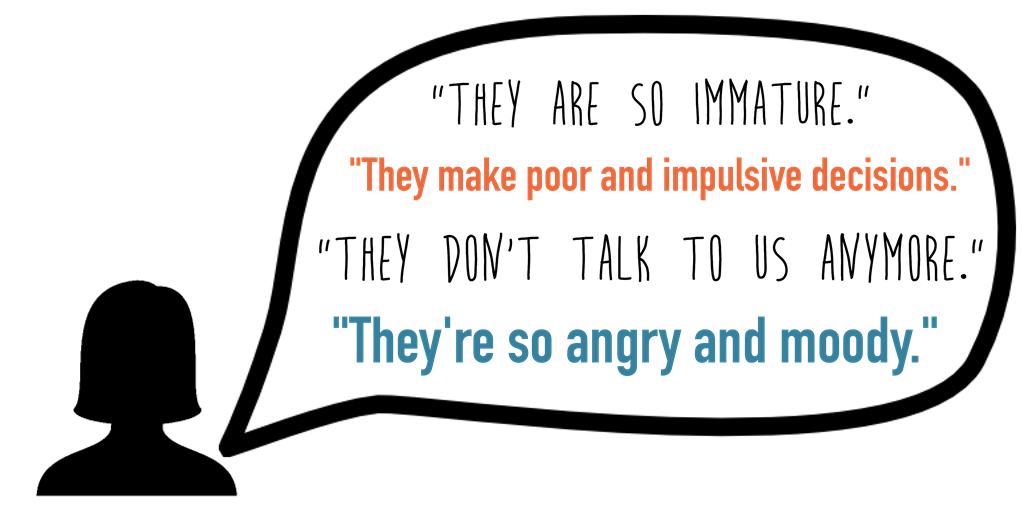
Emerging science is proving at great lengths that some of the ways we used to think about adolescence may be quite off. On a weekly basis YouTime Coaching receives emails and phone calls that very honestly communicate the frustrations of being a parent to an adolescent.
Here’s what the conversation topics look like…
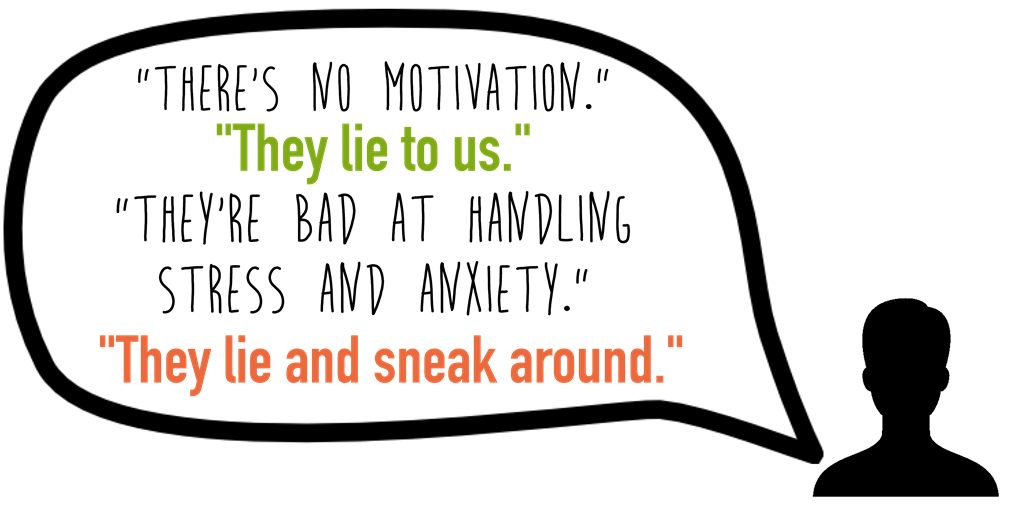
Here are a few things you need to know about the what the science is telling us.
“THEY JUST NEED TO GROW UP” MENTALITY WILL NOT HELP.
This line of thinking has existed for years and rightfully so, adolescence is a time of immaturity. The problem that lies within this way of thinking is that it frames adolescence as a period of time in which you must survive, simply try and get through, endure, and come out with minimal long-term scars.
Here’s a helpful change of perspective… Adolescence is not simply about maturity vs immaturity. During adolescence the brain goes through a rapid growth period and because of these changes new behaviors and abilities present themselves. All of those common “frustrations” (above) that we hear from parents aren’t just things that you need to endure but are newly developed abilities that will end up laying the groundwork for core personality traits your child will develop for use in adulthood.
Pushing boundaries, exploring decision making, getting a taste for independence, and being emotional may drive you crazy and caused tons of stress, but are all integral building blocks that each adolescent must go through. Use this time to cultivate positive experiences and lessons from those frustrations. Most importantly, be an active part of “the work” that goes into these crucial developmental period in your child’s life.
KNOW THE UPSIDES AND DOWNSIDES TO ADOLESCENCE.
Parent’s tend to have a keen eye for a child’s impulsive decision making, risky-behaviors, pushing boundaries with sources of authority, and their kids not wanting to spend time with them. What all of these behaviors have in common… they have an upside and a downside.
Novelty seeking and reward driven behaviors can motivate a child to explore new ways of doing things, allow them to keep an open mind to additional perspectives, and be open to change. The downside could lead to risky behaviors without a major thought or concern for the outcome, which leaves a child vulnerable.
Adolescence spending a lot of time with friend (and therefor little time with their parents) could help them develop strong social connections and support networks which are heavily correlated with happiness and mental wellness. The downside is that not being around adults and only being around peers increases their chances of risky behavior and minimizes the opportunity for guidance and knowledge from an adult figure, in turn increasing risky behaviors.
You see, each new ability and behavior that is formed during adolescence can have a profound impact on their develop towards adulthood. Stay engaged, but be aware of these new found abilities that your child may possess.
The inspiration for this blog came from an article written by Dr. Daniel Siegel. Dr. Siegel is a world renowned scientist and expert in the field of mindfulness. He has a wonderful ability to take complicated scientific findings and communicate them in a way that makes them practical and exciting. Please read his article “The Amazing, Tumultuous, Wild, Wonderful, Teenage Brain.” on mindful.org.
P.S.
If you are a parent or a young person who has had some challenges and would like to share your story, let us know in the comment section below! If you have any questions, and we mean any, you can send them right over to [email protected] or visit our page at www.YouTimeCoach.com.
by YouTime Coaching | Dec 7, 2016 | Academics, Attitudes, Behavioral Change, Change, Children, Communication, Direction, Life Coaching, Mental Health, parenting, parents, Problems, Self-Change, Self-Esteem, social problems, Stigma, Teenagers, Therapy, Trust |
Even a healthy and well-adjusted young person will have their fair share mood swings, moments of pushing back, impulsive decisions, and overall lapses in judgement. This is why parenting a young person consistently takes the top spot in The New York Times’ list of “Top 10 Easiest Professions”… yeaaaa right.
Whether the young person is in high-school or college it can sometimes be quite challenging to distinguish between “normal” and “could use some help”. So let’s clear a couple things up first regarding “help”.
Stigma.
Yes, unfortunately “getting help” still carries a substantially heavy stigma with it. For instance, it is very easy to assume that when you seek out professional help that something is broken and needs to be fixed. The young person is not broken, and neither are you. Here are a few other stigmas that may keep you and the young person from benefiting from additional support.
Misconceptions about getting help for a high-school/college age young person:
- If I get help, I am weak.
- This means I am crazy.
- (Typically parents) This is a waste of money.
- All you do is talk about my feelings.
- I will get medicated.
- Other people will think it’s (I’m) weird.
Stigmas have the power to not only prevent a young person from getting more specialized support but in many cases can create pretty harmful negative beliefs about who they are, how they are doing, and what their options are to start feeling better.
From the very beginning of the process, YouTime Coaching implements many strategies to combat some of these misconceptions. Here are a couple:
Trust Trust Trust:
With young people, trust is huge. That is why YouTime Coaching focuses right away on building a safe, secure, and trusting relationship between the young person and their coach. We believe that the young person’s relationship with their coach within the first month will determine much of their success in their work together. The coaches use strategic communication styles, in-between session check-ins, and work hard to create an relaxed judgment free zone.
Breaking the “Parent-Young person” Dynamic:
Sometimes simply being a parent makes it challenging to talk about the “tough things” with your young person. They see you through the “parent filter”, while you see them through the “young person filter”. YouTime’s Coaches are young, genuinely compassionate, and have the natural ability to connect with young people where it may otherwise be challenging for a parent to break through.
Take a look at www.YouTimeCoach.com to learn more about the process of coaching with young person, parents, and families.
When to get specialized help for your young person?
With the exception of when the young person asks for it, knowing when to seek out help can be challenging. Having some insight to what your young person’s baseline behaviors are can be helpful in assessing their/your need for some extra support. Here are a few things to keep on your radar but keep in mind that simply because you may see a change in these areas does not not necessarily mean your young person is struggling. It just means, keep communicating with them and finding ways to meaningfully connect, all while keeping your finger on the pulse to see if more evidence points to a “would it help it get some support?” talk.
- Their social life.
Questions to think about:
Has their friend group noticeably changed?
Are they spending a lot more time on their own?
Are they now jumping pretty hard into the party scene?
Is the young person having noticeable challenges in balancing their social life with other areas?
- Communication.
Questions to think about:
Has the young person’s communication patterns (language used, frequency, depth) drastically changed?
Is the young person “asking for help” but not necessarily coming right out and saying it?
Do you notice a rapid shift in mood when communicating with the young person?
Are you lost on how to communicate with the young person?
Have others communicated their concerns with you? (friends, teachers, bosses, siblings..etc)
- Academics.
Questions to think about:
Is there a noticeable drop in grade?
Are you seeing frequent absences or tardiness at school/work?
Have you received concerned communication from teachers?
Is your young person having trouble concentrating/focusing?
*if any young person you’re with has shown open, serious, and/or committed signs of harming themselves or others, please do not hesitate, call 911 and get professional help right away.
Remember, these questions are good starting points to give you a better understanding of what conversations to have with the young person, a professional, or somebody already in their support circle.
At the end of the day, if you still feel like something may be “off” with your kid and need to further figure out a plan of action, reach out to YouTime Coaching at [email protected].

by YouTime Coaching | Nov 26, 2016 | parenting, Physical Health, Sports Therapy, Teenagers
“Tough it out and get back in there!”
Black and blue ankle sprains, torn knee ligaments, and concussions have found a way to be commonplace during a child’s high-school and college athletic career. In a world where concussions in young people are making headlines every other day, many coaches, parents, and other support systems have their radar on high… but why?
You see, injuries ranging from severe concussions to sprains have multiple dimensions to a young person. The injury sustained itself has physical impairment in which a Doctor can diagnose and create a treatment plan for, but the thoughts and beliefs about the injury create a real mental dimension.
“I can’t believe my season is over.”
“I didn’t really want to play anyway.”
“I am going to lose my scholarship”
“The break isn’t that bad, coach said I’ll be back in a couple days…”
The “invisible wounds” (anxiety, depression, anger, denial, frustration, changes in motivation) of an athletic injury can have substantial impacts on your kids academics, social life, emotional well-being, and ability to recover.
PLEASE read on as one of our coaches, Ido Heller, walks you through what an injury really could mean to your kid, and what you can do as a support to ease the road ahead.
A CRUCIAL FACTOR IN YOUR YOUTH’S SPORTS INJURY:
Experiencing a permanent injury may lead to feelings of vulnerability and despair. Although the injury itself is the primary stressor, the perception of the injury is a crucial factor toward rehabilitation. The cognitive appraisal perspective suggests that the same injury may elicit different levels of stress in different people. For example, knee injuries that include severe pain, grinding, limited movement and visible deformity, are likely to have a more significant impact on (for example) a breaststroke swimmer, who heavily relies on legs and knees’ performance to generate propulsion, than a freestyle swimmer and non-athletes. Given that athletes’ identity and financial status (income or scholarship) is based on their ability to perform physically, such a severe injury makes them prone to depression.
[bctt tweet=”Experiencing a permanent injury may lead to feelings of vulnerability and despair. So how can you best help your child?” username=”youtimecoaching”]
The way athletes interpret their injury determines their emotional response (frustration, sorrow, relief), and ultimately their behavioral response (loneliness, sluggishness, devotion). Though scholars (e.g., Livneh, 1986; Livneh and Antonak,1991) suggest a general reaction pattern of individuals who experience a chronic injury disability (shock, realization, mourning, acknowledgments, and coping/reformulation), my personal experience in working with swimmers is more consistent with other researchers such as Brewer (1994) who assert that athletes’ physical, emotional and psychological foundation may affect this response pattern.
The fact that injury has occurred is less important than its meaningfulness; there is an opportunity for caregivers such as parents to assist their loved ones’ athletes who are suffering from chronic injury by discussing the meaning of the injury and resulting changes in lifestyle.
POTENTIAL CHALLENGES AND OPPORTUNITIES:
Shock, confusion, and feelings of being overwhelmed are usually observed in the immediate aftermath of an injury; athletes may reject any type of assistance because they view such help as unnecessary. Therefore, in the first phase, caregivers should provide only a empathetic and compassionate support.
When the individual begins to realize the weight of their injury, it is important to identify various traits that represent psychological resilience (positive emotionality, hardiness, ego resilience, hope) and leverage these to assist athletes in overcoming the mental and physical hardships of rehabilitation. For example, characteristics successfully used during the swimming season, such as toughness, determination, and accuracy can be pointed out by you (the parent, the friend, the coach) and generalized by the swimmer in overcoming challenges of the rehabilitation process.
Making a positive attribution to past success (optimism) is the foundation of individuals’ ability to take on and put in the necessary effort to succeed at challenging tasks now and in the future. As noted in innovative work of Livneh (1986) and phases of recovery, following injuries athletes may experience a lack of hope, distress, reactive depression, and internalized anger. Because it is a relatively extended period, some people such as coaches and peers may make statements such as “Tough it out!” and “Stop feeling sorry for yourself!” which are counterproductive. Instead, you, the caregiver, should encourage and nurture an environment that is responsive to the athlete’s needs.
[bctt tweet=”Setting goals are also an essential part of rehabilitation because it stimulates the athlete to think about alternative ways of improving performance and wellness.” username=”youtimecoaching”]
Setting goals are also an essential part of rehabilitation because it stimulates the athlete to think about alternative ways of improving performance and wellness. The athlete (or specifically, the breaststroke swimmer in our example above) must be assured that even though physical participation in sports as once experienced is no longer possible, there is still the challenge to channel many of her abilities and skills toward successful rehabilitation; then, meaningful life.
ADHD, ATHLETE & INJURY:
Athletes with ADD/ADHD are more prone to be injured than their counterparts without ADD/ADHD in open activities, training, and competitions. The underlying circumstances of injury risk in athletes with ADD/ADHD are that they anticipate fewer negative consequences, expect less critical injury, and report a higher likelihood of engaging in precarious behavior though they identify hazards at similar levels, compared with athletes with no ADD/ADHD. Following injuries, overcompensation attitude (i.e., the desire to work too hard in the rehabilitation process) is also more likely to occur among the former group. Hence, you the caregiver must nurture a stress-free positive environment, reinforce productive mindful behavior before and following an injury, and last but not least, present the various symptoms of the injury as well as what symptoms could be aligned with ADD/ADHD. This will allow your child to start compartmentalizing what is going on, help reduce stress, and will provide at minimum a chance to communicate about the mental challenges of their injury.
References:
Brewer, B. (1994). Review and critique of models of psychological adjustment models to athletic
injury. Journal of Applied Sport Psychology, 6, 87-100.
Gunther, M. (1971). Psychiatric consultation in a rehabilitation hospital: A regression
hypothesis. Comprehensive Psychiatry, 12, 572-585.
Livneh, H. (1986). A unified approach to existing models of adaptation to disability: I. A model
adaptation. Journal of Applied Rehabilitation Counseling, 17, 5-16.
Livneh, H., & Antonak, R. F. (1990). Reactions to disability: An empirical investigation of their
nature and structure. Journal of Applied Rehabilitation Counseling, 21(4), 13–21.