
by YouTime Coaching | Jun 19, 2017 | parenting, Teenagers
Fresh off the press, “PARENTS STRUGGLE WITH TRYING TO BE THEIR KID’S FRIEND”. If you have every seen the 2004 movie Mean Girls then you know Amy Poehler’s role as Mrs. George and yes, she is the “cool” mom. She has fake boobs, has no major rules on underage drinking (she would simply rather have them do it at their house), allows her daughter to have boys in her room (even offers them condoms…convenient), and always wants to know the “low down”. Super cool and super unhealthy all at the same time.
A study recently released by The Family Room LLC, FocusVision, and Lightspeed GMI reveals that 54 percent of Millennial parents consider their children as “one of my best friends.” This may be a stat for millennial parents, but the urge and desire to be your kid’s friend does not discriminate by generation.
On one hand, YouTime helps coach parents on how to have a supportive, positive, and open relationship with their kids despite the challenges they may face, but limitations and boundaries come with the territory. Below you’ll find three solid reasons why trying to be your kid’s bestie is not recommended.
3 Reasons Why Parents Should NOT be Their Kid’s Best Friend
Reason #1: IT’S NOT ENOUGH
Bottomline. Your kid needs more than a friend, and “more” includes the not-so-pretty-stuff as well. The feeling of a trustworthy, reciprocating, and accepting friendship is a miraculous thing, and we should all be so fortunate to experience this within our lifetime. With that being said, if simply being a friend to your kid had the strongest correlation for future success, that would be the gold standard for “how to parent”. Unfortunately, being your kid’s best friend is not the best indicator, but it sure as hell makes a parent feel a little more comfortable (with some hidden costs).
During adolescence, a parent struggles with issues of “not having enough information”. Their kid doesn’t talk to them as much and what they do share comes in the form of one syllable words. If that’s not bad, you’re in competition with their pursuit of instant gratification, impulsive decision making, and thrill-seeking behaviors. Providing a friendship caters to avoiding tough parenting decisions and/or accommodating troublesome child behaviors. Simply put, a friendship is not enough.
Kids desire boundaries, but parents fear them. Picture the child that continually pushes the limits and has no repercussions. To some kids, this will eventually come off as “my parents don’t care”. Kids need boundaries, need to be told both ‘yes’ and ‘no’, need positive reinforcement along with discipline and need a role model for relationships, communication, and how to create an environment that promotes self-respect and empathy towards others. Kids need both the ‘pretty’ and ‘no-so-pretty’ aspects of parenting.
Reason #2: YOU CAN’T BE THE GOOD AND BAD COP
Even with the best of intentions, parents can still end up with opposing views on parenting. Let’s the face the truth though, if you have one parent trying to be too much of a friend to their kid then the other will automatically assume some degree of “bad cop”. The imbalance will begin. Your kid will know exactly who to go to for money, who is less likely to yell at them for getting in trouble, who to go to for help, and also who to avoid during these circumstances. Parent Splitting is a real thing and can be a real pain in the ass too.
Many parents and even professionals dislike even using the word “cop” because kids don’t need cops. If you are policing your kids, you are sure to see some backlash that will make the relationship and your idea of authority even more confusing. A hard fact is that parents who want to be friends with their kids have a hard time making important (and unpopular) decisions for them in fear that it will tarnish this friendship. A young person needs a lot of structure, boundaries, communication, support, and coaching. That same young person is hit by a major wall when the “good cop” tries to lay down some necessary structure.
Keep this is mind… “good cops” are usually challenged with being a consistent source of authority and this can have a negative impact on the young person’s degree of respect for them as a parent. “Bad cops” are the people that kids learn to avoid and in some cases fear, both undesirable.
Reason #3: POWER STRUGGLES AWAIT
The constant battle of “who has the upper hand” is a natural hole to find yourself in while your child is growing through adolescence. During this period your kid may think they know it all or at least are willing to take the risk in proving it. Natural repercussions will most definitely occur during this period but the lessons and growth following these events may operate a little slower.
One important thing to remember. Kids desire boundaries, but parents fear them. Picture the child that continually pushes the limits and has no real repercussions. To some kids and over time, this will eventually come off as “my parents don’t care”. Kids need boundaries, need to be told both ‘yes’ and ‘no’, provided positive reinforcement along with discipline, and need a role model for relationships, communication, and how to create an environment that promotes self-respect and empathy towards others. Kids need both the ‘pretty’ and ‘no-so-pretty’ aspects of parenting.
If the scene is set with a lack of boundaries/house-rules, responsibilities earned privileges coupled with a lack of consistent, timely, and appropriate discipline then it sets the stage of a power struggle. In reality “power” is not an accurate word to use here, it should be replaced with respect, awareness, and understanding. Parents who work on these boundaries earlier, find it easier in the end all while their child develops self-respect, respect for their parents, and a deeper understanding of their behaviors.
PRACTICAL SOLUTIONS
Through the positive and successful work that YouTime has completed with young people and their families we have put together something for the parents. Whether your kid struggles with ADHD, executive functioning deficits, anxiety, or depression we have strategies build to make parenting a little easier.
Click below to have these effective parenting strategies immediately at your fingertips: CLICK HERE

by YouTime Coaching | May 19, 2017 | Advice, Appreciation, Behavior, Benefit, boundaries, Children, Communication, Direction, Dreams, Growth, Human Needs, Insight, Kids, parenting, parents, Positive Psychology, positive reinforcement, Support, Teenagers, Understanding
Kids can be a pain in the ass sometimes.
Harsh words? Maybe. One thing is for sure though, those words are definitely filled to the brim with truth… harsh truth. This isn’t taking away from your unconditional love for them, it’s simply acknowledging that kids can sometimes do things that are very tough to love.
This is why parents turn to advice from others, seek out simple solutions, and time hacks. Sometimes it isn’t all that easy and you give into your frustrations, irritations, and anger. As parents, you are teachers, EVEN WHEN IT SEEMS YOUR KID DOES NOT WANT TO LEARN FROM YOU. Because the eyes are always on you, the advice you get absolutely needs to be solid.
YouTime Coaching’s extensive work with high-school and college students along with all of the hours worth of support for parents has allowed us to understand some keys elements in how to be a great teacher for your child even during those tough times. When it comes down to it, a child wants to understand, perceive they have some control, and feel supported in a non-judgmental way.
The hardest times to be a “good teacher” with your kids? (never thought you’d ask!)
Just to mention a few:
- when setting boundaries
- when you are angry, frustrated, or irritated (and sometimes hungry)
- when parents are on different pages
- when you feel as though your child is not listening
- when “nothing else seems to work”
- when your kid is an adolescent
- anytime
We don’t want you to be good teachers… we want you to be in many cases the kind of teacher “you wish you had growing up”, the kind of teacher that is more emotionally available than some families had in previous generations, and most importantly we want you to be the type of teacher that not only shows but explains the benefits in learning from failures, how to be compassionate to yourself and others, and have enough awareness/knowledge about what they are doing and why they are doing it.
For these reasons and with an entire year of putting together some of the most effective researched methods of teaching, motivation, and human behavior we have creating the “R.I.S.E. Method of Parent Teaching”.
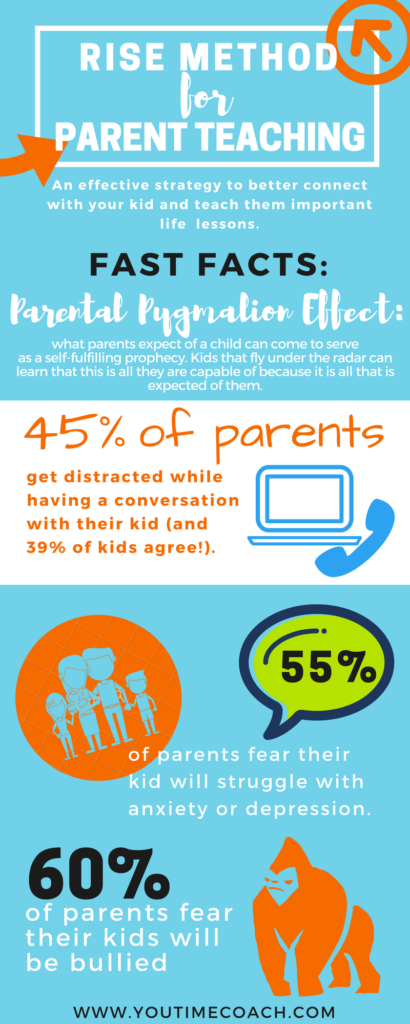
The premise behind the acronym “R.I.S.E.” is for parents to use the powers of awareness, communication, non-judgmental support, and compassion as a way to elevate their parenting and ultimately their relationship with their child.
Use can use this method while trying to set boundaries with your children, teach them important lessons, disciplining (btw before disciplining your kid read this amazing article, https://www.verywell.com/what-is-child-discipline-620113), and even just trying to improve your communication with them.
Remember, punishment is easy, discipline is hard. Implementing this method may be challenging and outside your comfort zone, if you need some guidance please drop us a line!
DOWNLOAD THE R.I.S.E. METHOD HERE.

by YouTime Coaching | May 12, 2017 | Anxiety, Behavior, Children, Depression, Distress, emotional problems, high school, Kids, Listening, parenting, Teenagers
Part II: From the Parent’s Perspective
In Part I, we met Emma, the brave high-school girl that traveled down the bumpy road towards self-acceptance. Through all of the anxiety, depression, and frustration of trying to understand “who she really is”, Emma found a way to finally accept the things she struggled with in life. Go ahead and get a refresher, or just read Part I for the first time here.
As a parent, seeing your child struggle can be heart wrenching. Some parents want to swoop in to help ease the discomfort (both yours and your child’s), while others may think these are “necessary learning experiences”. Many parents though are not even aware of how they respond to these types of conflicts (btw if you are curious to learn more about your conflict style, find out more through this assessment YouTime Coaching Conflict Mode Assessment)

As a parent one of the most impactful things you can do is be present for your child. Not passive, avoidant, accommodating, but present. Whether your 50 years old or 15, we all have the same needs (we just may meet them differently).
A parent’s own fear, insecurity, anger, and even sadness can prevent them from being fully present for their kids when they may need it the most. The symptoms of struggle for a young person may not be blatantly obvious, which makes being present, aware, and appropriately involved that much more important.
In our interview, Emma’s mother (Kate) shares a little bit about her experience during the time that her daughter was trying to “figure it all out”.
YouTime: When did you realize that your child had challenges that affected her everyday life?
Kate: When she was around nine we noticed challenges with school work. When she hit middle school the social challenges began to appear more than ever and the insecurities controlled her.
YouTime: What was the evaluation and assessment process like for you and your child?
Kate: When she was in the third grade her school contacted us regarding her inability to pay attention. She had no idea what that meant and thought nothing of it, she was a typical happy child and as for myself, I instantly went into denial because my daughter was “perfect”, it was the teacher right?! It was NOT my child with the issue. I was very defensive and protective… Eventually, I agreed to have her tested for ADHD and with research and family support I realized that even with ADHD she is still “perfect”. The real challenge began in middle school when the depression and the anxiety took control of her. It was and still is very trying at times and has had a major effect on our family and relationship with parents of her peers.
YouTime: What were some of the biggest frustrations for you as a parent?
Kate: My biggest frustration had to be adjusting in how I helped her with school work or approach personal situations when talking to her. The mom in me wants to yell “just finish the work, sit still, why can’t you do this, who cares what people think….”. But I know I can’t approach her like that if I want her to remain open and talk to me. She shuts down when I appear frustrated and withdraws herself. I have learned to not react before I think and to try to understand that she thinks and how she learns differently than I do.
YouTime: Did you have any strategies for maintaining a balanced mind during this time period?
Kate: Prayer. I do not know another honest way to answer that question. I know there are those who would answer differently but for me that is the only strategy I have had.
YouTime: What do you attribute most for the positivity in your relationship with your daughter now?
Kate: I do not make her feel like she is anything less than perfect to me and that her ADHD, reading disorder, depression and anxiety are all things that make her even more perfect. I have done my best to help her see these traits as gifts in one way or another. I fail daily, I am not a perfect parent but making notes with reminders on them all around the house for her, simply reminding her at lunch with a text telling her to remember certain things and not making her feel like I am annoyed by her inability to stay on task or hold friendships at school.
YouTime Coaching Take Home:
Take this page straight out of Kate’s book, “I fail daily, I am not a perfect parent…”
Parenting an adolescent is quite a challenging task, let alone having to continue managing the things going on in your own life. This is a beautiful example of how appropriate parental support, involvement, and mindfulness can have a major positive impact on a young person’s life.
If you or anyone you know could use some support in being more present for your kids send us over some of your thoughts and questions.

by YouTime Coaching | Apr 26, 2017 | Anxiety, Behavior, Brain, Children, Depression, Distress, emotional problems, high school, Kids, Listening, parenting, Teenagers |
Part I: Emma’s Perspective
Most of us can remember during our teenage years the mundane writing assignments gifted to us by our teachers (not always their fault). They asked you to write essays “discussing the role of family in To Kill a Mockingbird, paying close attention to Aunt Alexandra.” or “from Steinbeck’s, Of Mice and Men, please discuss his descriptions of the natural world. What role does nature play in the novella’s symbolism?”.
Memory refreshed? Okay good, I’ll stop.
In most cases, the teachers will typically receive 3-4 variations of the same essay, coming from very similar perspectives. Reading these staple books, understanding their overarching themes and processing what it means to our current reality is quite useful. Yet still, during such a crucial time of physical and emotional growth for adolescents there is no replacement for a chance to write about something personal, of deep meaning, and most importantly brutal honesty.
So with all of this in consideration, what happens when you ask a teenager a more potentially vulnerable, subjective, and open-ended question to write an essay on? For example…
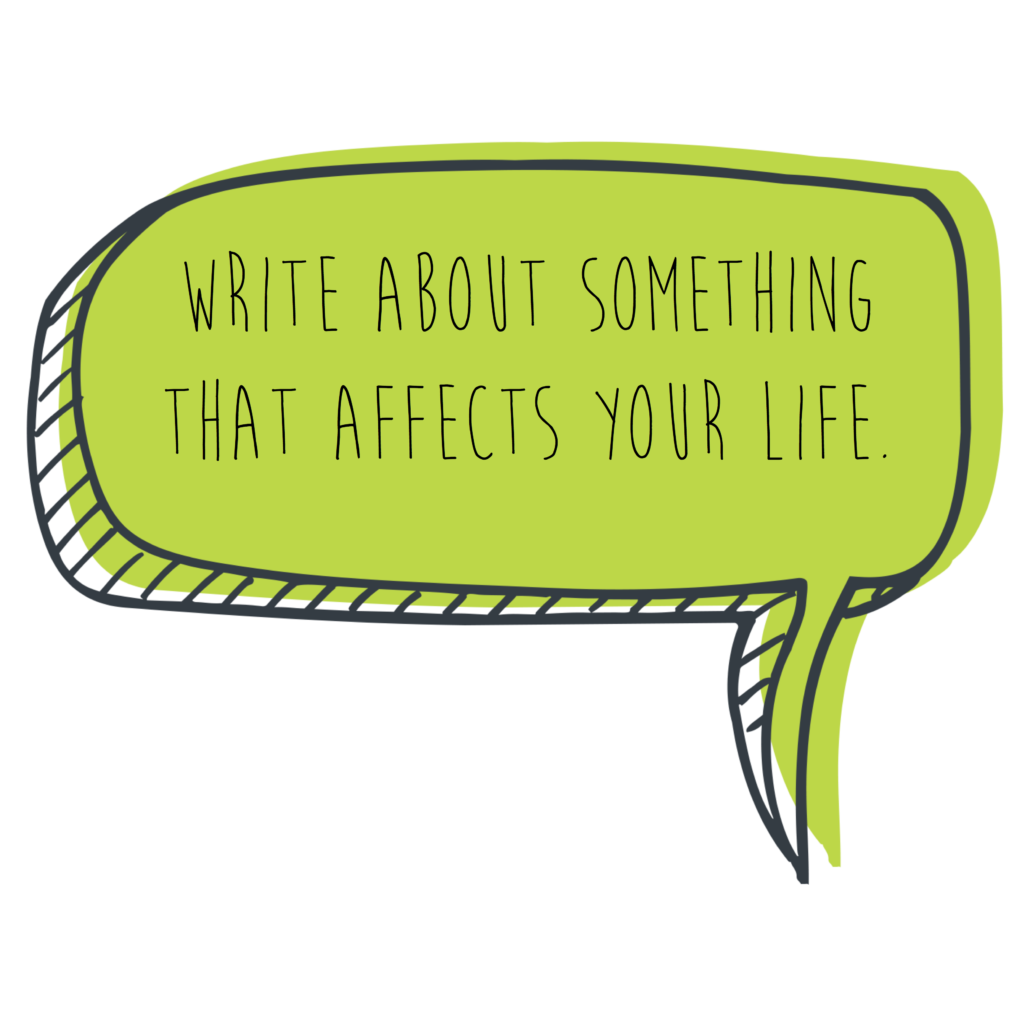
This leads us to Emma. On paper, Emma may sound like any ordinary high-school student. In reality, she is much more. Her personal journey towards self-acceptance is inspiring and can hopefully resonate with other kids the same age.
Here is Emma’s essay:
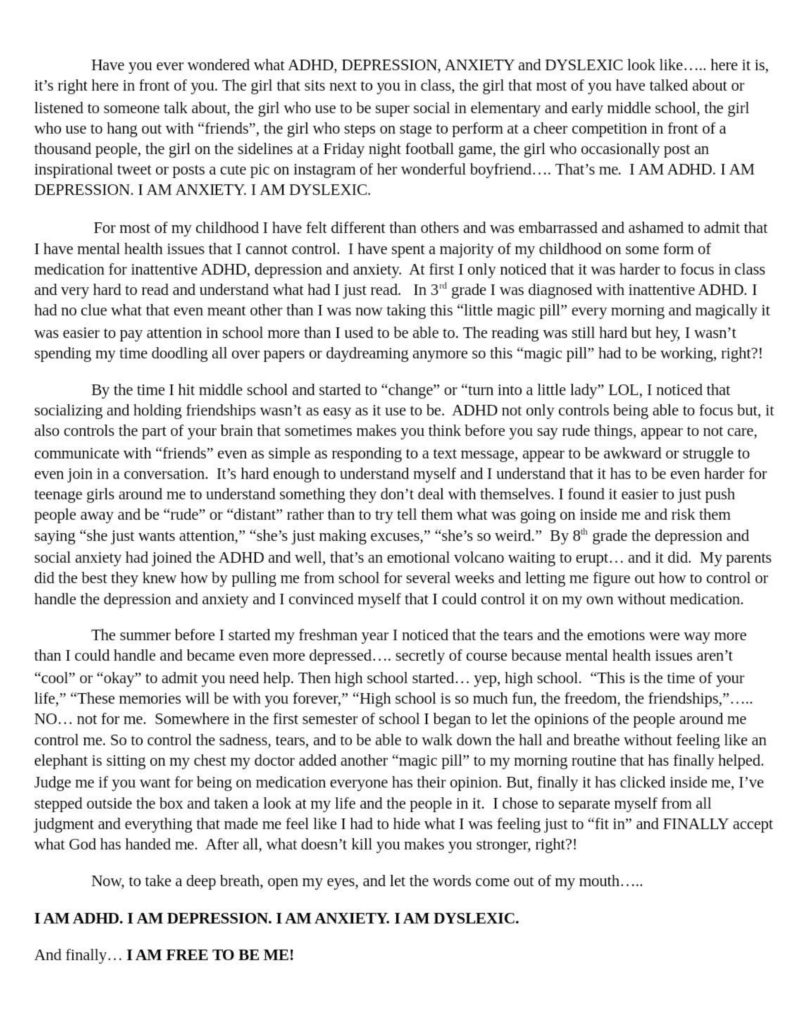 Amazing, huh?
We were able to snag some more of Emma’s time and ask her a few questions.
YouTime Coaching: Do you remember a moment when you realized things were “different” for you?
Emma: In elementary school things were easy and kids didn’t see me any different. Middle school is when I would say I started to realize that I could not complete things as fast or as easily as the other kids around me and I started to notice that I would say things without thinking, I would struggle to fit in with conversations my friends were have or when I would say something they would say “that isn’t even what we were talking about or that is stupid” and they were right, I found myself just saying random things to fit in. Eventually, I stopped talking in fear of sounding stupid or them laughing.
YouTime Coaching: What were some of your biggest frustrations during this process of understanding for you?
Emma: I would say my biggest frustrations are probably feeling so lonely and feeling like I will never find anyone that understands me. I am in high school now and teenagers are cruel, to be honest. Walking into a classroom and fearing the teacher will ask me to read out loud, walking into the lunchroom seeing all my old friends that I am no longer friends with because I did not know how to be a friend so to say… those are some of my biggest frustrations with myself.
YouTime Coaching: Who and what did you find most helpful in making some of the challenges more manageable?
Emma: My parents are so supportive and I know it has been so hard on them. I would say my mom has helped me more than anyone over the years. She has provided me with any ounce of information on ADHD, depression, anxiety, and dyslexia that she can find to help me understand what is going on with me. I would also say having a parent that is so motivated to educate herself in understanding me has been my biggest help.
YouTime Coaching: If you had a couple pieces of advice for another teenager going through something similar, what would the advice be?
Emma: Know that you are enough! Stop trying to “fit in” with kids that do not understand you and that do not care to understand you. TALK to someone, do not hold it in! Find someone that you are comfortable with and tell them how you feel no matter how dumb you may think it sounds. Oh, and fidget cubes… Those are lifesavers in school!!!!
YouTime’s take-home:
It could be a slip in grades, change in friends, hard time expressing emotions, or even controlling them. Teenagers can present their struggles very differently. Reaching the level of self-acceptance that Emma experienced takes a lot of courage, awareness, and support. Hopefully this story can be a testament to the power of parenting, genuine support for your teens, and that self-acceptance is a reality even in the midst of many personal challenges.

by YouTime Coaching | Mar 2, 2017 | Academics, Advice, Beliefs, Benefit, college, Decisions, high school, Preparation, steps, Success
A gap year is a year that students take between high school and college, usually doing some sort of structured, non-academic activity.
Sounds nuts. Why would anyone do this?
The reasons are many, but here are a few of the more common ones:
- A student is academically burnt out and needs a break from academics to recharge
- A student doesn’t yet have the maturity to succeed in college (did you know that the male brain and executive functioning capacity doesn’t fully mature until the late 20’s?!)
- A student has a passion that they want to pursue prior to college
- A student’s not that into the idea of college, (or parents aren’t that into the idea of dropping $200K on a “meh, I guess I’ll go” response)
- A student wants to gain more experience to then be able to make the best of college
- A student feels like they need another go at the college admissions process
Thinking the gap year might be right for your student? Here are some pros and cons to consider.
GAP YEAR: Pros
- According to an Australian study published in August in the Journal of Educational Psychology, taking a gap year is linked to higher motivation in college.
- Taking a structured Gap Year invariably serves to develop the individual into a more focused student with a better sense of purpose and engagement in the world.
- According to American Gap Association statistics, taking a gap year helped focus student academic and career paths: 84% say it helped them acquire skills to be successful in future careers, and 73% say the experience increased their college readiness.
GAP YEAR: Cons
- Some students may view the gap year as a vacation. Without a clear plan, the gap year can pass by without doing much positive good for your student. If your student isn’t willing to put in the work to plan a productive gap year, then they shouldn’t take one.
- Financial concerns can impact a student’s gap year. Not every parent can support their children completely during the gap year. Your student may need to work, or they may be able to secure a scholarship or grant from a gap year program or college.
Common Concerns
Even after discussing the pros and cons of a gap year, I typically hear three major concerns from parents:
- “Next year, my student will be ‘too old’ for college.” College isn’t high school: a college classroom often includes both lower- and upperclassmen, sometimes with graduate students or non-traditional students mixed in. Age is rarely an issue, especially a single year.
- “How do I know my student will go back to school?” This is one of my favorite excuses, because the best counter-argument is simply to wait until they work a full-time job. After 40-hour work weeks, most teenagers will beg to go back to school! In fact, according to a study, 90% of students who took a gap year ended up going back to school within a year. If you’re still concerned that your student may “drop out”, it may be wise to gain admission to a college that will allow a deferral enrollment for the following year.
- “Why should my student wait if s/he is ready now?” Adapting to a new set of academic and social responsibilities is not easy for everyone; the first semester of college is often a difficult transition. It can be fun and fulfilling to tackle these responsibilities on your own schedule, without the added burden of a strict class schedule, the stress of dorm living, or tuition. Your student may be ready intellectually now, but a gap year will likely leave them extremely prepared, not just ready.
If your student is considering a gap year, I always stress a well-rounded and structured approach, with an emphasis on personal growth. For example:
Summer: Apply for summer employment and begin planning for your upcoming fall.
September–January: You may want to participate in academic, social, and career enrichment opportunities specifically designed for gap years; some great places to find these opportunities are:
February–June:
- Apply for a job with the skills you learned from the fall, intern at a potential future workplace, or take a course at your local community college.
- You can also travel, especially if you needed the fall to help you save up for your trip.
July–September: Continue any of the opportunities you’ve started over the past year. Don’t forget to take time to relax and connect with friends!
The above plan is designed to help your student begin college after a gap year with a set of advantages: a rested mind, additional education (potentially in both the academic and career arenas), increased confidence from spending time in “the real world,” and an extra year of overall maturity. Too often, we allow personal growth to happen while we’re busy with other things. But especially during key transition times, the self should be the priority. Imagine how much more a student with a clear sense of passion and purpose can get out of the college experience!
Remember: college is ultimately about your student becoming their own person. Deferring enrollment until after a gap year can be a very rewarding stage on this personal journey, but only if it’s the right fit for your student!

Jay Bacrania CEO & Co-Founder of Signet Education
This blog was written by Signet Education’s CEO & Co-Founder, Jay Bacrania with assistance from Signet tutor, Matt Grzecki. Jay has worked extensively with both special needs and high achieving students. He has taken a broad academic path that spans the sciences and humanities. Jay holds an BA in Comparative Study of Religion from Harvard University and attended Berklee College of Music for two years for Jazz Trumpet Performance. Beyond tutoring, Jay is interested in managing and refining Signet Education. You can almost always bet on finding him there at all hours, teaching or finding ways to make Signet even better!
Signet Education provides exceptional individualized tutoring, test prep, admissions consulting, and organizational coaching for students.