
by Jonathan Wolf | Oct 13, 2018 | Anxiety, Communication, parenting, Teenagers, Uncategorized
Working with teenagers is great. One day, we are discussing their struggles in class or playing time on their sports team. Other days it’s how their parents are mad at them for smoking weed, vaping, playing too much Fortnite, or not putting enough energy into school work. As parents, I’m sure being a little more like Buddha in how we communicate with our kids could have great payoffs.
The way we communicate with a 5-year-old is much different than that of a 12-year-old. While this may not be up for debate, many parents get the urge to “amp up” the pressure once high-school starts. In sessions, kids tell me their parents are constantly telling them, “this is when it really starts to count”, “you need to really buckle down on studying and apply yourself”, “colleges will see this”, and “you really need to set yourself apart from others”.
To simplify things, there are two types of pressure when it comes to kids. “Actual pressure” is expressed through more overt actions like telling your child that they need to get particular grades in school or telling them they need to participate in a certain activity even if they don’t enjoy it. “Perceived pressure” is when a kid sees their successful parent and feels the need follow in their footsteps, regardless of what you may be telling them.
Inherently, the pressure is neither good or bad, but how we communicate our messages can be the defining factors. There is a teaching in Buddhism known as, “The Four Elements of Right Speech”. Using them as a guideline to communicate with your teen or young adult can help you shift from a place of defensiveness and anger to a place of patience and understanding.
The Four Elements of Right Speech:
1. Tell the truth. Don’t lie or turn the truth upside down.
I’ve found in my practice that parents tend to either lean towards being the, “I’m going to lay it all out there and tell it straight up” type of truth-telling parent or the, “I don’t want to hurt them so I’ll either minimize it or not mention anything at all” type of parent.
Communicating the truth to your kid can frequently be seen as conflict and that will immediately make a person go into “conflict mode”
(have your own conflict mode assessment done by YouTime Coaching here). Telling the truth is crucial but doing so in a skillful and compassionate way is paramount. Check yourself before communicating the truth to your kid and make sure you are doing so in a way that doesn’t make your kid feel threatened, so they can have the ability to listen.
2. Don’t exaggerate.
Kids always seem to be slipping up and making mistakes. Sometimes (yes, even you!), the mistake is made into some much more worse than it actually may be. When parents do this they are typically trying to justify their own anger.
Exaggerating mistakes paints a very specific image for your kid to see themselves through. In many cases, it can affect their self-image. Like with many aspects of parenting, the impact may be unintentional but it can quickly affect trust within the relationship (on both sides). Again, check yourself and your own emotions before communicating with your kid.
3. Be consistent.
“You did it when you were my age!”
Parents LOVE telling their teenagers what they can’t do. “You are not allowed to drink, smoke weed, and you need to do well in school”. Those same parents typically can turn around and reminisce with their significant other about the times they went to parties in high-school or got in trouble for staying out too late. The things you did at their age are not an open invitation for them to participate but it is a point of reference you need to consider in order to handle the situation.
“You let (insert brother or sister’s name) do it!”
Teenagers and young adults love making comparisons and while treating each child the same is literally impossible keeping some consistency between siblings is important. Sometimes this may come down to communication and explaining why certain siblings get different treatment. Just keep in mind that having a base of “this goes for everyone”, is very important for parents.
For teens, the inconsistencies are typically seen as a conflict. It creates a division between parents and kids. Be consistent in how you communicate your concerns and praises.
4. Use “smart” language.
Take two seconds and think about how your parents spoke to you when you were a teenager. What ways made you angry, sad, or happy? It is pretty crazy how quickly we forget this when communicating to your own child. “Smart” language functions through choosing the words and a tone that will help your kid stay open to discussion rather than being argumentative and going into shut down mode. “Smart” language means not using insulting, cruel, abusive, or condemning words when speaking with your kid.
Again, remind yourself that most (not all) of the issues you are dealing with as parents are situations that need to be managed and not problems that can be just solved. Choose your actual words wisely.
Remember:
Teens are typically self-critical with rampant negative self-talk. The communicate tips above will help prevent you, as a parent, from layering on more criticism and judgment which usually puts your kid in a state that is not efficient for any type of productivity. Keep in mind that you still model to your child how to handle emotions. Remember that the first to yell loses the fight and that these strategies are used to support your child in their own self-improvement.

by Jonathan Wolf | Aug 28, 2018 | Academics, Communication, Growth, parenting, Time Management
Some families believe that as you naturally mature, executive functioning skills such as time management, organization, and planning will naturally improve as well. Unfortunately, this is only true to a degree and in reality, most kids struggle with specific areas of their executive functioning. These same kids need more than some time to “grow out of it” and real improvement is created through parents that remain hands-on and engaged during the process. Getting older, experiencing new things, and maturing can do wonders for a growing adolescent, while that natural process can also be a pitfall for parents.
YouTime Coaching recently contributed to Phase2Parenting’s article on helping your teen with time management without having to completely manage them… READ ON HERE.


by YouTime Coaching | Jan 19, 2018 | Uncategorized
This will be short and sweet. How many times have you heard a parent say, “Are you even listening?”. Getting a kid to listen can be like pulling teeth, but maybe therein lies the problem. “Getting them” to listen implies an effort to change something about them when the solution could be all about you.
One of the issues that ALWAYS comes up with clients and their families is communication. Communication is a monster topic and can get very complex at times, so we will stick to focusing on one area…
Before we take the plunge into this, ask yourself the following questions (whichever are applicable to your situation)
Is communicating with your 13 year old the same as communicating with them when they are 21?
Do you listen with the intent to respond? (be honest)
Are you aware of how your kid responds to your approaches when it comes to talking about particularly tough topics?
Today’s focus, how communication needs to change and evolve as your kid matures, changes and moves through different stages in life.
There may be more to why your child isn’t listening, check out YouTime Coaching’s blog,
Why Aren’t You Listening? to see what else may be going on between their ears.
Earlier this week I had a phone call with a client’s parents. He is 25 and trying to be more financially independent but the family is not used to this being the reality. As he makes progress (got a job, paying rent…etc), he still feels as though his parents have no confidence in him. While this individual already struggles with his own self-confidence, the parents won’t get the full finger-pointing here. What they did get is a lesson in how communication needs to evolve as your child evolves as well. What they didn’t realize is that their communication was telling their son, “I have no confidence in your ability to do this.”. This was not at all their intention, actually the opposite. The efforts to improve communication begin.
The concept of evolving communication with your child as they grow up can be quite foreign to parents. With a little effort and thought put into it, things can be much easier while also supporting your child through these changes. Here is some advice for evolving your communication with your child.
First, do some perspective taking from their shoes.
They have a unique perspective. Think about all the possible ways your child could misinterpret your comments. They hear what you’re saying but their inner dialogue filters the message. Everybody has narratives (storylines) for how they believe things work in this world. Usually, narratives come from previous experiences. These narratives are a filter between you and your child and keep in mind, they change. Step into their world for a few moments before engaging in meaningful communication.
Second, promote confidence and self-efficacy.
Parents are frequently one of the main sources of inner-confidence for a child. They learn from you, listen to you, and then their undeveloped brains try to make sense of it all. When you are speaking with your child about their goals or important changes they are experiencing, find ways to communicate your confidence in them. This will empower your child and when a kid feels empowered they are more likely to be more motivated and continue these positive behaviors.
Yes, you are parents, but this does not mean that your reactions, responses, and communication styles aren’t a culmination of your own upbringing. If you expect your child to “dig deeper” than you should be learning more about the origin of your own patterns. Take a closer look at your own shit and baggage, and identify how it may affect communication with your child. Do you get frequently frustrated, yell, or just like to avoid conflict at all costs (don’t worry you are not alone)? Know your own influencers and patterns as an insight to your kids, and be more skillful in your approach to communication with them.
by Jonathan Wolf | Jan 9, 2018 | Uncategorized
In parenting, you may think that kids are needy and can sometimes be a pain in the ass. Well, kids may think, “right back at ya”. Being a better parent is not about admitting you are a bad one, it is simply acknowledging that the thunder, lightning, and challenges early adulthood can drop on an unprepared young person (which you will most likely have to deal with) makes investing some effort now worth it. Since parenting is so damn unpredictable and complicated, we will provide you clear skills that are vital to your child’s upbringing. Always keep in mind, these skills are simple to understand but require work to master.
STEPPING UP YOUR PARENTING GAME: YOU THERE?
Physically, sure. Mentally, meh.
A small pilot study in the Journal of Pediatrics followed 55 caregivers and found out that of those parents, 40 of them used a mobile device while eating with their kids. On top of this, 3 gave their phone to their kid to keep them occupied.
Of course, this one example is a microcosm of a bigger issue. The issue is not being present with your kid. Both kids and parents have more going on and at a faster pace than ever before, which puts an even bigger emphasis on improving this area of your parenting game.
Here are sometimes where parents are not as present with their child.
- Meal times
- In the morning getting ready
- When you feel rushed for time
- Anytime you are multitasking
- After busy work days
- When the environment is messy
- When your kid asks you a question
Being distracted, listening with the intent to respond, or being controlled by some emotion (irritation, anger, sadness…etc) can reek havoc on your ability to truly be there for your kid. Why does this really matter?
Kid don’t just need attention, they need genuine attention. They have an uncanny ability to grow up fearing that they are not good enough, are not able to be loved, and/or that they will constantly be facing rejection. As with many things, the reasons behind this does not neatly fall into one box, but things such as not being present when around your child can contribute to changes in their self-worth. This isn’t just about them because when you are fully there for them, listening, open, and non-judgmental then the parent will reap the benefits as well.
Try some of these strategies:
1. Start by taking a closer look at the bulleted items above and get an idea of how present or distracted you truly are.
2. Try having dinner with no electronics on and see what you notice.
3. Look your kids in the eyes when you are having a conversation with them without the intent to respond.
4. Try remaining more “open” so they can feel accepted and are more likely to talk to you about how they are doing.
5. Play a game with them, without your phones around or the tv on.
6. Work with them on finding a time to “just spend some time together”. Picking an activity is okay, just keep it simple and personal (and off the phones).
Now is the time to start investing your efforts into being more present with your child and share your stories on YouTime Coaching’s social media pages below!

by YouTime Coaching | Nov 20, 2017 | Uncategorized
We want answers.
In our line of support, we very frequently come across the frustrated parent. Your kid seemingly can’t muster up enough self-control to pay attention to the “important stuff” in school or at home but can easily be ready to hang out with friends or play video games. Well, sometimes frustration is an understatement.
As we all know, a diagnosis of ADHD has been growing over the last decade. While there is still debate as to why it’s growing, there is not much debate in the sheer numbers. Even outside of the increase in diagnosis there are other explanations as to why a young person has trouble focusing.
The Mental Building Blocks:
Executive functioning skills are the mental building blocks that enable all of us to manage our emotions, keep some order in our lives, and get things accomplished. When people think about these skills they typically gravitate towards time management, organization, and planning/prioritizing. Afterall, it is quite obvious when a kids room is a war zone, their backpack a natural disaster, and their priorities, well, not present.
What people need to remember here is that these skills go far past the previously mentioned. Executive functioning skills include important factors such as stress tolerance, sustained attention, and emotional regulation. If we remind ourselves that these are skills, then we maintain the perspective that they can be developed and strengthened.
ADHD is not the only reason why people lose focus.
When people are in the middle of a stress response or have trouble regulating their own emotional reactions/responses they can also struggle with sustained attention. Yes, individuals with ADHD typically have deficits in their executive functioning skills, but individuals without ADHD can also be challenged with these same deficits. Having a little more direction and understanding in where the attentional issues are coming from can help form the first steps in developing strategies to mitigate these struggles.
Want to learn more about your kid’s (or yours!) executive functioning skills? Head on over to the assessments page here (CLICK) Assess and Understand Your Strengths and Assess and Understand Your Weaknesses.



by YouTime Coaching | Oct 24, 2017 | Academics, Anxiety, Change, college, Communication, Confidence, Control, Focus, Growth, parenting, Uncategorized
We hear it all the time… helicopter parenting and that the millennial generation is being raised too protected from struggle, diversity, and overcoming “normal” life-stage challenges. Wherever you stand on this doesn’t necessarily matter because both sides need to learn from how they are experiencing struggle both directly and indirectly. Your college freshman will undoubtedly be faced with challenges, but it will not be everything your anxiety is telling you it will be.
There are some important takeaways and a crucial reminder.
JUST BECAUSE STRUGGLE AND YOUR CHILD’S NAME ARE IN THE SAME SENTENCE DOESN’T MEAN IT IS A CUE TO STEP IN. Understand that taking a supportive backseat versus getting into the driver seat can be quite valuable. Not only does it give your child a chance to build confidence in their abilities to navigate tough situations or seek out help but it allows parents invaluable time to build trust in their kid’s ability to handle struggle.

For parents that just sent their kids away for their first year of college here are some things you should know about what may be going on and the struggles that freshman most commonly face.
Read more of Youtime Coaching’s published article, “Know Your Kid’s Freshman College Struggles” in the Grafton News by clicking HERE.

by YouTime Coaching | Sep 26, 2017 | Advice, Anxiety, Attitudes, boundaries, Children, Communication, Compromise, Consistency, Decisions, Emotions, Expectations, Failure, Fear, Fighting, Focus, Life Coaching, Listening, parenting, parents, positive reinforcement, Trust
As a parent, ever wonder what is going on inside your kid’s mind?
Through the positive work we have completed with adolescence, young adults, and families we’ve heard and seen almost everything. Kids want their freedom (sometimes without responsibility) and respect, while parents struggle with communication, setting boundaries, and timing.
Here are ten real thoughts direct from clients about their parents.
#1 I can’t talk to them because they will just get angry at me.
#2 All they care about are grades.
#3 They tell me to stop doing things that they do all the time and it’s bullshit.
#4 They won’t understand if I told them or will make me feel like it isn’t important.
#5 They choose when it’s convenient to say no and get upset.
#6 I don’t want to be like them.
#7 I tell them what they want to hear.
#8 When I actually try to talk to them about something that happened, I just get in trouble.
#9 When you start lecturing, I stop listening.
#10 When you trash my friends, I start disliking you, not them.
Remember, parenting is an imperfect process and so is being a kid. We are not sharing this list so you can take on all of the items one by one, instead, use it as a guide to see where more attention could be placed. When it comes to your kid’s motivation things can drastically change as they get older but if you’re able to adapt with the times, stay hip, and simultaneously hold true to healthy principles then this process could be easier on you.
Here’s just one easier way to think about motivation. Remember, in parenting, effort counts.
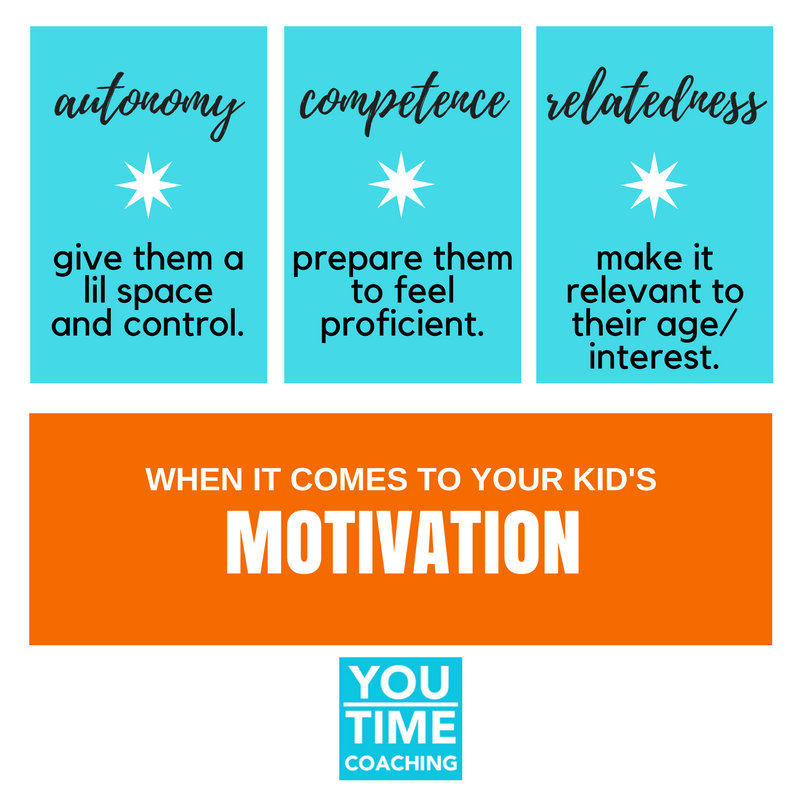
What goes into your kid’s motivation?
Just like when a kid doesn’t get their way, the thoughts kids have about their parents are changing by the minute. The importance behind these thoughts is where the focus should lay. Communication is typically always an underlying relationship issue between parents and kids. Check out these other blogs for helpful tips on communication with your teens, How to Love Your Kids When They Are Tough to Love and Do NOT Try to be Your Child’s Best Friend.
Feel free to leave comments below or on any of our social media pages to get a conversation going!

by YouTime Coaching | Sep 1, 2017 | Uncategorized
Oh boy, nothing makes me happier to hear somebody say, “I can’t do it”.
Sure, there’s a percentage of people who actually won’t be able to do “it” because of their skill level or how difficult the task is, but another big percentage of those people actually mean I won’t stick with it. These groups don’t need to be mutually exclusive and in fact, we have all been in both boats.
When you say that you “can’t” do something but actually have the skills and abilities to perform the task you are sending a mixed message to your brain. Typically the message is either fear or instant gratification based. When the message is fear-based but there is no threat of real danger then this will trigger a real fight or flight response (on false pretenses) and begin the pattern of convincing your brain that perceived fear is the same as actual danger.
Saying “I can’t do it” is quite a nice way of convincing yourself that whatever it is you’re trying to do you can’t actually do because of something outside of your control. It is also a nice way to completely screw up your rational way of thinking and can drastically limit you.
When people say they can’t do it, they really mean they won’t make time for it and don’t like the outcome when they try it. Let me introduce you to an important word:
RESILIENCE: The capacity to recover quickly from difficulties; toughness.
Those who master resilience tend to feel more in control of their lives, have healthier social support, maintain a healthy self-image/confidence, and can identify a greater sense of purpose. If you do not like the outcome, try again. If it doesn’t fill your expectations, try again. Quickly cutting yourself off because of some level of discomfort, pain, Vulnerability, boredom, or frustration severely cutting you off from opportunity and growth.
In this field, there is not a shortage of hearing excuses and fear-based rationales for why things don’t get done. Obviously, cultivating an environment of acceptance is important but at the same time, clear and “to-the-point” communication is sometimes most helpful.
Whoever is reading this, just know that you should stay away from accepting “I can’t do it” as a completely honest answer. Our minds, especially when driven by fear or instant gratification can convince us of pretty much anything.

by YouTime Coaching | Aug 22, 2017 | Mindset
The feeling when…
Somebody tells you to calm down when you’re angry.
When somebody is playing their music out loud on their cell phone in a public place.
When you are finished washing dishes and your significant other/mom/dad/sibling comes over with a dish they forgot to put in the sink.
When you are telling your kid something and they are obviously not listening.
When you are telling your parent something and they are obviously not listening.
When somebody’s rationale is “because I said so” or “this is my house”.
When you are trying to joke around but others are taking you seriously.
Sweating the small stuff?
Many people that do in fact sweat the small stuff. They will look at that list and come up with reasons why these items aren’t “small”. A case can be made for almost everything, but looking at these items from a third-party perspective (an outsider that has no skin in the game), this is the small stuff.
When we are exposed to these experiences our mind goes on a rampage. During that rampage, it can sometimes feel nearly impossible to regulate the weather going on inside your mind. Two executive functioning skills that get hit pretty hard are flexibility and emotional regulation. It is possible that you are predisposed to irritation, frustration, and anger but it is also possible that your reaction to these triggers is so automatic and fast that you don’t stand a chance in responding (versus reacting) differently.
If you feel like this, you also may also feel stuck in your ways. During a recent conversation with a client, I asked them, “What are you truly risking?”, in reference to anxiety-based behaviors. They responded, “feeling stupid and anxious”. My reply, “Feeling stupid and anxious is your fear, but not the real risk. The real risk is not developing healthy and positive relationships with people. The real risk is feeling like you aren’t part of something bigger and feel disconnected. All things that you have said you would like in your life.” Within one hour this client had a new perspective to see through and a greater feeling of importance to make necessary changes. What they really needed to see things differently was time and space from the issue.
A little extra time and mental space during these moments of frustration, stress, irritation, and anger can have a major impact. Follow these three steps to help better manage the “small stuff”.
LEARN MORE ABOUT YOUR BUTTONS
We have them and they get pressed from time to time. Maybe you know what sets you off, but take a few moments to write down the people, places, and things that you know are trouble zones. Being more aware of the triggers will better equip you to intervene.
PICTURE IT AND PREPARE FOR IT
If you know that you will be in a situation that could be triggering, try visualizing it before you are actually there. Take a look at The Swish Technique: click here
GET BACK IN TOUCH
We all know how to have a little compassion when a puppy has an accident, a baby spills their food, or when a 10-year-old says, “I’m stupid”. Practice showing compassion to yourself and the others around you by looking at them as a person, not just a comment or a trigger. Keep in mind that you are allowed to experience these emotions, so show some compassion to yourself as well. This could be through acknowledging and labeling what you are feeling as “frustration”, “anger”, or “irritation” instead of saying “I’m irritated”. These emotions do not define you and are only temporary states. Lastly, if you need some space, take it.
With gripping emotions such as irritation, frustration, and anger there are a lack of finger snapping solutions, but If you do try snapping your fingers during a moment of anger and it works, please call us and share your magic. Above are some solid steps to make positive changes with the relationships around you.

by YouTime Coaching | Aug 3, 2017 | Uncategorized
When I grew up I was not a fighter.
I went to a Quaker school for 8 years (they deeply believe in non-violence), and became a black belt in a martial arts form that literally translates to “open fist”, meaning you learn how to defend yourself without necessarily attacking. Even though I may have received the ‘non-violent’ approach from multiple sources, it does not make you impervious to emotional and physical injury, including failure.
When I was in fourth grade a kid named Charlie kept making fun of me on the playground. I gave him verbal warning number one…number two… and after he continued to poke, I picked up a rubber trash can and threw it at him. Keep in mind, I was very scrawny growing up so this was not as if I was throwing an Olympic javelin towards his head. The trash bin did actually hit him causing no injury, but scared him enough that he left me alone.
Another time I was running towards the basketball courts and tripped, falling face first on cement. Fortunately, I have no scars to prove it, but it did leave a nice strawberry on my cheek. The pain healed and I moved on, knowing that if I continued to run like that there was a risk involved. For a long time the fall played over and over in the back of my mind whenever I went to play basketball at that court.
As a kid, I felt fragile.
Physically speaking, I was typically underweight, did not have a lot of muscle, felt I had a low threshold for pain, was scared easy, and compared myself to my “stronger” peers.
Years later, experiencing all of the struggle, adversity, injuries, pain, ADHD, and anxiety adolescence and young adulthood has to offer I believe that I have turned out quite well. With that being said, those same playgrounds have recycled rubber playing surfaces instead of concrete, bolted down trash bins vs throwable ones (this one may actually be for the better), and typically parent’s or another adult constantly supervising and ‘co-playing’.
In a society where around a third of kids are sent to school with sanitizing gel, what is the impact of a parent’s anxiety in how fragile a kid may grow up. Psychology Today’s Editor at Large, Hara Estroff Marano rights an interesting piece titled, “A Nation of Wimps”.
Read the article here and share your thoughts below!
Don’t go at this alone. If you need some support with your high-school, college, or young adult child we want to hear more. Go to the contact us page by clicking here and let’s see how we can help.